News · 23 October 2026 · 4 min read
Six storeys planned for his leafy street. If it ticks the boxes, he can't appeal
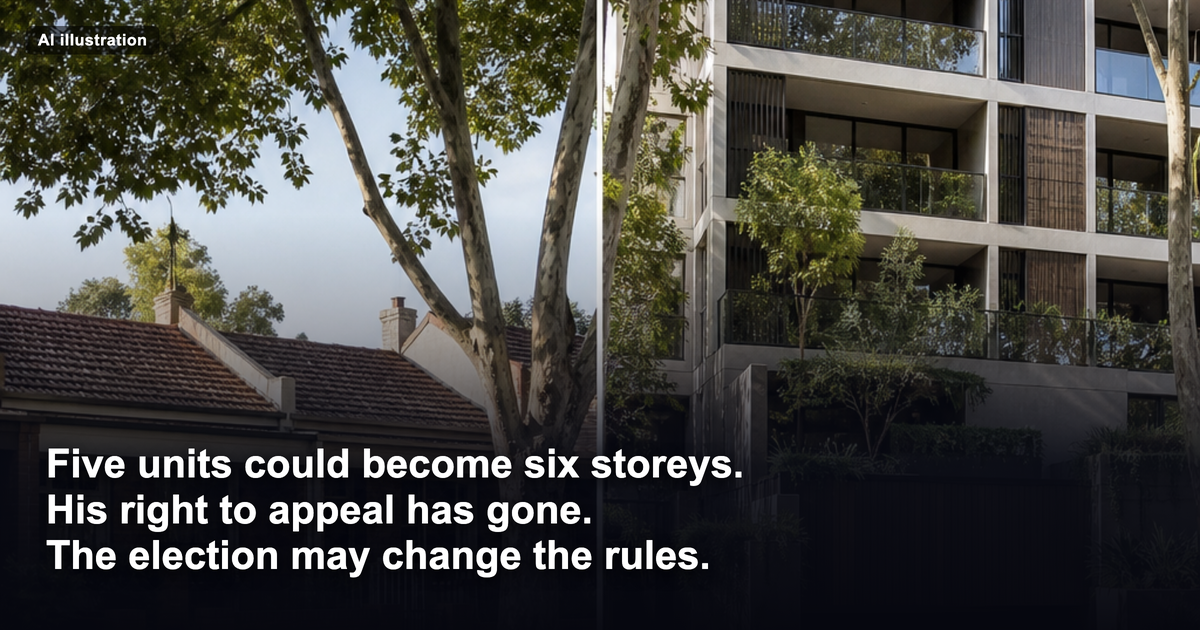
Dave Corrigan lives in an apartment across the road from a Mercer Road site in Armadale where a developer wants to replace five single-storey units with a six-storey block. ABC's 7.30 reported on 23 October 2026 that under Victoria's new planning rules, his objections carry limited weight and his right to appeal has been stripped away.
He is not alone. Armadale is one of 60 designated activity centres in Victoria, and the new planning rules are opening areas around them to denser housing.
The plan for Mercer Road
Plans have been lodged with the council for a six-storey development on Mercer Road, about 900 metres from Armadale train station. The five existing single-storey units would be demolished. If approved, 29 two- to three-bedroom apartments would be built above two levels of underground parking.
The proposal has not been approved.
Mr Corrigan told 7.30 the plan was outrageous. "[It's] enough to almost make me consider moving, to be honest," he said. He objects to where it is: "I could probably understand on a main road and High Street ... but in the middle of Mercer Road, that's just ridiculous."
That is one resident's opinion. It is also a fair summary of what many owners near activity centres are now weighing up.
Why his objection carries so little weight
The "deemed to comply" rules took effect in April. If a development meets a set of standards set by the government, it can be approved without the usual objections or appeals. Labor argues the rules reduce red tape, speed up housing approvals and give developers more certainty.
Under the government's activity centres plan, areas around major train and tram routes are being opened up to denser housing. In some locations, that includes buildings of up to 20 storeys or higher.
Stonnington Mayor Melina Sehr told 7.30 that residents often assumed taller buildings would be concentrated around railway stations and major roads, but that this was no longer the case. "Council's involvement is minimal because if they tick the government's planning boxes now, residents have no right to object, they have no appeal rights and council has very limited ability to make changes to those proposed developments," she said.
The government's case rests on supply. Labor says Victoria needs an estimated 2.24 million additional homes by 2051, with at least 70 per cent of them in established areas. "We've acted to say that the status quo is no longer an option," Planning Minister Sonya Kilkenny told 7.30.
The ABC also visited Box Hill, east of the CBD, as an example of what high-density housing can look like. There, a 52-year-old lives with his partner in a two-bedroom apartment in a 30-storey tower.
What this changes for an owner nearby
Setting the politics aside, the change for owners is this: if you own an established house or unit in or near an activity centre, you now have less control over what gets built next door. The ABC's headline, "Sell or put up with it", sums up how some residents feel.
The effects can run in more than one direction. The 7.30 report does not document any effect on prices, so treat these as questions to test against your own property:
- Amenity. A much taller building next door can change what it is like to live in a single-storey home.
- Buyer demand. Some buyers pay for a low-rise street. If that character is no longer protected, some of those buyers may look elsewhere.
- Land value. On a site that could itself be redeveloped, the rules that frustrate a neighbour may attract a developer. The five units on Mercer Road are an example of an existing low-rise site proposed for much denser use.
- Policy risk. The Coalition has pledged to scrap activity centres and return planning powers to councils. Whether that happens depends on the election result. Any decision based on today's rules carries the risk that they change.
Before you buy, hold or sell
Selling because of one proposal is a big, costly and hard-to-reverse decision. Here it would rest on a plan that may not be approved and rules that may not survive the election. You also have more options than selling or putting up with it.
If you are buying, check whether the property is inside or near one of the 60 activity centres and what building heights are allowed there. Look at which nearby sites could plausibly be redeveloped, such as older single-storey unit blocks. Then test the purchase twice: once assuming the rules stay, and once assuming councils get their powers back.
If you are thinking about selling, separate the feeling from the facts. Find out whether the proposal next door has been approved and what it would actually involve. Remember that the source says nothing about what it does to values in either direction.
If you are investing, be clear about what you are paying for. A low-rise streetscape is something the current rules no longer protect. Land near transport is something they are designed to use more intensively. Those are different bets, and the election could affect both.
If you are deciding whether to buy, hold or sell near one of Victoria's activity centres, Jacob's free live webinar shows how we test a decision like this street by street.
If there's a specific street you're weighing up right now, check its Street Score first — it's free, takes ten seconds, and tells you whether that street is pulling the suburb average up or riding on it.
Market data & R-Scores for locations in this article
Drill Down Into the Markets Mentioned Above
Inspect live monthly R-Scores, median prices, rental yields, and street-by-street scores for the cities and council areas referenced in this article:
Frequently asked questions
What is the key data takeaway in "Six storeys planned for his leafy street. If it ticks the boxes, he can't appeal"?
Dave Corrigan lives in an apartment across the road from a Mercer Road site in Armadale where a developer wants to replace five single-storey units with a six-storey block. ABC's 7.30 reported on 23 October 2026 that under Victoria's new planning rules, his objections carry limited weight and his right to appeal has been stripped away. The government's case rests on supply. Labor says Victoria needs an estimated 2.24 million additional homes by 2051, with at least 70 per cent of them in established areas. "We've acted to say that the status quo is no longer an option," Planning Minister Sonya Kilkenny told 7.30.
What does this mean for Australian property investors with usable equity or cash?
The ABC also visited Box Hill, east of the CBD, as an example of what high-density housing can look like. There, a 52-year-old lives with his partner in a two-bedroom apartment in a 30-storey tower. Ripehouse Advisory recommends stress-testing borrowing buffers first and selecting individual suburbs and streets on objective data rather than macro headlines.
How can I check the Suburb R-Score and Street Score for Armadale (WA)?
Use Ripehouse Advisory’s free research tools at ripehouseadvisory.com.au/locations, /suburbs, and /streets to inspect the monthly 27-indicator R-Score, median house price, rental yield, vacancy rate, and ABS SA1 census street scores for Armadale (WA).
General information only. It does not take your objectives, financial situation or needs into account, and nothing here is legal, financial, taxation or investment advice specific to your circumstances.