News · 24 October 2026 · 4 min read
Darwin is the only capital where house prices still rise. So why are owners listing?
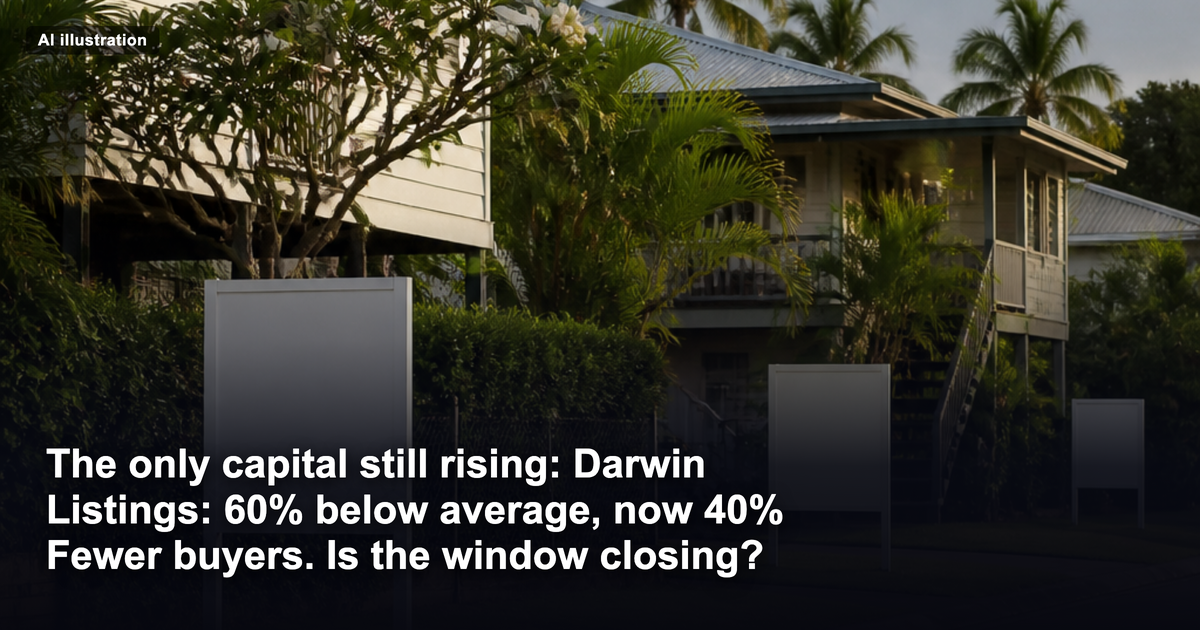
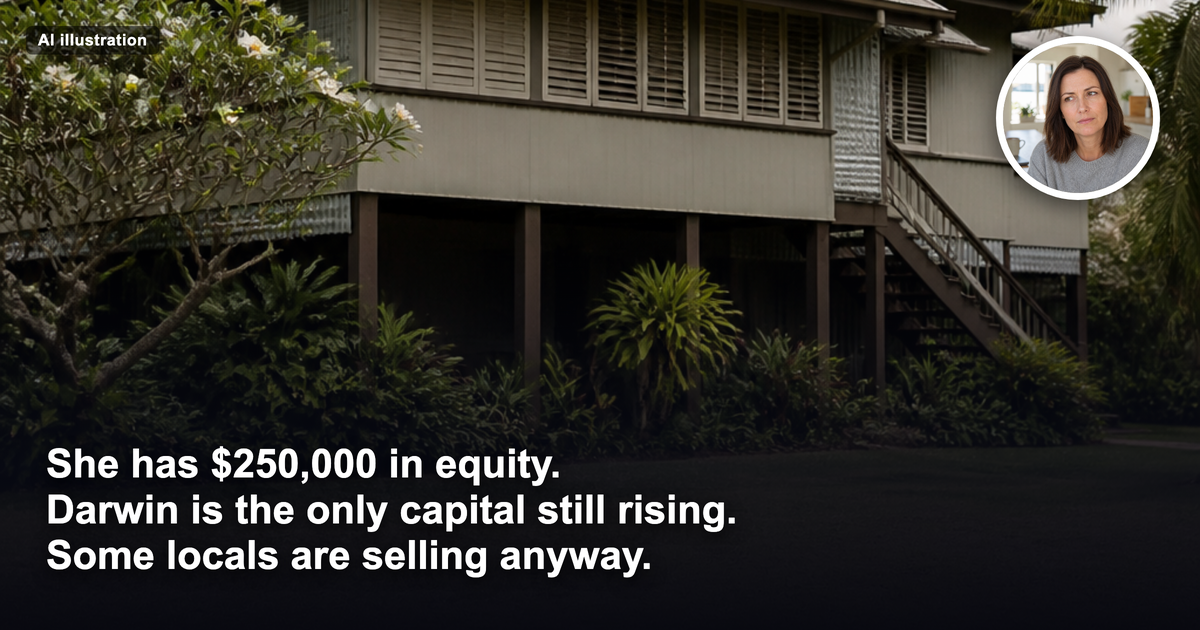
Darwin is the only Australian capital where house prices are still rising. At the same time, more owners are putting homes on the market and fewer buyers are turning up, the pattern that often appears before a market changes direction.
According to ABC News, that combination has a growing number of Darwin owners and investors listing now. Cotality's head of research warns there may only be a small window to get a good price.
The numbers behind Darwin's rise
Cotality's September figures, reported by ABC News on 24 October 2026, show Darwin house prices rose 0.3 per cent for the month and unit prices rose 0.8 per cent. Gerard Burg, Cotality's head of research, called it the "strongest property market in the country" at a time when prices are slumping nationally.
He said the rise was largely due to limited supply and years of sluggish building activity. For Darwin, the ABC notes, this comes after more than a decade of stagnation.
Supply is now increasing. Mr Burg said total listings were around 60 per cent below average in mid-January. They now sit around 40 per cent below average and are "continuing to track up". He said more owners were listing but there were fewer buyers, which suggests the tight market may be gradually unwinding.
Kerri-Ann Laurence, a real estate agent who has sold homes across Darwin for more than two decades, has also seen listings rise since January, but says "historically, it's still quite low". She has noticed that interstate investors, who over the past year had been buying across greater Darwin within days of a listing, are easing off as prices keep climbing. Even so, she expects the market to keep rising, pointing to projects including Beetaloo gas, which is now flowing.
Two people close to the market read the same signals differently. One sees a market that may be turning. The other sees further to run. Both could be partly right.
Why a 0.3 per cent month changes less than it sounds
A rising headline can make selling look like an easy call. But the monthly gain is modest, and the cost of selling is not.
Assumptions: a Darwin house worth $600,000 (a round figure for illustration, not the Darwin median), selling costs of about 2.5 per cent for agent commission and marketing, and simple arithmetic with no compounding.
- One month at September's 0.3 per cent rise: about $1,800
- Twelve months at that pace, if it held: about $21,600
- Selling costs at 2.5 per cent: about $15,000
- A 2 per cent fall if the market turned (an assumption, not a forecast): about $12,000
For an owner who was planning to sell within the next year anyway, the gap between a market that keeps edging up and one that softens matters, but it is not enormous. For someone selling only because of a headline, selling costs alone could absorb most of a year's growth at September's pace.
The rate risk, and the rent cost of leaving
Mr Burg pointed to the risk of another rate rise: "There is the risk, of course, that the RBA may do another hike to the interest rates in November, and that would have another further impact." He also said: "There is still some uncertainty around where property demand is heading in the coming months." A November rise is possible but not certain.
Rents point the other way for owners who stay. Darwin is the third most expensive capital to rent in, behind Sydney and Perth. Cotality data shows median dwelling rents rose about 11.6 per cent in the year to September, and Mr Burg put the vacancy rate at about 1.9 per cent. In some parts of Darwin, he said, "it is actually cheaper to purchase the house under a mortgage than it is to rent a similar property".
For a homeowner, that weighs against selling without a clear plan for where to live next. Selling at a good price and then renting in one of the country's most expensive rental markets can wear down the gain. For an investor, high rents and low vacancy help cash flow even if price growth slows.
Three positions, three different questions
- Selling the home you live in. Ask what you will do next. Ms Laurence says most of her clients are relocating, moving for family reasons, upsizing or downsizing, and that some downsizers in particular are seizing the opportunity. Those sellers have a reason beyond price. Selling to beat a possible turn and then renting is a different bet.
- Holding a Darwin investment. Weigh the rent and vacancy picture against your reason for owning. Tax on any capital gain, your loan and what you would do with the money are likely to matter more than one month's index result. Get personal tax advice before you decide.
- Buying because Darwin is the only capital still rising. Waiting may be the smarter move. Interstate investor demand is easing, listings are climbing and a rate rise is possible. Darwin's own history, a crash soon after 2010 followed by more than a decade of stagnation, shows how long a market can take to recover once it turns.
None of this means Darwin will fall. Listings are still well below average, supply is still tight, and an experienced local agent expects prices to keep rising. The outlook could go either way.
Before you list, or buy
Write down four things: your reason for acting, the cost of the transaction, where you would live or invest next, and what happens if prices rise or fall slightly over the next year. If the decision only works in one of those scenarios, you are betting on timing.
If you are weighing whether to sell, hold or buy in Darwin, the Investor Decision Review can test that decision against your own numbers.
Price, listings, rent and vacancy figures: Cotality, as reported by ABC News, 24 October 2026.
If there's a specific street you're weighing up right now, check its Street Score first — it's free, takes ten seconds, and tells you whether that street is pulling the suburb average up or riding on it.
Market data & R-Scores for locations in this article
Drill Down Into the Markets Mentioned Above
Inspect live monthly R-Scores, median prices, rental yields, and street-by-street scores for the cities and council areas referenced in this article:
Frequently asked questions
Darwin is the only capital where house prices still rise. So why are owners listing?
According to ABC News, that combination has a growing number of Darwin owners and investors listing now. Cotality's head of research warns there may only be a small window to get a good price. Cotality's September figures, reported by ABC News on 24 October 2026, show Darwin house prices rose 0.3 per cent for the month and unit prices rose 0.8 per cent. Gerard Burg, Cotality's head of research, called it the "strongest property market in the country" at a time when prices are slumping nationally.
What does this mean for Australian property investors with usable equity or cash?
He said the rise was largely due to limited supply and years of sluggish building activity. For Darwin, the ABC notes, this comes after more than a decade of stagnation. Ripehouse Advisory recommends stress-testing borrowing buffers first and selecting individual suburbs and streets on objective data rather than macro headlines.
How can I check the Suburb R-Score and Street Score for Darwin (NT), Sydney (NSW), Perth (WA)?
Use Ripehouse Advisory’s free research tools at ripehouseadvisory.com.au/locations, /suburbs, and /streets to inspect the monthly 27-indicator R-Score, median house price, rental yield, vacancy rate, and ABS SA1 census street scores for Darwin (NT), Sydney (NSW), Perth (WA).
General information only. It does not take your objectives, financial situation or needs into account, and nothing here is legal, financial, taxation or investment advice specific to your circumstances.