News · 24 October 2026 · 4 min read
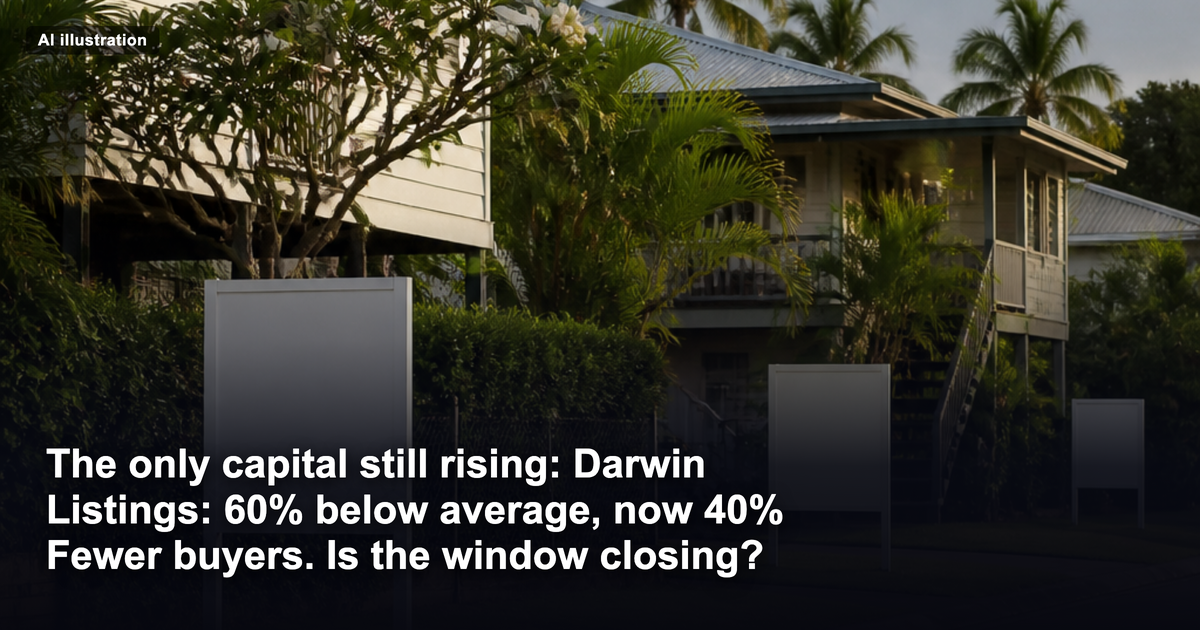
Darwin is the only capital where prices are still rising. So why are some locals selling?
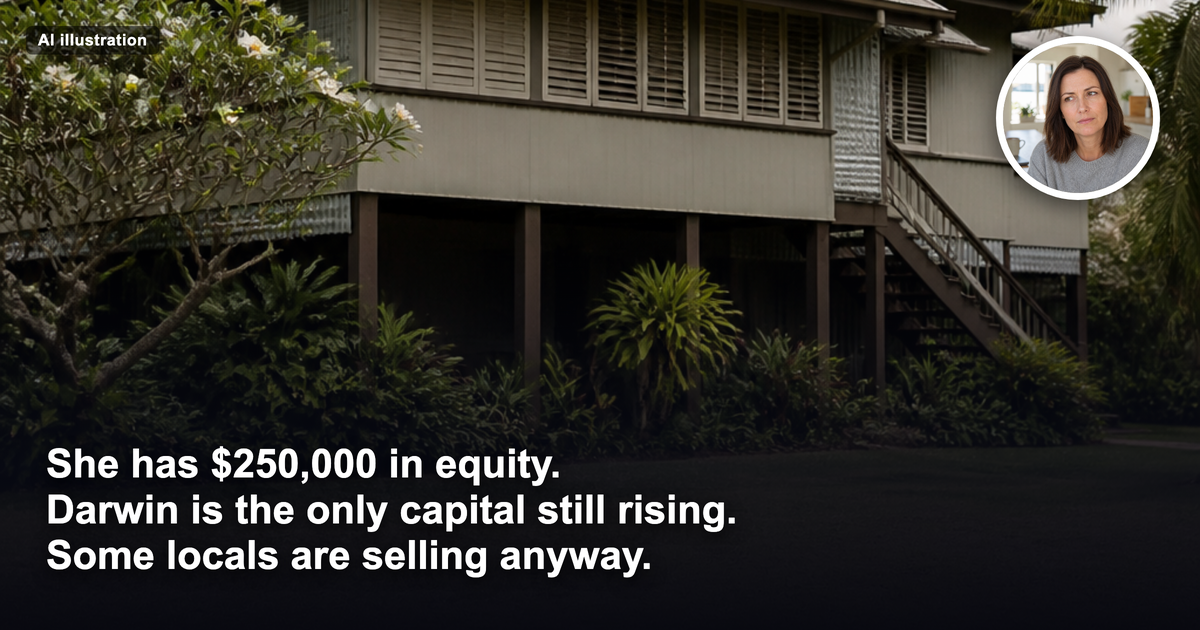
She is 40. She is a single mother with a son in Year 4, and she has already done the hard part. The mortgage on her Newcastle home is under control. The bank says she has about $250,000 of usable equity, and she wants that money working.
On Saturday morning she opened the news and saw the words she had been waiting for. According to the ABC, Darwin is the only Australian capital where house prices are still rising. The nation's "strongest property market".
Before she finished her coffee, she had a Darwin listing open in another tab.
She is a composite illustration, not a real person. We use her because a lot of households are in the same position this week.
Her situation
She gets one go at this for a while. One deposit, one loan, one property. If it goes wrong she has no second pool of equity to fall back on, and the school fees keep coming.
So the logic feels clean. Buy where prices are going up. No other capital is still rising. Darwin is.
Then she read the rest of the story.
The question
"Darwin is the only capital still going up. Some people who live there are selling. Should I be buying from them?"
The answer: the headline tells you where prices have been
The ABC report says two things, and most people only take in the first.
The first is that Darwin is the only capital where house prices are still rising.
The second is that some Darwin home owners are selling up, and some researchers expect the market to turn.
Put those two facts side by side. Some of the people with the best view of Darwin, who live on its streets and watch its listings, have decided now is the time to sell. That does not make them right. Some researchers think the market may turn. Nobody can tell you when, or whether, it will. We are not calling a top, and you should be wary of anyone who does.
But it does tell you what a "strongest market" headline measures. It measures the past. Rising prices report what buyers have already paid. By the time a city earns that headline, the people who bought early have their gains, and some of them are cashing out. The buyer who turns up because of the headline is often the person they sell to.
That is the expensive mistake. Chasing the strongest market can mean buying the result after someone else has already banked it.
The rule almost nobody prices in
Forget Darwin for a moment. Her bigger problem is structure.
If her only investment property sits in one city she picked because of one headline, her whole investing future rides on what that market does next. If it turns, as some researchers expect, she has nothing else to carry her. Her equity is committed, her borrowing capacity is used up, and all she can do is wait.
That is concentration risk, and you will rarely see it in a headline.
The questions that matter come before you pick a city:
- What does this property need to do for her whole financial position, and over how long?
- Can her budget carry it if rents soften or the place sits empty for a while?
- If this market goes flat for years, does the rest of her plan still work?
- Is she buying a street with strong demand, or a city that had a good quarter?
What this means for you
If you have equity and you are reading the same headlines, the name of the city is the least useful part of the decision.
Two streets in the same suburb can be getting completely different results. That is true inside Darwin, and it is true in every market people are currently calling flat. A city-wide figure is an average of winners and losers. Nobody buys the average. You buy one house on one street, and that street has its own demand, its own supply and its own tenants.
A city headline cannot tell you which kind of street you are buying on. Street-level data can.
The Ripehouse view
We think property is still one of the most powerful ways an Australian household can build wealth. We also think most people use it badly because they make the decisions in the wrong order. They choose the hot city first, then the property, and then hope the structure holds.
We work the other way around. Structure comes first: what the portfolio needs, how much risk any one asset should carry, and what happens if a market turns. Then the street. Then the asset. Timing comes last, because nobody times the market reliably.
Our client portfolios have achieved median growth of +19.0% per year on a 5-year rolling basis, against roughly 4.3% nationally (benchmark: CoreLogic/Cotality). That result is measured across many markets, not one well-timed call. We don't ask you to take our results on faith. We publish them, including the portfolios that underperformed.
Past performance is not a guarantee of future results.
The right asset on the right street, held inside the right structure, will do more for her than the right headline ever could.
If you are deciding whether to chase this year's strongest market or build something that still holds up when it turns, join Jacob's free live webinar to see how we test that decision street by street.
If there's a specific street you're weighing up right now, check its Street Score first — it's free, takes ten seconds, and tells you whether that street is pulling the suburb average up or riding on it.
Market data & R-Scores for locations in this article
Drill Down Into the Markets Mentioned Above
Inspect live monthly R-Scores, median prices, rental yields, and street-by-street scores for the cities and council areas referenced in this article:
Frequently asked questions
Darwin is the only capital where prices are still rising. So why are some locals selling?
On Saturday morning she opened the news and saw the words she had been waiting for. According to the ABC , Darwin is the only Australian capital where house prices are still rising. The nation's "strongest property market". The ABC report says two things, and most people only take in the first.
What does this mean for Australian property investors with usable equity or cash?
Our client portfolios have achieved median growth of +19.0% per year on a 5-year rolling basis, against roughly 4.3% nationally (benchmark: CoreLogic/Cotality). That result is measured across many markets, not one well-timed call. We don't ask you to take our results on faith. We publish them, including the portfolios that underperformed. Ripehouse Advisory recommends stress-testing borrowing buffers first and selecting individual suburbs and streets on objective data rather than macro headlines.
How can I check the Suburb R-Score and Street Score for Darwin (NT), Newcastle (NSW)?
Use Ripehouse Advisory’s free research tools at ripehouseadvisory.com.au/locations, /suburbs, and /streets to inspect the monthly 27-indicator R-Score, median house price, rental yield, vacancy rate, and ABS SA1 census street scores for Darwin (NT), Newcastle (NSW).
General information only. It does not take your objectives, financial situation or needs into account, and nothing here is legal, financial, taxation or investment advice specific to your circumstances.