News · 20 October 2026 · 4 min read
Victoria wants a landlord licence. Both his rentals are there. The proposal is not his real problem
He is 44 and about $900 a month out of pocket on two rental units. Both are in the same Melbourne suburb. One he bought in 2017, the other in 2021, because he knew the area and it felt safer to buy where he could drive past.
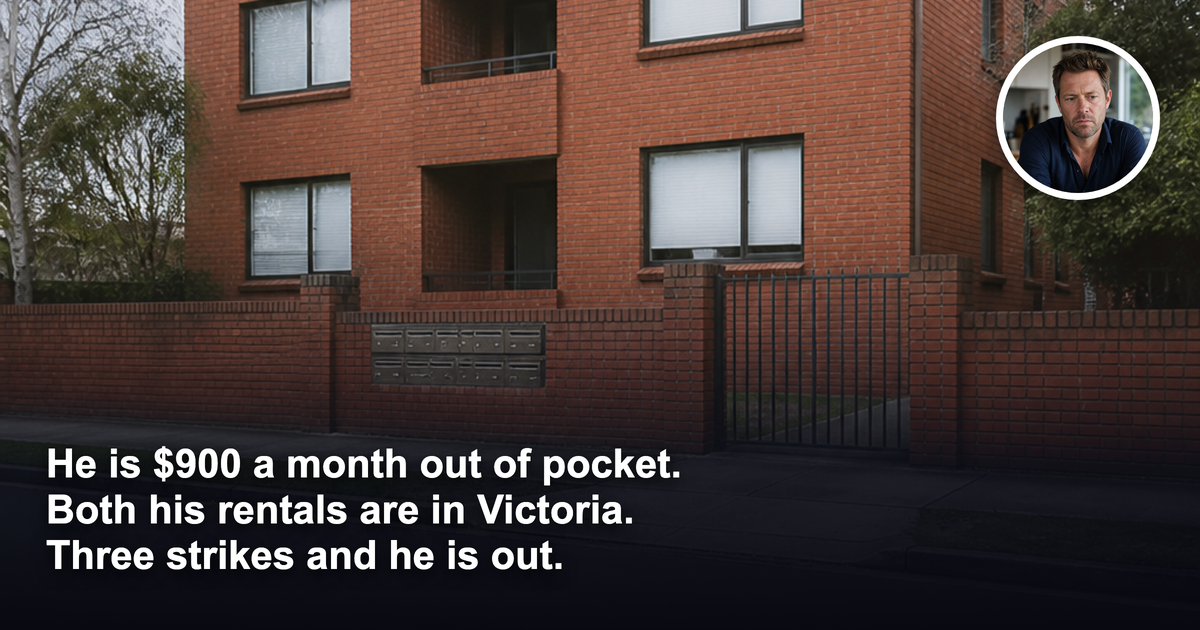
He is 44 and about $900 a month out of pocket on two rental units. Both are in the same Melbourne suburb. One he bought in 2017, the other in 2021, because he knew the area and it felt safer to buy where he could drive past.
He is a composite illustration, not a real person. The situation is common enough that it does not need a name.
Last week he read that Victorian landlords could soon need a licence to rent out a home, and could lose it after three strikes.
He did the maths at the kitchen table. Two properties. One state. One set of rules he has no vote over beyond the one everyone gets.
The question
"Both my investments are in Victoria. If this three strikes thing comes in, I could be banned from renting them out. Should I sell one now before it gets worse, or am I overreacting to a headline?"
The answer: it is a proposal, and that is the point
Start with what has actually happened, because the headline is doing more work than the facts support.
The three strikes idea is an election pitch from the Victorian Greens ahead of the state election, as reported by Property Update and others. Under the proposal, owners would hold a licence before letting a property, and a landlord who collected three strikes would be barred from renting out homes. The party has costed an independent regulator to run it at about $50 million.
Nothing has passed. No licence exists. No strike has been issued to anyone.
So he has not lost anything, and selling into a scare is the one move that turns a possibility into a real cost: agent fees, marketing, a capital gains event, and the stamp duty he paid in 2021 that never comes back.
But he is not wrong to feel exposed. He is just worried about the wrong thing.
The rule he already priced in without noticing
The same reporting puts the tally of Victorian rental reforms at more than 150, according to the state's renters minister. Bond claims now need advance notice and evidence. Owners must keep proof a property met standards before it was advertised. Safety checks run on a schedule. Each one is manageable on its own. Together they are a compliance load that looks like running a small business.
Whether the licence arrives or not, that direction of travel is already real. And he has 100 per cent of his investment capital sitting under it.
That is the expensive mistake, and he made it years ago, for a reason that sounded sensible: buy what you know, buy where you can drive past.
Driving past a property does nothing for its return. It does nothing for its vacancy rate. It does nothing when a parliament 20 minutes away rewrites the terms of holding it.
What this means for you
If everything you own answers to one state's rulebook, you are not diversified, no matter how many doors you hold. You are making one bet on one government, renewed every four years.
That is true in Victoria today. It has been true in New South Wales, where sale-based evictions now carry a re-letting exclusion. It will be true somewhere else next year.
Investors who hold across two or three states still feel policy shifts, but they are never fully exposed to any single change. One state tightens, the others carry the portfolio while the dust settles. Returns are judged on what the whole holding does, not on how much research went into one suburb.
And within any state, the gap between assets is bigger than the gap between policies. Two streets in the same Melbourne suburb can be having completely different outcomes right now, on days on market, on vacancy, on who is buying. A licence does not change that. The asset and the street decide whether a rule is a nuisance or a crisis.
The Ripehouse reframe
The proposal is a prompt, not a verdict. The decision it should trigger is a structural one.
Across 997 client portfolios since 2021, our median portfolio growth has been +19.0 per cent a year on a 5-year rolling basis, against roughly 4.3 per cent nationally. Those portfolios are built across states on purpose, chosen street by street on data rather than postcode familiarity. Benchmark per CoreLogic/Cotality. Past performance is not a guarantee of future results.
For him, the real question is whether his next dollar, and possibly the equity in one of those units, should buy him a position somewhere a different parliament sets the rules, on a street the numbers support.
Structure beats timing. The right asset on the right street, held across more than one rulebook, beats any headline about three strikes.
Want to see how a portfolio is built to absorb a policy change like this before it happens? Join Jacob's free live webinar.
If there's a specific street you're weighing up right now, check its Street Score first — it's free, takes ten seconds, and tells you whether that street is pulling the suburb average up or riding on it.
General information only. It does not take your objectives, financial situation or needs into account, and nothing here is legal, financial, taxation or investment advice specific to your circumstances.