News · 19 October 2026 · 4 min read
Melbourne rents hit $600 a week: what an extra $1,560 a year does, and does not do, for an investor
Melbourne's median rent has reached $600 a week, according to realestate.com.au data published on 18 October. That is a record for the city and about $30 a week more than a year ago.
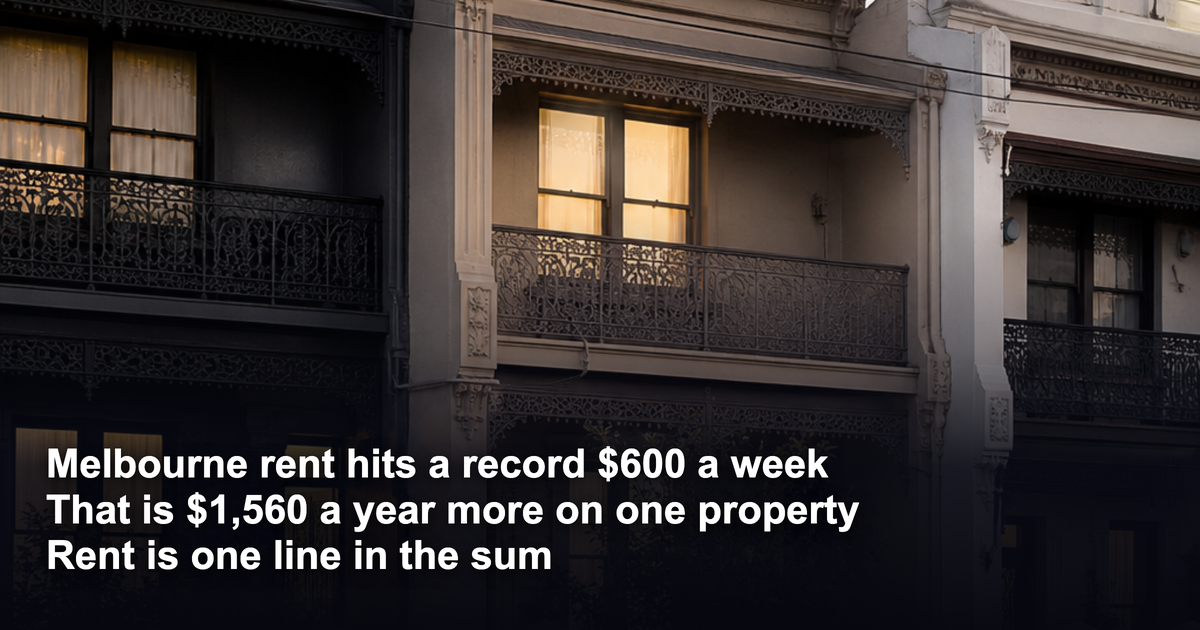
Melbourne's median rent has reached $600 a week, according to realestate.com.au data published on 18 October. That is a record for the city and about $30 a week more than a year ago.
For a tenant, $30 a week is real money. The same report describes renters cutting back on food and healthcare to keep a roof over their heads. Nobody with a mortgage and spare equity should read that figure with any satisfaction.
For an owner with equity, though, the figure asks a specific question. The gross rent on one median Melbourne property is now about $1,560 a year higher than it was twelve months ago. Does that change whether you should use your equity now, and where?
The number, three ways
Take the $30 a week and multiply it by 52. That is $1,560 a year.
Divide it by twelve. That is about $130 a month.
Put it against the previous rent of roughly $570 a week. That is a rise of about 5 per cent in the gross rent line.
Hold all three versions in your head, because the way the number is dressed changes how it feels. A record $600 a week sounds like a headline. An extra $130 a month sounds like a phone plan. Both are the same fact.
What changed, and what did not
The report gives the figure and the hardship behind it. It does not break out every cause, and this article will not guess at them or forecast where rent goes next. A record is a record because tenants are paying more for the same stock. That is all the number tells you.
What did not change is everything else on an investor's statement. The mortgage repayment did not fall because rent rose. Council rates, insurance, land tax, management fees and maintenance all move on their own timetable. The $1,560 is gross. It lands before any of those are paid, and this article makes no claim about what is left after them, because that depends entirely on the loan, the property and the owner.
What it means if you have equity to deploy
Two things, and they pull in different directions.
First, more gross rent helps. Lenders count a portion of rental income when they assess how much you can borrow, so a higher rent line supports serviceability at the margin. On a leveraged purchase, $130 a month also narrows the gap between what the tenant pays and what the property costs to hold.
Second, it narrows that gap. It rarely closes it. For most leveraged purchases the monthly shortfall is larger than $130, which means the rise improves the cash position without changing the shape of the decision. You are still buying an asset that costs money to hold, in the hope that its value and rent grow faster than the cost of holding it.
The expensive mistake is to read a citywide median as a reason to buy a city.
The $600 figure is the midpoint of every rental across greater Melbourne. Your property will not earn the median. It will earn one street's rent, sit vacant for one street's number of days between tenants, and be revalued against one street's sales. The median tells you the city is tighter than it was. It tells you nothing about the house you are about to sign for.
The decision and the trade-offs
An owner with usable equity is looking at three moves right now.
- Use the equity in Melbourne, where rent has just set a record.
- Use it interstate, where the rent line, the price and the growth profile are all different.
- Wait.
The same $30 a week does different work depending on what you paid. Spread $1,560 across a dear asset and it is a small percentage. Spread it across a cheaper one and it matters more. Rent alone cannot settle that comparison, because the thing that decides a portfolio over ten years is the growth of the asset, and growth happens at the level of the street, the land content and the local supply pipeline, none of which appear in a median rent.
Waiting has its own cost. Equity that sits unused earns nothing, and a buyer who waits for a cleaner headline is timing a market with a number that has already moved. Structure beats timing. The right asset on the right street, bought with the holding costs honestly modelled, outlasts a good or bad year in the rent line.
The line most people skip
Two streets in the same Melbourne suburb can be having completely different outcomes right now. One has new supply landing around it and listings taking longer to lease. The other has almost nothing coming to market and tenants competing for whatever appears. Both share the same median rent in the headline.
That is why we measure the decision at street level, with days on market, vacancy and sales history for the specific blocks under consideration, rather than at the level of a city record. Rent is an input. The result is what we publish.
Across client portfolios we report a median portfolio growth of 19.0 per cent per year on a 5-year rolling basis, against about 6.3 per cent for the combined capitals over the same period. Benchmark sourced from CoreLogic/Cotality. Past performance is not a guarantee of future results. We publish those figures in full, including the portfolios that underperformed, so that nobody has to take the number on faith.
This article is general information only. It does not take your circumstances into account and it is not personal financial, legal or tax advice.
If you are weighing whether a record Melbourne rent is enough reason to put your equity to work, want to see how we test that decision street by street? Join Jacob's free live webinar.
If there's a specific street you're weighing up right now, check its Street Score first — it's free, takes ten seconds, and tells you whether that street is pulling the suburb average up or riding on it.
General information only. It does not take your objectives, financial situation or needs into account, and nothing here is legal, financial, taxation or investment advice specific to your circumstances.