News · 18 October 2026 · 5 min read
He was told his $200,000 was 'property-backed'. Then a $3.4 billion developer collapsed
He is 46, lives in Canberra with his partner and two teenagers, and has about $200,000 sitting in an offset account that he has decided is doing nothing. He has no investment property. He has a demanding job, a mortgage he is ahead on, and no appetite for tenants, tradies or...
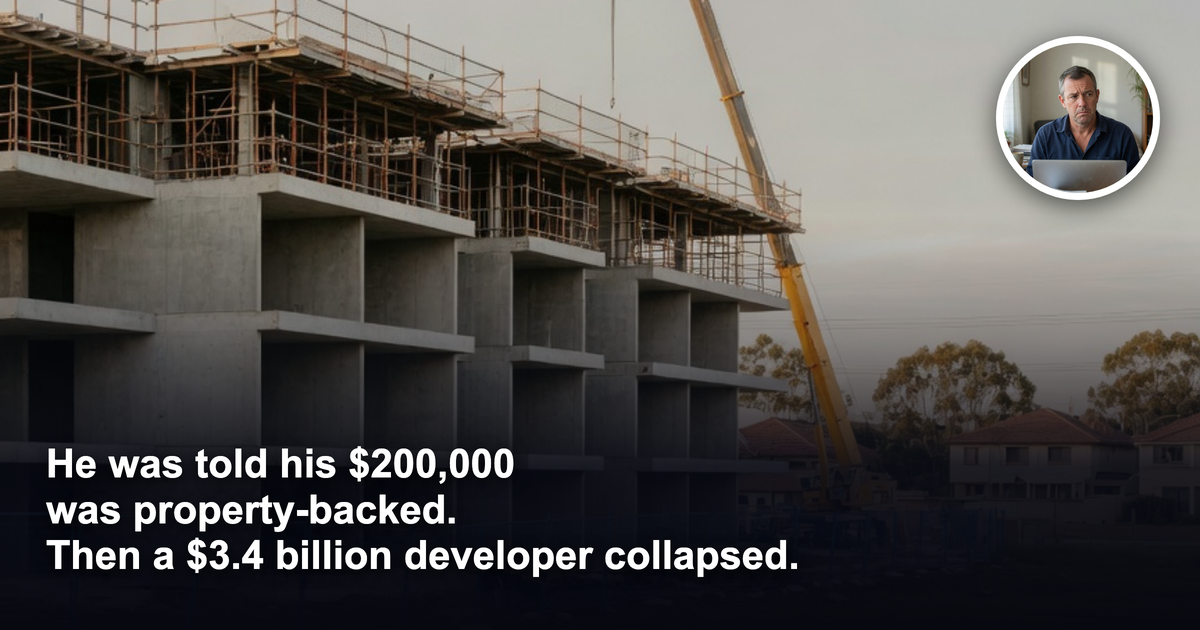
He is 46, lives in Canberra with his partner and two teenagers, and has about $200,000 sitting in an offset account that he has decided is doing nothing. He has no investment property. He has a demanding job, a mortgage he is ahead on, and no appetite for tenants, tradies or Saturday open homes.
He is a composite illustration, not a real person. The pitch he received is real, and it is being made to people like him every week.
The pitch went like this. A private credit fund lends money to property developers. The loans are secured against the land and the buildings going up on it. Investors receive a steady monthly distribution well above a term deposit. No tenants. No agents. "Property-backed income" without the property.
He was ready to sign. Then he read what happened to Bathla.
The question
"I was told my $200,000 would be secured by real property, so the worst case was that the fund sells the building and I get my money back. Now a $3.4 billion developer has gone under and the lenders are selling their loans to get out. If it is property-backed, why would anyone need to get out?"
The answer: it depends on where you stand in the queue
Here is what the ABC reported on 17 October.
Bathla Group, a Sydney developer, has collapsed in a failure the ABC has put at $3.4 billion. The lenders behind it are now, in the ABC's words, taking matters into their own hands to recover their money.
One of the largest, La Trobe Financial, had disclosed $38.1 million in loans to Bathla in August. It has now sold its development loan on a 72-apartment project at Marsden Park, in Sydney's north-west, to 360 Capital for about $31.2 million. La Trobe recovered its outstanding principal, interest and late-payment charges and walked away.
Look at why it could. That loan was a senior facility. First mortgage. First in line to be paid.
360 Capital's own mortgage trust already held an $8.9 million loan on the same building that ranked behind La Trobe. To protect that second-ranking money, it put in another $5.2 million and bought the first mortgage as well. The company said the step "was not taken lightly" and was "very important to protect the value of the trust's subordinated position". Only by controlling both mortgages does it now expect to recover what it is owed.
Morningstar analyst Winky Tan told the ABC that first-mortgage lenders are in a much stronger position to recover their money, while mezzanine lenders further down the queue risked losing most, if not all, of their investment. She added that even the senior lender's outcome depends on whether the remaining apartments can be sold, and at what price, in a falling market.
So the answer to his question is this. "Property-backed" tells you there is a building somewhere. It does not tell you whether you are first, second or fifth in line for the proceeds when that building has to be sold half-finished.
The part that should worry anyone who cannot get their money out
The same report lists what has happened to investors in funds with and without Bathla exposure.
Centuria Bass and CVS Lane suspended withdrawals from some funds in August. MA Financial, which says it has no Bathla exposure, introduced withdrawal limits on some funds anyway, amid concern that more investors would try to leave. Metrics Credit Partners, also with no stated Bathla exposure, suspended withdrawals from some unlisted funds amid scrutiny of how its assets were valued.
Read that again. Funds with no exposure to the collapse froze redemptions because of the collapse.
That is the cost of a pooled product. Your money sits in the same bucket as everyone else's, and when the nervous ones run for the door, the door closes for all of you. The regulator has been saying this for a while. ASIC has warned of questionable valuations, opaque fees and inadequate disclosure across the sector, and commissioner Simone Constant has said the industry is "beyond warnings" and should prepare for enforcement action.
Ms Tan called it a perfect storm: higher interest rates, falling property prices, developers struggling to refinance, and investors trying to pull money out at the same time.
What this means for you
If you have been offered a private credit or developer-debt fund as the hands-off alternative to buying a property, three questions matter more than the headline distribution.
- Where does the fund's money sit in the capital stack? Senior, mezzanine, or somewhere in between? The Marsden Park deal shows the gap between those positions is the difference between full recovery and a fight.
- Who controls the asset when things go wrong? In that deal, control went to whoever owned both mortgages. You, as a unitholder, control nothing.
- How do you get out? A term deposit matures. A house can be listed on Monday. A frozen fund pays you when the manager decides it can.
None of this says private credit is a scam. Some of these lenders will be paid in full. The point is that the thing you were sold, security in bricks, belongs to the fund manager, on the terms of the loan, in a queue you never saw.
The Ripehouse reframe
Our man in Canberra wanted to avoid the hard parts of property. What he nearly bought was property risk with none of the control.
When you own the asset directly, on the right street, you hold the title. You decide when it is sold and at what price. You see the rent land every week. If the market softens, you are a landlord with a tenant and time, and nobody can freeze you out of your own house.
We also do not take developer kickbacks, which matters more than usual in a story like this. Projects get funded, marketed and sold on by a chain of people who each have a stake in the outcome. An independent buyer, choosing an established asset on the data, sits outside that chain altogether.
And the data is the point. Two streets in the same suburb can be having completely different outcomes right now. A new-build project in a growth corridor is exposed to exactly the forces that sank Bathla: oversupply and falling prices. An established house on a street with low vacancy and short days on market is a different investment, even if both are called "property".
Structure, not timing. The right asset, the right street, and your name on the title, before any yield figure in a brochure.
Want to see how we test a decision like this street by street before any money moves? Join Jacob's free live webinar.
If there's a specific street you're weighing up right now, check its Street Score first — it's free, takes ten seconds, and tells you whether that street is pulling the suburb average up or riding on it.
General information only. It does not take your objectives, financial situation or needs into account, and nothing here is legal, financial, taxation or investment advice specific to your circumstances.