News · 17 October 2026 · 5 min read
$440,000 tops Australia's best-buy regions list. What it cannot tell you before you spend your equity
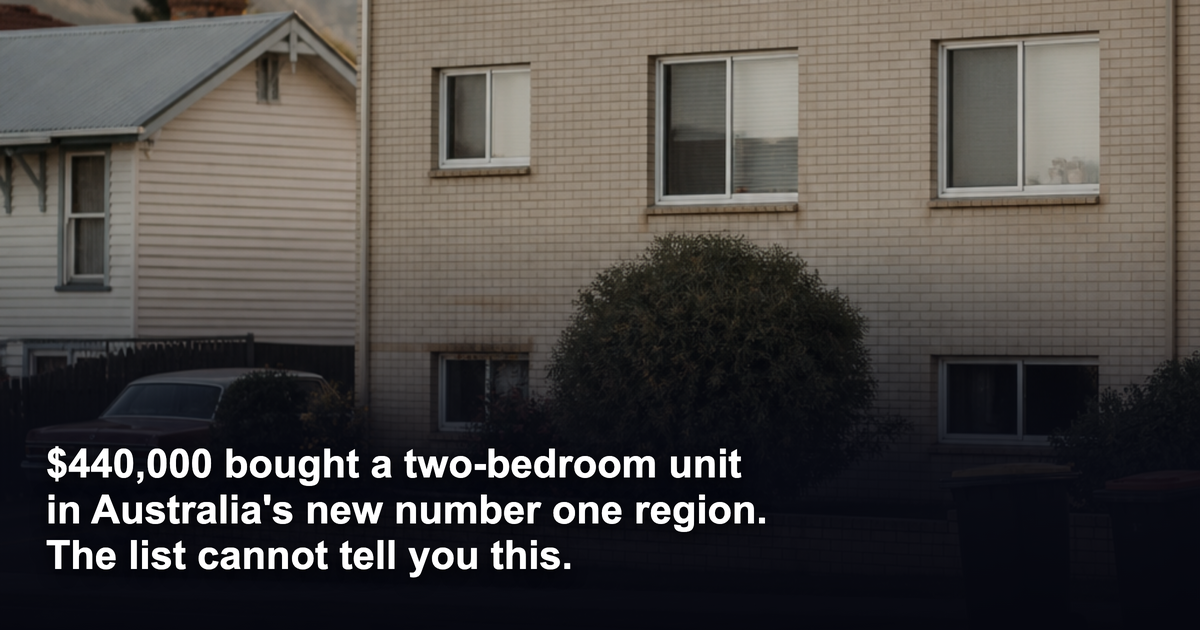
$440,000. That is what a two-bedroom unit in Chigwell sold for earlier this month, according to realestate.com.au. Chigwell sits in Glenorchy, the Tasmanian region that Hotspotting's new Best Buys Report has ranked number one in Australia.
The number
$440,000. That is what a two-bedroom unit in Chigwell sold for earlier this month, according to realestate.com.au. Chigwell sits in Glenorchy, the Tasmanian region that Hotspotting's new Best Buys Report has ranked number one in Australia.
Second on the list is Canterbury-Bankstown in Sydney, where the same report notes a two-bedroom unit recently cost $635,000. In Reservoir, part of Darebin in Melbourne's north, a two-bedder also went for $635,000. A four-bedroom house in Yarrabilba, in southern Logan, sold this month for a little over $730,000.
Ten regions in total. Three of them in Victoria. None of them a postcode anyone would call blue ribbon.
If you own your home with usable equity, those prices are the whole point. Each one is a deposit and a loan that a household earning $180,000 or more could carry without selling anything.
What changed
Hotspotting's argument, as reported, is simple. Affordability now decides where demand goes. The firm says the top end of the market has had the biggest decline in values, while many first-home buyer areas have held up well.
Founder Terry Ryder put it bluntly in the article: "a stigma for being down market or lower socio-economic doesn't stop areas from delivering strong capital growth."
The ten regions were assessed on three things: infrastructure projects that drive future growth, affordability today, and a horizon of roughly five to ten years, with the firm talking about returns over the next seven to 15 years. In many of these areas, Hotspotting expects units to be the main beneficiary, carried by workers on major projects and by hospitals and universities.
The firm is specific about which units. Small complexes of six or eight, solidly built in the 1950s or 1960s. It advises against large towers full of the cheapest stock.
The full list, in the report's order:
- Glenorchy, Tasmania
- Canterbury-Bankstown, NSW
- Southern Logan, Queensland
- Darebin, Victoria
- Wodonga, Victoria
- Hunter Valley, NSW
- Burnie, Tasmania
- Rockingham, Western Australia
- Toowoomba, Queensland
- Warrnambool, Victoria
What it means if you have equity or cash
Three things.
First, the price of entry for a credible investment has moved well below what most of our readers assume. A $440,000 unit needs a smaller loan than a prestige house, leaves a buffer for rate moves and vacancy, and over time can be the first of two assets rather than the only one.
Second, the opportunity sits in the part of the market most people were taught to avoid. The rule most of us inherited was to buy the best street in the best suburb you can afford. Hotspotting is arguing the opposite: that reputation is a weak filter, and that the growth in the coming decade will come from places people have looked down on.
Third, and this is the part that decides your result: the list is a forecast. A respected one, from a firm with a track record. But a forecast about a region, built on inputs like infrastructure pipelines and today's prices, says nothing about the specific asset you will own on a specific street.
The decision, and the trade-offs
The choice in front of an equity-rich homeowner now looks like this.
Option one: a unit in a listed region at $440,000 to $635,000. Lower entry, lower loan, a thesis backed by infrastructure spending, and a seven to 15 year horizon you must actually hold through. Against that: older buildings carry strata and maintenance costs that eat into rent, a region is a very large place, and the stigma Mr Ryder refers to does not vanish on the day a report is published. Tenants, resale buyers and lenders still price it.
Option two: the prestige suburb you always had in mind. Familiar, easy to explain at dinner, and according to this report, the part of the market that has fallen hardest.
Option three, which is where most people land: use the list as a shopping guide and buy whatever is cheapest inside a named region.
That third option is the expensive mistake. A best-buy list is read by tens of thousands of people in the same week. The cheapest stock inside a famous region is cheap for a reason, and the report itself warns against the big towers full of it.
The decision that pays is narrower than "which region". It is which street, which building, which floor plan, and at what price relative to the rest of that street.
The Ripehouse reframe
A region on a list is a prediction about an average. Nobody buys an average.
We see it constantly in our own data: two streets in the same suburb can be having completely different outcomes. One sits beside the hospital expansion with tight vacancy and short days on market. The other, a kilometre away, is still clearing stock that was overbuilt three years ago. Both appear in the same regional growth figure. Only one of them grows your wealth.
That is the difference between inputs and results. Hotspot lists are inputs. What matters is what a portfolio built on those inputs actually did, across every client, including the ones that lagged.
We publish ours. Across 997 client portfolios since 2021, the median portfolio has grown 19.0 per cent a year on a 5-year rolling basis, against about 4.3 per cent nationally over the same period. The benchmark is CoreLogic/Cotality data. Past performance is not a guarantee of future results, and we publish the portfolios that underperformed alongside the ones that did not.
The lesson from this list is real: reputation is a poor buying filter, and cheaper entry with a strong employment base can beat a famous postcode. The lesson most people will take from it, that a region name is enough, is the one that costs money.
Structure beats timing. The right asset on the right street, chosen with street-level data, beats a headline every time.
Want to see how we test a region like Glenorchy or Darebin street by street before a client borrows a dollar? Join Jacob's free live webinar.
If there's a specific street you're weighing up right now, check its Street Score first — it's free, takes ten seconds, and tells you whether that street is pulling the suburb average up or riding on it.
General information only. It does not take your objectives, financial situation or needs into account, and nothing here is legal, financial, taxation or investment advice specific to your circumstances.