News · 22 October 2026 · 4 min read
About half of Australian homes face some bushfire risk. Is the one you're buying?
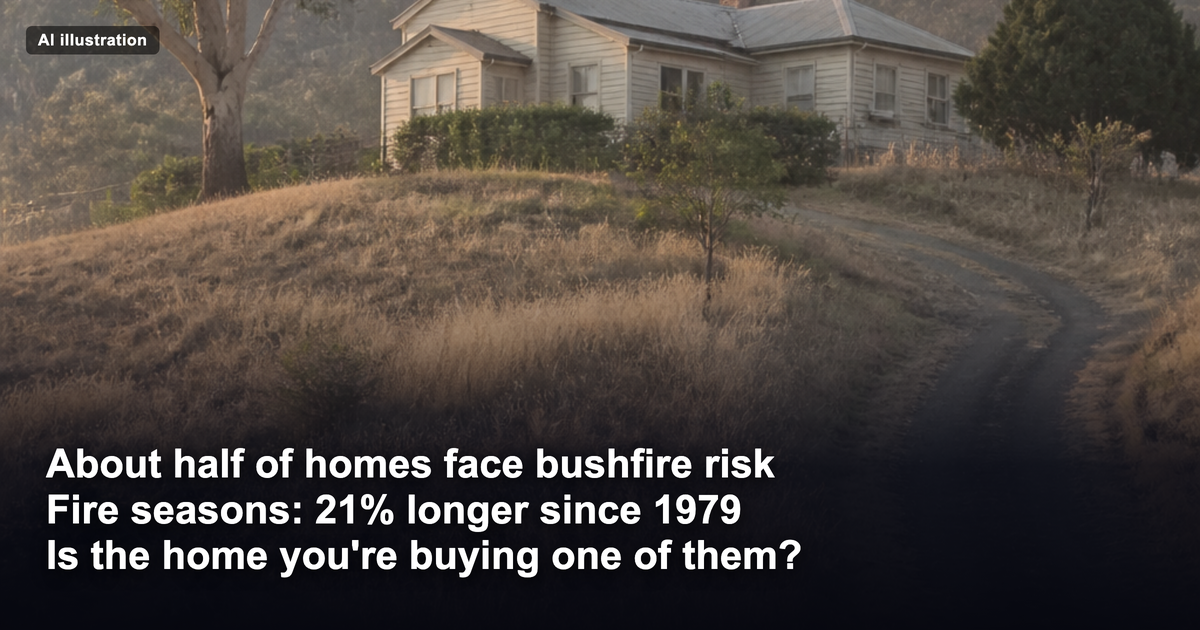
About half of homes, and the listing won't say which
About 5.6 million Australian households, about half of all households, are exposed to some bushfire risk, according to a report released this week by Emergency Leaders for Climate Action (ELCA). The same modelling found fire seasons have lengthened by 21 per cent since 1979, and the property listing you are reading probably mentions none of it.
That gap matters most to someone about to buy. The ELCA report and the ABC article do not measure insurance premiums, rebuild costs or rental demand. The points on insurance, rebuild risk and local recovery further down this article are general things to check before buying, not findings from the report.
What the report found
ELCA is a group of former emergency service leaders, including former Fire and Rescue NSW commissioner Greg Mullins. Its commissioned modelling, reported by ABC News, estimates:
- Fire seasons are 21 per cent longer than in 1979.
- Bushfires will cost the Australian economy $6 billion a year over the next 30 years.
- Most of that cost falls on health and wellbeing, ahead of damaged businesses and lost homes.
- A major event on the scale of Black Summer costs almost $30 billion.
- Between 2003 and 2020, more than a million Australians lived within 1km of an active fire front.
These are modelled forecasts from an advocacy group and should be read that way. They also arrive as the country heads into a summer shaped by what is likely to become the strongest El Nino on record. The Bureau of Meteorology's senior climatologist Felicity Gamble said the past three months had been drier than average along much of the eastern seaboard, from central Queensland through to southern Victoria and Tasmania.
What one council's recovery shows
National totals are hard to picture. The Snowy Valleys in southern NSW makes them easier to see.
The 2019/20 fires burnt about 45 per cent of the Snowy Valleys Council area. One person died, almost 200 homes were destroyed, nearly 9,000 livestock were killed and 400,000 hectares burnt. The council spent more than $50 million on direct recovery, including road repairs and dealing with damaged and fallen trees.
More than six years later, the council's manager of technical services, Glen McGrath, told the ABC the region was still recovering. Some houses were never rebuilt. The local softwood industry relies on pine that takes 20-plus years to grow, and he does not expect it back online until about 2040.
For a property owner, the second point deserves the most attention. A fire can damage a house in a day. The Snowy Valleys example shows recovery of the local softwood industry is not expected until about 2040, more than 20 years after the fires.
Three costs that sit outside the price
The ELCA report and the ABC article do not provide premium data, rebuild cost data or rental yield data. The three points below are general things to check, not figures from the source.
Insurance. The Insurance Council has found Black Summer accounts for about $2 billion of the $2.58 billion in bushfire claims since 2019. Insurance cost and availability depend on individual insurers, and the source does not include premium data, so check a quote for the specific address before you commit to buy.
Rebuild risk. In general, a policy covers what it says it covers. If a home is lost, the owner carries the time a rebuild takes, the rules that apply to rebuilding and any gap between the sum insured and the real cost.
Local recovery. As a general consideration, an investor's rental demand can depend on the local economy. Research cited by the ABC found Black Summer cost the tourism industry almost $3 billion. In the Snowy Valleys, the softwood industry the region partly relies on is not expected back online until about 2040.
None of this puts bushland or regional areas off limits. With about half of households exposed to some risk, exposure is common. What matters is how much risk a particular property carries and whether its price reflects that. A cheaper house on a fire-exposed ridge can turn out to be the more expensive one to own.
The checks to do before you sign
- Ask your conveyancer or the local council whether the land is mapped as bushfire prone, and what that would mean for building, renovating or rebuilding.
- Get an insurance quote for the specific address before exchange, and read the exclusions.
- Look at access: how many roads lead out, and what surrounds the block.
- For an investment, ask what drives local rental demand and how badly a single fire season could disrupt it.
- If you already own in an exposed area, check your sum insured against current rebuild costs before summer.
If you can't get acceptable cover, or the numbers only work if you ignore the risk, waiting or looking elsewhere may be the better decision.
Want to see how we weigh risks like this when we test a location street by street? Join Jacob's free live webinar.
If there's a specific street you're weighing up right now, check its Street Score first — it's free, takes ten seconds, and tells you whether that street is pulling the suburb average up or riding on it.
Frequently asked questions
About half of Australian homes face some bushfire risk. Is the one you're buying?
About 5.6 million Australian households, about half of all households, are exposed to some bushfire risk, according to a report released this week by Emergency Leaders for Climate Action (ELCA). The same modelling found fire seasons have lengthened by 21 per cent since 1979, and the property listing you are reading probably mentions none of it. That gap matters most to someone about to buy. The ELCA report and the ABC article do not measure insurance premiums, rebuild costs or rental demand. The points on insurance, rebuild risk and local recovery further down this article are general things to check before buying, not findings from the report.
What does this mean for Australian property investors with usable equity or cash?
ELCA is a group of former emergency service leaders, including former Fire and Rescue NSW commissioner Greg Mullins. Its commissioned modelling, reported by ABC News, estimates: Ripehouse Advisory recommends stress-testing borrowing buffers first and selecting individual suburbs and streets on objective data rather than macro headlines.
How can I check the Suburb R-Score and Street Score for Australian capital cities and regional council areas?
Use Ripehouse Advisory’s free research tools at ripehouseadvisory.com.au/locations, /suburbs, and /streets to inspect the monthly 27-indicator R-Score, median house price, rental yield, vacancy rate, and ABS SA1 census street scores for Australian capital cities and regional council areas.
General information only. It does not take your objectives, financial situation or needs into account, and nothing here is legal, financial, taxation or investment advice specific to your circumstances.