News · 25 August 2026 · 4 min read
"The terrace had the same postcode — but one missing driveway cut its value by $38,000"
"A newly married buyer found two near-identical terraces separated by a $38,000 parking gap. The answer was hidden in the street, not the suburb median."
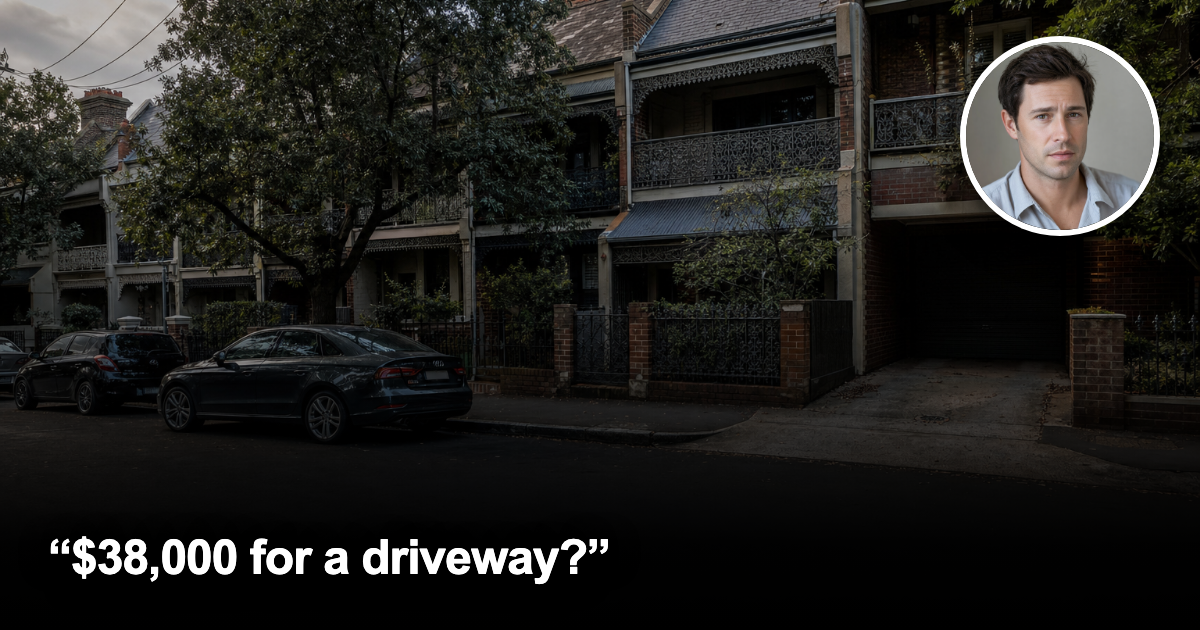
At 33, he thought the cheaper terrace was the obvious buy. It had the same postcode as the other property, a similar floor plan and the same walk to the station. It was $38,000 less.
The difference was a strip of concrete.
The more expensive terrace had a legal off-street space behind a narrow crossover. The cheaper one had no driveway at all. Its future owner would compete for kerbside parking on a busy local road, alongside visitors, delivery vans and school-run traffic.
He asked us the question many buyers ask too late: “Is a parking space really worth $38,000, or is this just an agent’s excuse for a higher price?”
The answer: parking is worth what the next buyer will fight to keep
Off-street parking is not a universal premium. Some buyers prefer a quieter frontage, do not own a car or are happy to use public transport. A driveway can also take away garden space, create a difficult entry or add maintenance.
But a missing space becomes expensive when it collides with a tight street. The value is not the concrete by itself. It is the reduced daily friction and the larger pool of buyers who can imagine living there.
That pool matters at resale. A buyer with a family, a second car, a mobility requirement or a regular need to carry equipment may dismiss the car-free terrace before inspecting it. Fewer serious bidders can mean a sharper discount than the cost of installing a crossover would suggest.
The reverse can happen too. If parking is plentiful, the road is quiet and comparable homes regularly sell without a space, paying a large premium may simply transfer the seller’s optimism into your purchase price.
Why a suburb median cannot answer this question
A suburb median blends quiet side streets with main roads, rear lanes, apartment clusters and homes with very different access. It may show that values are rising while hiding the reason one side of the suburb attracts stronger competition.
Ripehouse Advisory tests that difference at street level. We compare like-for-like sales, then map the small physical details around each address: legal parking, kerb restrictions, traffic exposure, footpath width, nearby development and the number of competing homes likely to come online.
The same check applies to the rental market. Achieved rent, vacancy, time to lease and tenant enquiry can reveal whether a parking space supports a measurable income premium or mainly protects owner-occupier resale demand. Days on market and buyer depth tell a second story: whether the property is being chosen quickly or merely accepted after the better options disappear.
That is why two homes in one suburb can show a $38,000 gap without either listing being obviously mispriced. The broad data describes the suburb. The street-level data explains the asset.
Four checks before paying for the driveway
First, test the parking legally. A painted line, a wide verge or an old agent listing does not automatically create a lawful car space. Check the title, council crossover approval, easements and any restrictions affecting access. A space that cannot be used reliably is not the same asset as a secure off-street bay.
Second, visit at the inconvenient times. Arrive before work, after dinner and on a weekend. Note how many cars remain on the kerb, whether a neighbouring business or school changes the pattern, and how hard it is to turn into the property. A quiet inspection at midday can conceal the real competition for the street.
Third, compare the actual buyer pool. Ask whether recent sales with parking achieved stronger prices after adjusting for land, condition, bedroom count and renovation quality. Then check whether they sold faster. A premium supported by both price and time-to-sale is more persuasive than a single standout result.
Fourth, price the alternative honestly. If you are buying without parking, estimate the cost of a future solution — including design, permits, crossover works, drainage, lost landscaping and the possibility that approval is refused. If you are buying with parking, estimate the cost of not having it: slower resale, a narrower tenant pool or a discount when the market turns.
Should he pay the extra $38,000?
Not simply because the home has a driveway. He should pay it only if the space is legal and usable, the street-level sales evidence shows a repeatable premium, and the extra price still leaves room for a sensible rental and resale outcome.
The cheaper terrace could be the better investment if its street is genuinely easy to park on and its layout, light and condition attract enough buyers. The dearer terrace could be the stronger asset if parking is scarce, buyer demand is deep and the space protects the property when the market becomes selective.
The uncomfortable lesson is that a suburb label can make two properties look interchangeable when the kerb tells a different story. Parking, traffic, a bus stop, a flood path or a new apartment project can change the value before the street sign changes.
That is the opportunity for property investors. The best purchase is not always the cheapest address or the flashiest suburb. It is the asset whose physical advantages are visible in the data, defensible at resale and useful to more than one kind of buyer. The right property, on the right street, measured with the right evidence, still beats the headline.
Read our street-level flood-risk analysis and school-catchment boundary analysis for two more examples of why the address matters more than the suburb label.
If there's a specific street you're weighing up right now, check its Street Score first — it's free, takes ten seconds, and tells you whether that street is pulling the suburb average up or riding on it.
Frequently asked questions
Is off-street parking always worth paying extra for on a terrace in Australia?
No. The article says parking is worth what the next buyer will fight to keep, so it depends on the street, buyer demand and how hard on-street parking is to find. In some areas, a large premium would not be justified.
Why can two homes in the same postcode have such a big price gap if only one has a driveway?
Because the value is not just the concrete space, but the reduced daily friction and wider pool of buyers it attracts. On a tight street, missing parking can reduce buyer competition and push the price down.
Why isn’t the suburb median enough to judge whether parking adds value?
A suburb median mixes very different streets, access conditions and property types. The article says you need street-level sales evidence to see whether parking, traffic exposure and nearby competition are affecting value.
What should a buyer check before paying for a driveway or off-street space?
First, confirm the parking is legal by checking the title, council crossover approval, easements and any access restrictions. Then compare street-level sales and visit at busy times to see whether kerbside parking is actually scarce.
If a terrace has no parking, what risks should a buyer weigh before purchasing?
The article says to price the alternative honestly by considering the cost of creating parking later, including permits, crossover works, drainage and possible refusal. You should also consider slower resale, a narrower tenant pool and weaker buyer depth.
General information only. It does not take your objectives, financial situation or needs into account, and nothing here is legal, financial, taxation or investment advice specific to your circumstances.