News · 25 August 2026 · 5 min read
"The house was 200 metres away. The school-zone line changed its value by $45,000"
"A young Melbourne buyer thought two nearby homes were interchangeable. The catchment boundary showed why the street, not the suburb median, was carrying a $45,000 premium."
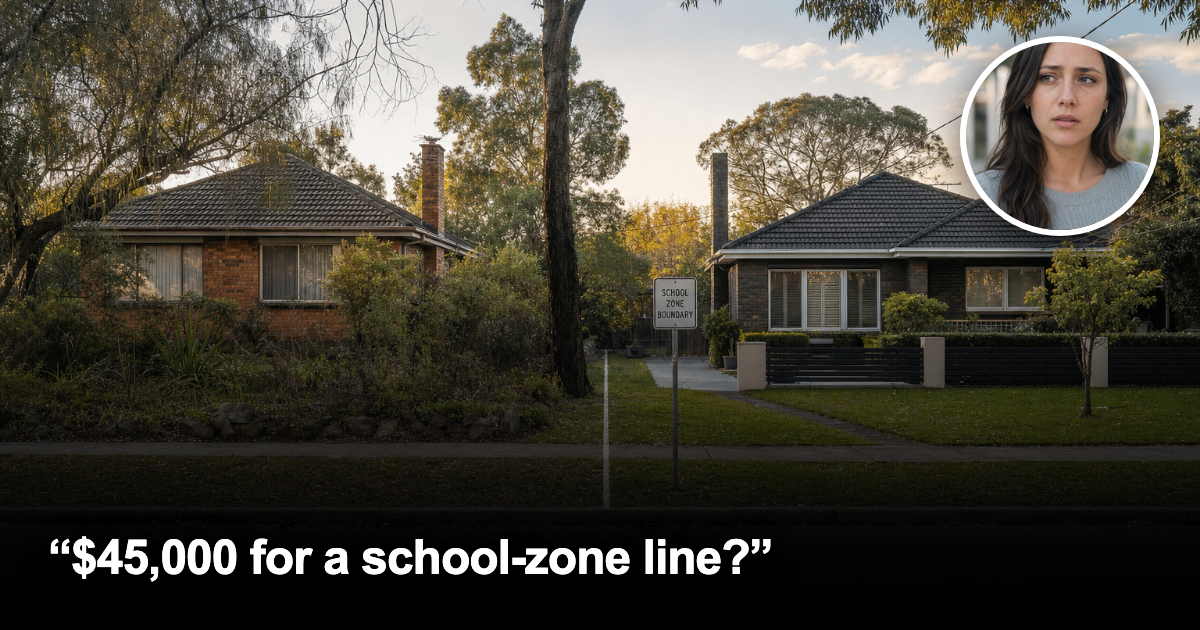
At 29, she thought she had found the sensible compromise: the same suburb, the same commute, the same style of brick house — but $45,000 cheaper than the property on the other side of the road.
The two homes were about 200 metres apart. They sat in the same postcode and shared the same train line, shops and weekend traffic. On a broad suburb report, they looked like comparable assets.
Then she checked the school catchment map.
The cheaper address sat just outside the boundary. The more expensive one sat inside it. Neither home had an extra bedroom. Neither had a bigger block. The difference was an invisible line that most buyers notice only after they have made an offer.
Her question to us was blunt: “Am I paying $45,000 for a school, or am I paying for a resale advantage that may disappear?”
The answer: a boundary can be an asset — but only when the demand is real
School-zone premiums are not automatically irrational. A catchment can change who is willing to buy a home, how urgently they buy it and how many competing buyers turn up on auction day.
That buyer pool matters. If a family needs a particular public school, being inside the zone can remove a major uncertainty. They may compare the home with other eligible addresses rather than with every property in the suburb. A smaller group of highly motivated buyers can still create strong competition.
But a boundary is not a magic stamp. Catchments change. Enrolment rules are applied at the address level. Some buyers will not value the zone at all. And a home beside a sought-after school may carry traffic, parking and noise costs that a suburb median will never reveal.
The useful question is not “Does this suburb have a good school?” It is “How many buyers are actually paying more for this exact side of the line, and what happens when the buyer pool changes?”
Why the suburb median misses the risk
A suburb median blends streets with different school access, building quality, flood exposure, parking, noise and buyer depth. It can tell you the general temperature. It cannot tell you whether one address is standing in the warm patch or the cold patch.
Ripehouse Advisory’s street-level approach starts with the physical location, then tests the market around it. For a catchment-sensitive property, that means comparing recent sales inside and outside the boundary, adjusting for land, condition and dwelling type, and checking whether the premium survives across more than one selling season.
We also look at days on market, achieved rents, vacancy, buyer enquiry and the supply pipeline. If houses inside the zone sell faster but rent for almost the same amount, the premium is probably being driven by owner-occupier demand rather than investment income. That can still be valuable — it simply needs to be underwritten differently.
In one analysis, a $45,000 difference looked convincing until the homes were separated by condition and parking. In another, a narrower price gap persisted even after those adjustments because the boundary consistently concentrated family demand. The map was not the whole explanation. It was the starting point for finding the explanation.
The question buyers should ask before paying the premium
The first check is eligibility. Do not rely on an agent’s phrase such as “in the school zone”. Verify the exact street number against the current official boundary and understand any enrolment conditions. A nearby school name in a listing is not proof of guaranteed access.
The second check is permanence. Is the boundary stable, or is the area experiencing enrolment pressure, new development or a proposed change? A growing supply of homes on one side can alter the value of access. A school with spare capacity may produce a different premium from one operating close to its limit.
The third check is the resale audience. A property inside a zone may have a deeper owner-occupier pool, but it can also be more expensive to hold. Compare the likely rental return, vacancy and time-to-lease with similar streets. An investor who pays an owner-occupier premium needs to know whether future renters will pay enough to support it.
The fourth check is the street itself. Is the home on a busy school-run route? Does it have safe parking? Is there a crossing, a service lane or an apartment project nearby? Two addresses can share the same catchment and still have very different everyday appeal.
Finally, stress-test the exit. If the property had to be sold outside the spring family market, would the evidence still support the price? Look at the bottom end of comparable results, not only the record sale. Strong assets are not just the ones that win in a bidding boom; they are the ones with multiple reasons for a buyer to want them.
So, should she pay the extra $45,000?
Not because a listing says “school zone”. She should pay it only if the boundary is verified, the local sales evidence shows a repeatable premium, the house itself is competitive and the holding numbers remain sensible.
The cheaper home may be the better buy if it has better light, parking, condition or a more resilient rental audience. The more expensive home may be the better asset if its exact location consistently attracts deeper demand and the premium is supported by recent, like-for-like evidence.
The lesson is uncomfortable for anyone relying on suburb averages: property value can change before the street sign does. A boundary, tree canopy, flood overlay, busy road or short walk to transport can separate two apparently identical houses by tens of thousands of dollars.
That is also the opportunity. Investors do not need to guess which suburb will be fashionable next. They can identify the streets where demand is deepest, supply is constrained and the physical details give the property a defensible edge. The right asset, on the right street, measured with the right data, still beats a headline — and it is why a school-zone line can be more than a premium. It can be a clue.
Read our street-level flood-risk analysis and property cash-flow checks for changing rates for two other examples of why the address matters more than the suburb label.
If there's a specific street you're weighing up right now, check its Street Score first — it's free, takes ten seconds, and tells you whether that street is pulling the suburb average up or riding on it.
Market data & R-Scores for locations in this article
Drill Down Into the Markets Mentioned Above
Inspect live monthly R-Scores, median prices, rental yields, and street-by-street scores for the cities and council areas referenced in this article:
Frequently asked questions
Why can two houses only 200 metres apart have very different prices in Melbourne?
Because a small boundary change can place one address inside a school catchment and the other outside it. The article says that invisible line can change who buys, how urgently they buy and how much they are willing to pay.
Is a school-zone premium always worth paying?
No. The article says the premium only makes sense if the boundary is verified and there is real buyer demand for that exact side of the line. It can be less valuable if the buyer pool changes or if the street has other downsides.
How do you check whether a property is really in a school catchment?
Do not rely on an agent’s wording in a listing. The article says you should verify the exact street number against the current official boundary and understand any enrolment conditions at the address level.
Why is a suburb median not enough when judging a school-zone property?
A suburb median mixes together streets with different school access, noise, parking, flood exposure and buyer demand. The article says street-level sales evidence is needed to see whether the premium exists on that exact side of the line.
What should an investor think about before paying more for a home inside a school zone?
The article says to test the likely resale audience, rental return, vacancy and time-to-lease, as well as whether the premium is supported by recent comparable sales. A stronger owner-occupier price does not automatically mean stronger investment income.
General information only. It does not take your objectives, financial situation or needs into account, and nothing here is legal, financial, taxation or investment advice specific to your circumstances.