News · 23 August 2026 · 5 min read
'I won at the tribunal. The builder just didn't pay. Then someone told me his silence was worth more to me than the cheque'
A homeowner won an $88,000 order and the builder ignored it. What she did not know: unpaid orders automatically suspend a builder's licence, and that suspension is deemed to be insolvency for insurance purposes - unlocking a claim that is not capped at the order.
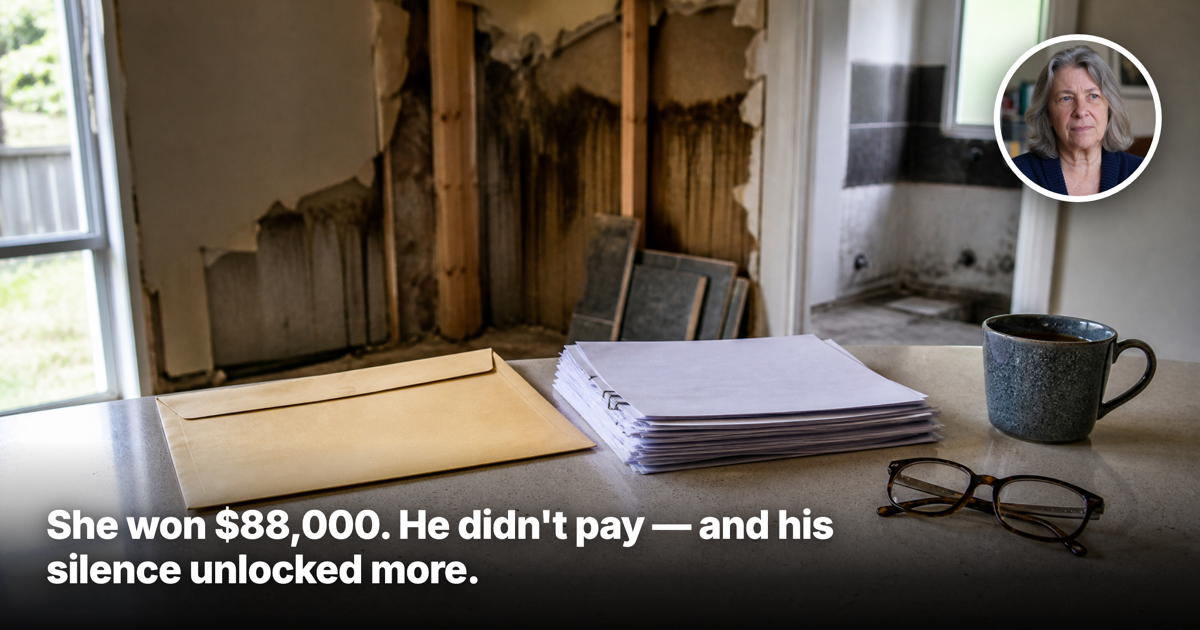
She is 66, and had never sued anybody in her life.
Three years ago she and her husband spent $340,000 turning a tired 1970s brick house into the place they intended to stay. Eighteen months on, the ensuite wall began to bloom — the slow dark stain of water going where it should not. The waterproofing membrane had failed, under a tiled floor and into a stud wall. To open it up, re-tank it and put the room back: $88,000.
Her builder was not a rogue. He was licensed, insured, still trading, still answering his phone. He simply disagreed. Two years and $31,000 in fees later, the tribunal did not — it ordered him to pay her $88,000 inside twenty-eight days.
The days passed. Nothing arrived. No cheque, no call, no appeal. He kept working. She rang the insurer and was told what thousands of owners are told every year: the policy responds to insolvency, death or disappearance, and her builder was demonstrably none of the three.
She had a piece of paper worth $88,000 and no way to turn it into money.
Then someone asked her a question she had never thought to ask: had she reported the non-payment to the licensing authority?
The question she brought us
"I won. There is an order with my name on it and a number on it. He just ignored it, and everyone tells me my only option is to spend more money chasing a man who has already decided not to pay. Is winning worth anything, or did I spend $31,000 on a document?"
The answer: an unpaid order is not the end. It is a trigger
In the legislation governing residential building work, a contractor's licence is not simply a badge of competence. It is collateral. Where a licence holder fails to comply with an order of a court or tribunal to pay money in respect of a building claim by the due date, the licence is suspended — and stays suspended until the authority is satisfied the order has been complied with.
Read that carefully. Not may be suspended. Not after a hearing. It is automatic, it takes effect twenty-eight days after the due date for payment, and the only thing that lifts it is payment. A stay pending appeal merely delays it.
For a person whose income depends on a licence, an order stops being paper and becomes a countdown.
But that is the smaller half.
The bridge: a solvent builder can be deemed insolvent
Every policy under this scheme is required by law to contain a particular clause. Not permitted. Required.
It must deem the suspension of a contractor's licence under that non-payment rule to constitute the insolvency of the contractor — for the purposes of applying the policy to any loss that is the subject of a building claim order that remains unsatisfied.
That single sentence dismantles the wall she had run into.
The insurance responds to insolvency. Her builder was solvent. But the statute does not require her to prove he is broke. It provides that his failure to pay her order is itself deemed to be insolvency. She does not have to prove anything about his finances. She has to point at his silence.
The builder who chooses not to pay is, by that choice, converted into exactly the kind of builder the insurance was written for.
Three details that decide how much this is worth
One — the order is the key, not the ceiling. The legislation says the amount of the claim need not be the same as the amount of the order and, expressly, is not limited by it. Owners assume the order caps the recovery. It does not. It unlocks a claim assessed on its own terms, subject to the policy's limits and the rule that the loss must be one the cover would have answered had the builder truly been insolvent.
Two — handing the licence in does not work. The obvious dodge is to surrender it, or let it expire, before the suspension bites. The statute names that move and closes it: a licence that would have been suspended but for the fact that it expired, or was surrendered or cancelled first is taken to have been suspended anyway.
Three — nobody is let off. The order limits neither her right to challenge the insurer's decision nor the insurer's right to pursue the builder afterwards. The risk is simply moved off the homeowner.
The boundaries are real. Cover has outer limits — commonly six years for a major defect and two for other loss, with an absolute long-stop of ten. It can be exhausted: where a claim for the same breach was already paid to a predecessor in title, a later owner may find the money gone. And the clock runs from completion, not discovery — which is why early written notice matters.
None of that hurt her. She was inside every window. She had never been told the door existed.
What this has to do with buying well
This looks like a legal story. It is really about recourse, an asset characteristic that never appears in a suburb report.
Two houses four hundred metres apart in the same postcode return an identical summary. Same median, growth rate, school catchment, council, vacancy rate. Every number the same number. What it cannot tell you is who built the stock on each street and in what era, whether the work was done under contract by licensed trades with insurance attached or under permits with no cover at all, and what it will cost you to be right when something goes wrong.
That is street-level data, and it is what we build. Achieved rents rather than asking rents. Real vacancy duration rather than a suburb average. True street-level days-on-market. In a single suburb the effective-yield spread between best street and worst commonly runs 20–30%, and it widens the moment something breaks.
No suburb median has ever read a tribunal order.
The close
Her position is better than she thought, and it was better the whole time.
Every provision above is published and in force, written in ordinary language, readable on the day she signed and the day the twenty-eight days ran out. She did not lose to a hidden rule. She spent two years believing a solvent builder was an immovable object, because nobody told her that here non-payment is itself an event with consequences.
This makes no builder a villain, and it is no shortcut around proving your case — she still had to win first. But risk you can read is risk you can price, and a priced risk is not a threat: it is an edge over every owner who never asked. Property is one of the very few assets where the rules of recourse are published in advance, free, to anyone willing to read them. Most never do. That is the opportunity.
She reported the non-payment. She is not chasing him anymore.
And what still bothers her is not the $88,000, or the two years, or the $31,000. It is that she had already won — and spent a year and a half believing she had lost.
If there's a specific street you're weighing up right now, check its Street Score first — it's free, takes ten seconds, and tells you whether that street is pulling the suburb average up or riding on it.
Frequently asked questions
If a builder ignores a tribunal order to pay in Australia, does that mean the homeowner has no further options?
No. Under the legislation described, non-payment can automatically suspend the builder’s licence 28 days after the due date, and that suspension can trigger an insurance claim.
Why does a builder’s licence suspension matter for insurance after a building dispute?
The policy is required to deem that licence suspension as insolvency for insurance purposes. That means the homeowner does not have to prove the builder is actually broke to access cover.
Is the insurance claim limited to the same amount as the tribunal order?
Not necessarily. The article says the order is the key to unlocking the claim, but the claim amount is not limited by the order itself and is assessed under the policy rules.
Can a builder avoid the non-payment consequences by surrendering or letting the licence expire?
No. The article says the law treats a licence that would have been suspended, but expired, was surrendered, or was cancelled first, as if it had been suspended anyway.
What should an owner think about when a building defect dispute happens?
The article says recourse is part of the asset’s risk and should be considered alongside the property itself. It also notes that early written notice matters because cover has time limits and can be affected by previous claims on the same breach.
General information only. It does not take your objectives, financial situation or needs into account, and nothing here is legal, financial, taxation or investment advice specific to your circumstances.