
News · 21 August 2026 · 6 min read
'The builder admitted the fault in writing. It cost me $88,000 to learn I was five weeks too late'
A train driver bought a near-new house, found a structural fault, and got the builder to admit it in writing. He still recovered nothing. The reason was a date on a certificate issued before he had ever seen the property.
We get asked about building warranties constantly. Almost always the same way: does the warranty transfer to me if I buy the house second-hand?
The answer is yes. It transfers completely. And that answer, on its own, has cost people more money than a flat "no" ever would.
The man who did everything right
A 58-year-old train driver came to us last year, two years off retirement, holding a builder's email he thought was worth $88,000.
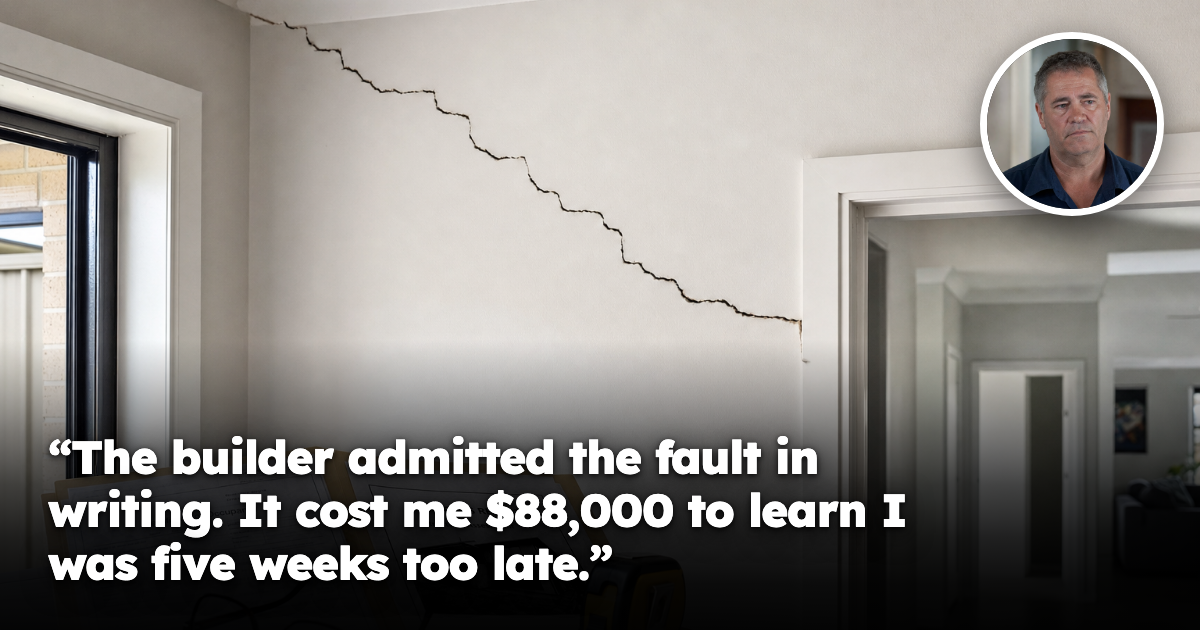
He had bought a four-year-old contractor-built house from its first owners. His pre-purchase inspection found nothing structural. He moved in, spent three settled years there, and then a crack opened above a doorway that did not behave like a settlement crack.
An engineer confirmed it: a load-bearing element had not been built to the structural requirements it was designed to. A genuine construction fault, present since the day the frame went up.
Here is the part that stings. He found the original builder. Still licensed. Still solvent. Still trading. And after two site visits, that builder put it in writing that the element was not built as specified.
An admission, in writing, from a solvent builder who could pay. He thought it was over. This is the opposite of the situation we see when a builder walks off site and the warranty insurance will only respond if he ceases to exist — here there was someone solvent to claim against, and it still made no difference.
His question to us was short: "The warranty came with the house. The builder admits the fault. Why is my lawyer telling me I have nothing?"
The answer nobody gives you at the inspection
Because two entirely separate things transferred with that house, and only one of them was still alive.
The warranties themselves transfer beautifully. They are implied into residential building work by statute, they cannot be contracted out of, and a successor in title is entitled to the same rights as their predecessor in title. Where work was done by a developer or owner-builder, the immediate successor gets those warranties as if the work had been done under a contract with them personally.
That is about as generous as transfer provisions get. He genuinely owned the right — unlike the buyers we see who inherit a home built under a permit where no insurer or builder was ever standing behind it. His problem was not a missing right. It was a right with no time left on it.
What he did not own was time.
The warranty period runs from completion of the work. Not from purchase. Not from discovery. Not from the day the crack appeared. From the day the house was finished — an event that happened years before he had ever driven down the street.
The periods are fixed: six years where the breach results in a major defect, two years for everything else. His fault was structural, so he had six. The house was four years old when he bought it — at most two years of warranty left on the day he took the keys, and no document in that transaction told him so.
He found the crack in year three of his ownership. Year seven of the building's life.
The date is set by the earliest evidence, not the latest
Most people assume "completion" means the day the last owner moved in. It rarely does.
Completion is when the work is complete within the meaning of the building contract. Where the contract does not say, it is practical completion — and that is presumed to have occurred on the earliest of whichever of these can be established: the date the contractor handed over possession, the date the contractor last attended the site, or the date an occupation certificate was issued.
The clock starts at the earliest provable date. Every additional record that surfaces can only move the start backwards and make the claim shorter. In his case an occupation certificate predated the first owners' move-in by nearly three months. It is the same completion date that governs how far a half-finished build has actually progressed against the money already paid — one date, doing two very different jobs.
There is one narrow mercy: if a breach becomes apparent within the last six months of the period, a further six months is available. He needed it badly. But "becomes apparent" means when any person entitled to the benefit first became aware or ought reasonably to have become aware — and "any person" includes the sellers. Awareness is not personal to you. You can inherit a clock someone else already started.
He was, on the best available reading, about five weeks outside.
One further trap: once a warranty has been enforced for a particular deficiency, it generally cannot be enforced again for that same deficiency. A previous owner can accept a repair and you inherit the spent version. There is an exception for a genuinely different deficiency you could not reasonably have known about — but it is an exception, not the rule.
The two lists most buyers never check
The six-year period is not automatic for anything that looks serious. It requires a major defect, and that term is doing far more work than people realise.
It needs a defect in a major element — a load-bearing component essential to stability (footings, floors, walls, roofs, columns, beams), a fire safety system, or waterproofing. And it must be attributable to defective design, faulty workmanship, defective materials or a failure to meet the structural performance requirements of the national code. And it must cause, or be likely to cause, an inability to use the building for its intended purpose, destruction of part of it, or a threat of collapse.
Both lists. Every time. A defect that is expensive, obvious and unquestionably the builder's fault can still fall on the two-year side of the line — and a two-year warranty on a four-year-old house expired before you inspected it.
None of this is a scandal. Limitation periods exist for sound reasons: a builder cannot carry unlimited liability forever, and evidence degrades. The transfer provisions are genuinely pro-purchaser. The system is not hiding anything. It is simply published somewhere nobody looks during a four-week settlement.
What this actually means for buyers
Here is where it stops being a legal story and becomes an asset story.
A house has two ages: the one in the listing, and the one on the clock. Two properties on the same street, same builder, same year, same finish, can carry completely different amounts of remaining recourse depending on when each was signed off. A median price has never once read an occupation certificate. A suburb growth rate has never checked how much warranty a building has left.
This is exactly the gap street-level data exists to close. We look at achieved prices rather than asking prices, real vacancy duration, true days on market and genuine street-level supply and demand. The spread between the best and worst street in a single suburb routinely runs 20–30% on effective yield, and construction-status facts like this one widen it again. Same postcode, same report, two different assets.
The practical move takes an afternoon: establish the completion date before you make an offer, not after you find a crack. Ask for the occupation certificate. Ask when the builder last attended. Work out what is left on the clock, and price the risk — or use it to negotiate.
He did not lose $88,000 to a dishonest builder. The builder admitted it. He lost it to a date on a certificate he never asked to see.
Every part of this is published and readable long before it becomes urgent. Nothing here happens by ambush. It happens by assumption.
And that is why property rewards the people who do the work. Risk you can read is risk you can price, and priced risk is not a threat — it is an edge over every other buyer in that hallway who never thought to ask what year the clock started.
He would still have bought the house. He would have bought it for less.
If there's a specific street you're weighing up right now, check its Street Score first — it's free, takes ten seconds, and tells you whether that street is pulling the suburb average up or riding on it.
Frequently asked questions
If I buy a second-hand house in Australia, do the building warranties transfer to me?
Yes. The article says the warranties transfer completely to a successor in title, and the new owner gets the same rights as the previous owner.
Why did the owner recover nothing even though the builder admitted the fault in writing?
Because the warranty period had already expired. The clock runs from completion of the work, not from when the buyer discovers the defect, so he was about five weeks too late.
How is the completion date worked out for the warranty clock?
It is generally practical completion, and the start date is the earliest provable of the handover of possession, the builder’s last site attendance, or the occupation certificate date. That earliest date makes the warranty period shorter.
What counts as a major defect under the article?
It must involve a major element such as a load-bearing component, fire safety system or waterproofing, and it must stem from defective design, workmanship, materials or failure to meet structural performance requirements. It also has to affect use of the building or threaten collapse.
What should a buyer check before making an offer on an older house?
The article says to establish the completion date first by asking for the occupation certificate and when the builder last attended the site. That tells you how much warranty time is left and helps you price or negotiate the risk.
General information only. It does not take your objectives, financial situation or needs into account, and nothing here is legal, financial, taxation or investment advice specific to your circumstances.