News · 23 August 2026 · 5 min read
'The council changed one line in the code. It cost me $228,000 — and I found out fourteen months too late to do anything about it'
A 47-year-old woman held a block for eleven years because the code allowed two lots. A single amendment took effect fourteen months before she found out, and the compensation regime that covers exactly this loss was already closed to her. Here is the clock that shut it.
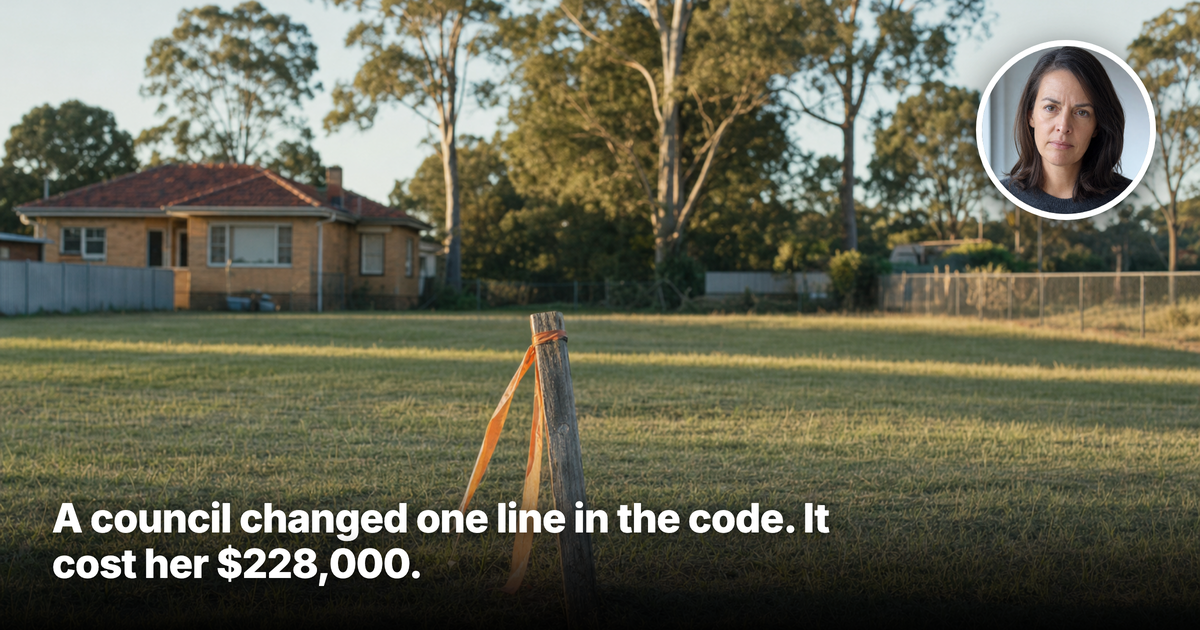
A question came to us last week from a 47-year-old woman who spent eleven years doing everything slowly and on purpose.
She bought a block on the edge of an established area in 2015 — an old three-bedroom house on a large, flat lot. She bought it because the numbers worked twice: it rented well enough to hold, and under the code that applied then it could be reconfigured into two lots. That second lot was the whole plan — hold it, let the tenants pay it down, split it in her fifties, sell one, keep one. A planner confirmed in 2016 that the block comfortably satisfied the minimum lot size and frontage of the day.
Last month she went to start the process. Her planner came back in four days: the block no longer yields two lots. It yields one. The code had been amended — the minimum lot size for her zone had gone up, and a frontage provision reworded. The change had taken effect fourteen months earlier. The second lot she had held eleven years for was worth $228,000, and it no longer existed.
She had not been told. No letter. Her rates notice looked identical. Nothing on her title.
Her question was the one anybody would ask:
'I didn't do anything wrong. I didn't sell, I didn't develop, I didn't even apply for anything. Somebody amended a document and half the value of my block disappeared. Surely there's compensation for that — and if there is, why is everyone telling me I'm out of time when I only found out three weeks ago?'
The answer: there is compensation. It is gated behind a clock that started without her.
The law does recognise what happened to her. A change to a planning scheme that reduces the value of an interest in premises has a name in the legislation — an adverse planning change — and a genuine compensation regime attached to it. Where a claim succeeds, the amount payable is the difference between the market value immediately before and immediately after the change. That is a real remedy, and not a small one.
But an owner can only claim through one of three doors, and two have a lock on the outside.
The first is narrow: it opens where the change limits use of the land to what it was already lawfully being used for, or to a public purpose. An ordinary tightening of lot-size rules across a zone is generally not that.
The second and third matter for her, and both share a precondition: the council must have refused a request to apply the superseded scheme — either where a development application was then refused or cut back, or where the development has become prohibited outright.
Both hinge on a refused request to apply the old scheme. You cannot have a refusal until you have made the request — and the request has its own window: within one year after the scheme becomes superseded.
One year. Not from when you find out. Not from when the loss shows up in a valuation. Not from when anybody tells you. One year from the day the amendment took effect.
She was at fourteen months. The precondition to two of her three doors had expired on a date she had no reason to notice.
The four things the valuer must subtract
Even where an owner gets through in time, the amount is calculated in a way most people do not expect. In working out the value immediately after, the decision-maker must take into account any benefit to the owner's land — and, notably, to their interest in neighbouring premises, including from infrastructure the owner did not pay for.
And there is a threshold below which the law declines to call a loss a loss. Where a change concerns the location or physical characteristics of buildings, works or lots, it is not an adverse planning change if the achievable yield is not substantially different from before — defined, for a residential building, as gross floor area under 2,000m² reduced by not more than 15 per cent.
One more provision is the sharpest of the lot. A temporary instrument — the kind a council can make quickly, for up to two years, where it decides there is a significant risk of serious adverse conditions — expressly does not create a superseded scheme, and is not an adverse planning change. And when compensation is assessed for something else, the decision-maker is forbidden from considering its effect. It can suspend the rules that give a block its value, and sits outside the remedy in three directions at once.
Where compensation is paid, the council must notify the titles registrar and the payment goes on the register. The change that destroyed the value goes nowhere near the title. The system keeps a permanent note of what it paid you, and none of what it cost you.
What this actually means for an investor
The thing she lost was never a suburb characteristic. It was a lot characteristic on a street.
Her block and a block four hundred metres away — same postcode, same catchment, same council, same median, same growth rate, same vacancy rate — produce a word-for-word identical suburb report. Every number the same number. One yields two lots and one yields one, and after the amendment that gap widened rather than closed. A suburb median has never once measured a frontage.
This is where street-level data earns its keep. In a single suburb we routinely see a 20–30% spread in effective yield between the best and worst streets — achieved rents rather than asking rents, real vacancy duration, true days on market. Development potential disperses harder still, because it turns on lot geometry, frontage and the code applying to that parcel.
None of this is an argument against holding land for its upside. It is an argument for knowing which upside you own and how durable it is. Every one of these provisions was published, in force and readable years before her planner sent that email. Nobody hid anything; she simply never had a reason to look.
So the fix is one line added to how you hold a development-potential asset: check the code against your lot annually, not at exit. A planner can confirm current yield in a few days, and if the answer has changed you are inside the window that matters instead of fourteen months past it. Same discipline as checking whether an approval has actually added equity, and the same reason two identical-looking blocks can support different numbers of homes, and why a value shift can land on an owner who never sold anything.
Risk you cannot see is a threat. Risk you can read is a line item — and a priced line item is an advantage over every buyer who never asked the question.
She has not lost the block. It is still a good asset on a good street, still rented, still paying itself down. What she lost was an option she thought was permanent and was actually renewable — and a window she never knew she stood in front of.
If there's a specific street you're weighing up right now, check its Street Score first — it's free, takes ten seconds, and tells you whether that street is pulling the suburb average up or riding on it.
Frequently asked questions
What is an adverse planning change in this context, and can it lead to compensation in Queensland?
Yes. The article says Queensland law recognises a planning scheme change that reduces the value of an interest in land as an adverse planning change, with a compensation regime attached. If a claim succeeds, compensation is based on the difference in market value immediately before and immediately after the change.
Why was the owner in the article told she was out of time to claim compensation?
Because two of the compensation pathways depend on a request to apply the superseded scheme being made within one year after the scheme becomes superseded. She found out about the change 14 months later, so that one-year window had already closed before she discovered the loss.
Can a council change to lot-size or frontage rules stop a block from being split into two lots?
Yes. In the article, a council amendment increased the minimum lot size and rewrote a frontage provision, which meant the block no longer yielded two lots. The change affected the parcel-specific development potential, even though the suburb itself had not changed.
Does a planning compensation claim consider benefits as well as losses?
Yes. The article says the post-change valuation must take into account any benefit to the owner’s land, and even to neighbouring premises, including infrastructure the owner did not pay for. That means the compensation amount is not just a simple loss calculation.
How can an investor avoid missing a planning change that affects subdivision potential?
The article’s practical advice is to check the code against the lot annually, not just at exit. A planner can confirm current yield in a few days, which gives the owner a chance to act within the relevant time window if the rules have changed.
General information only. It does not take your objectives, financial situation or needs into account, and nothing here is legal, financial, taxation or investment advice specific to your circumstances.