News · 22 August 2026 · 6 min read
'My builder walked off and sued me for $61,000. A lawyer read one sentence and told me he was never allowed to ask'
She is 67, downsizing, and she paid $104,000 for an extension with no roof. Then her builder walked off and sued her for another $61,000. A lawyer read one sentence and told her the claim was one the law did not permit him to make — because some building contracts only work in one direction.
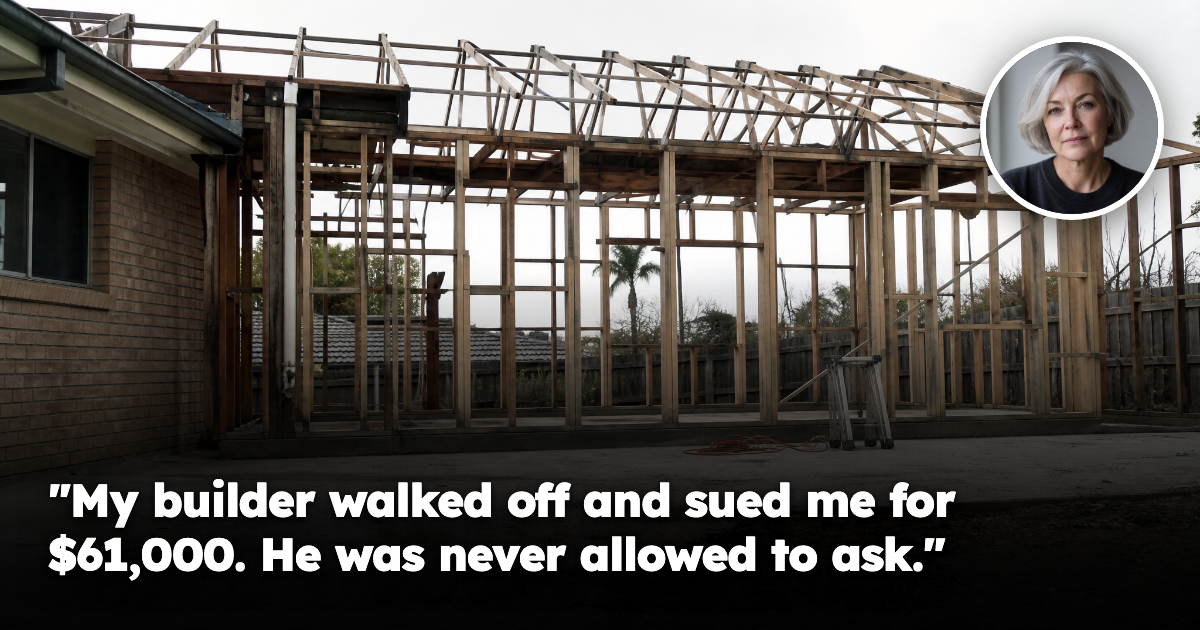
She is 67, a piano tuner, and she had done everything in the right order.
The house was a downsize — one level instead of two, ten minutes from the grandchildren instead of an hour. The plan was modest: open up the rear wall, extend the living space, put in a bathroom she could still use at eighty. She got three quotes and picked the middle one.
Work started in March. By July the slab was down, the frame was up, and the relationship had curdled. She had made two payments early, at his request, because materials had to be ordered ahead. In August he stopped answering the phone. In September a letter arrived from a solicitor she had never heard of, claiming $61,000 for work performed and losses suffered, and threatening to secure it against the house.
She had paid $104,000 by then. The extension had no roof.
She took the file to a lawyer expecting a fight about how much work was actually finished. That is not the conversation they had.
The question she asked
"He walked off my job, and he is the one demanding another sixty-one thousand dollars. But I signed that contract too, and I did stop paying near the end. So how can a contract I signed, and admit I stopped honouring, be something only I have to obey?"
It is the right question, and the answer is stranger than the one she was braced for.
The answer: some building contracts only work in one direction
Most people assume a contract is symmetrical. Two signatures, two sets of obligations, two sets of remedies. If one side fails, the other sues. That instinct is correct almost everywhere in commercial life — and deliberately wrong in residential building.
The governing legislation contains a sentence that does something unusual. Where a person contracts to do residential building work while not properly licensed to contract for it, or under a contract that fails the basic written-form requirements, that person is not entitled to damages, and is not entitled to enforce any other remedy, for a breach committed by the other party. The contract is unenforceable by the person who contracted to do the work.
Then, in the same sentence, it turns around: that person remains liable for damages and subject to every other remedy for a breach committed by them.
The document is not void, not cancelled, not unwound. Every clause survives — and it survives pointing one way. The owner can enforce it. The builder cannot. A separate provision makes the asymmetry explicit, preserving every other right a person may have "other than the person who contracts to do the work."
The insurance rule does the same thing, and goes harder. Where the required contract of insurance is not in force in the name of the person who contracted to do the work, that contractor is not entitled to damages, cannot enforce any other remedy for the owner's breach, and — this is the part that ended her matter — is not entitled to recover money for that work under any other right of action, including a claim in restitution for the value of work actually done.
When a contract fails, the standard fallback is a claim for the fair value of what was actually built. It is the oldest workaround there is. The legislation names that workaround and shuts it by name — someone anticipated the argument and legislated against it in advance.
Her builder's licence had lapsed, an administrative renewal missed while the business was busy. The insurance certificate for her job had never issued as a consequence. The lawyer read the sentence twice and told her the $61,000 claim was not a weak claim. It was a claim the law did not permit him to make.
The parts that keep it honest
This is not a licence to stop paying builders, and the article would be dishonest if it pretended otherwise.
The bar is not absolute. Where a court or tribunal considers it just and equitable, a contractor without the required insurance can still recover on a value-of-work basis despite the prohibition. The legislation even lists a factor for deciding that question — the impact on the resale price of the property. The tie-breaker in a payment dispute is an asset-value question about the house. That is a discretion, not a formality, and nobody should plan around it going their way.
The defect is also curable. Work that is uninsured stops being uninsured if the required insurance is subsequently obtained, and the builder's rights come back with it. It is a very different problem from the warranty a buyer inherits with a clock already running against it, where the rights are perfectly intact and simply run out of time.
Rules run the other way too. A deposit is capped at ten per cent of the contract price, and demanding more is an offence, not a negotiation. Progress payments on larger jobs are authorised only in defined forms: an amount payable on completion of a specified stage described in clear and plain language, or payment for labour and materials already supplied, supported by invoices. A payment claimed ahead of the work is not a favour to a builder's cash flow. It is an unauthorised payment.
Her two early payments for materials were exactly that, and she was never going to get them back easily. Being right about the law is not the same as being whole.
When these disputes reach a tribunal, the system's first instinct is not to move money — it is to fix the house. A tribunal determining a defect claim is directed to have regard to the principle that rectification by the responsible party is the preferred outcome. That is a sharper consequence than the building system usually delivers; elsewhere it tolerates a certifier conflict of interest that is not an offence at all.
What it means for you
She could have known all of this in about four minutes. Licence status is a public register, as is the insurance certificate that should have issued for her job before a cent changed hands. She never checked, because the quote was on letterhead, the ute had signage, and the referral came from a neighbour.
This is why our research engine works below the suburb. Two houses in one suburb share a median, a growth rate, a school catchment and a council. They do not share the trades who service them, the vintage of the building stock, the renovation intensity of the street, or the local planning provisions that quietly displace the statewide building rules on one block and not the next. Those are parcel- and street-level facts, and they show up in the numbers that matter: achieved rent, real vacancy duration, true days on market. We routinely see a 20–30% spread in effective yield between the best and worst street in a single suburb. A median has never once checked a licence number.
The pro-investment read here is not "renovation is dangerous." It is the opposite. Every rule she tripped over was published, free, and readable months before it mattered — the licence register, the form requirements, the payment caps and the one-way rule, all in plain sentences anyone can find.
Risk you can read in advance is not risk. It is a line item — and pricing a line item nobody else has bothered to read is precisely how disciplined investors keep buying good assets from people who never checked.
She settled the claim at zero. The extension was finished by someone else, for $38,000 more than it should have cost, and it is a genuinely lovely room.
She still keeps the licence-check page bookmarked on her phone. It took her four minutes and $61,000 to learn where it was.
If there's a specific street you're weighing up right now, check its Street Score first — it's free, takes ten seconds, and tells you whether that street is pulling the suburb average up or riding on it.
Frequently asked questions
Why couldn’t the builder legally sue for $61,000 after walking off the job?
The article says some residential building contracts in Australia only work one way if the builder is unlicensed or the required insurance is not in force. In that situation, the builder cannot enforce the contract or recover money under other claims, including restitution for work done.
Does that mean a homeowner can simply stop paying a builder whenever there’s a dispute?
No. The article says the rule is not a licence to stop paying, and a court or tribunal can still consider whether it is just and equitable for the contractor to recover something in some cases. The homeowner can still face issues if they breach the contract.
What should I check before paying a builder for residential work in Australia?
The article says to check the builder’s licence status on the public register and confirm the insurance certificate that should be in place for the job. These are published, free checks that can be done before any money is paid.
Are builders allowed to ask for big payments before work is finished?
Not in the way described here. The article says deposits are capped at 10% of the contract price, and progress payments are only allowed in defined forms, such as payment for a completed stage or for labour and materials already supplied and invoiced.
If a builder’s insurance is missing, can they later fix it and regain their rights?
Yes. The article says the defect is curable: if the required insurance is later obtained, the builder’s rights come back. Until then, though, they cannot enforce the contract or recover money for the work under the usual fallback claims.
General information only. It does not take your objectives, financial situation or needs into account, and nothing here is legal, financial, taxation or investment advice specific to your circumstances.