
News · 23 August 2026 · 5 min read
“I sold my investment property for $612,000. My bank kept the security over it — and I’d never signed anything agreeing to that”
She sold an investment unit for $612,000 with nothing owing on it, and her lender still held the security over it. The clause allowing that was lawful — but an extension like it is unenforceable unless the lender did two specific things first.
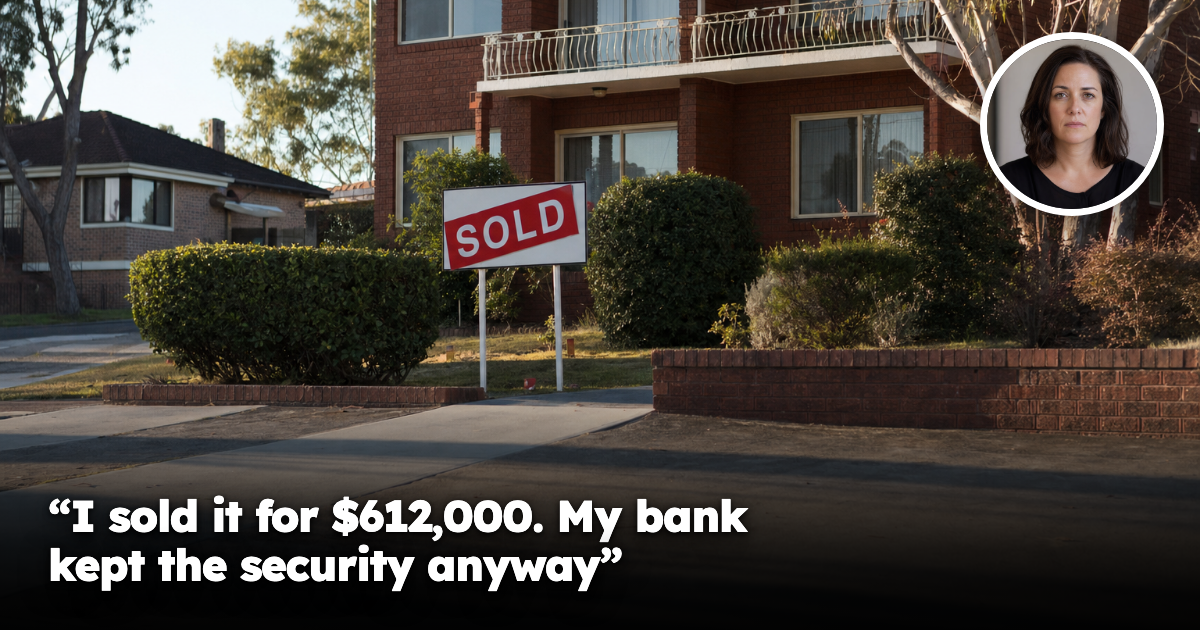
She is 44, and she has owned exactly two properties in her life.
The first she bought in 2017 — a modest unit she never lived in, bought to rent out, paid down for nine years. The second she bought four years later with the same lender, because the first loan had gone smoothly and it seemed simpler to keep everything in one place.
This year she sold it. Not out of distress: she had never missed a payment on either loan, and the sale came in at $612,000 against the $487,000 still owing.
Then her lender said releasing the unit meant dealing with the second loan too. The mortgage over the unit, she was told, secured both facilities. Settlement stalled eleven weeks, and she was quoted $1,340 in costs to sort out something she was fairly sure she had never agreed to.
Her question, exactly as she put it to us:
"I only ever borrowed against that unit once. How can a mortgage I signed in 2017 be holding up the sale because of a loan I took out four years later?"
The clause is real. That is not the interesting part.
Clauses extending a mortgage to cover future borrowing from the same lender are entirely ordinary — lawful, common, and there for a sensible reason: a lender that already holds security would rather not repeat the exercise every time you come back.
So the answer to "can a mortgage cover a later loan?" is yes. The answer to "does it, automatically?" is very different — and it is the part almost nobody reads.
The permission is not the same as the extension
Where a mortgage of this kind covers credit under a later contract, the relevant consumer credit rules make that extension unenforceable against the later contract unless the lender has done two things.
First, given the borrower a copy of the contract document for the loan the mortgage is to be extended to cover.
Second — and the word in the rule is subsequently — obtained from the borrower a written acceptance of the extension of the mortgage.
Both. In that order.
So it is not enough that she signed the second loan, nor that it was drawn down and repaid on time for years. Signing a loan is agreeing to owe money. Accepting an extension of a mortgage is agreeing which asset stands behind it — two separate acts of consent, because they are two separate things.
The rules lean the same way elsewhere: a provision charging all of a borrower's property is void, and a mortgage is void to the extent that it secures more than the borrower's liabilities plus reasonable enforcement costs. Security is meant to be specific, identified and no larger than the debt. The all-accounts extension is the one permitted exception — and only on conditions.
What she was actually entitled to ask
She did not need to argue the clause was unfair. She needed to ask a narrower, colder question: show me the written acceptance.
That is not an aggressive question. It is the one the framework is built around. If the lender produces a copy of the second loan documents and a written acceptance signed by her, the extension stands. If not, it does not reach the second loan, whatever the clause says on its face.
Three other levers were available, and she had been told about none of them.
A borrower generally cannot dispose of mortgaged property without consent — but the lender must not unreasonably withhold it, or attach unreasonable conditions. Requiring substitute security of equivalent kind and value is expressly not unreasonable. A lender may protect its position; it may not charge for saying yes.
A court can authorise the disposal where consent is unreasonably withheld — or where the lender fails to reply within a reasonable time. Eleven weeks of silence is not neutral. Delay is itself a ground.
And costs are capped at what was reasonably incurred; any term claiming a greater right is void, and excess already collected can be recovered back. Her $1,340 was not automatically wrong — but it was a number she could demand itemised, not simply pay.
One point matters to investors, because it is widely misunderstood: this framework is not limited to owner-occupiers. It expressly reaches credit provided wholly or predominantly to purchase, renovate or improve residential property for investment purposes. Her unit was an investment from day one — which put her squarely inside the rules, not outside them.
What this has to do with buying well
Her security structure quietly changed what her first property was. She thought she owned an asset she could sell whenever she chose. She actually owned one whose sale was contingent on a loan taken out years later — same building, same street, same tenant, different asset, because of a document.
That is the same discipline we apply to physical location, and the core of how we research. Two houses in one suburb share a median, a growth rate, a catchment and a council. They do not share a street, an achieved rent, a real vacancy duration or a true days-on-market. We routinely see a 20–30% spread in effective yield between the best and worst streets inside a single suburb — a gap no suburb-level report will ever show you, because the median has already averaged it away.
A suburb median has never once told anybody what their mortgage secures. Nor which side of the street lets faster, or which pocket clears in nineteen days while the one behind takes seventy. All knowable in advance, all ignored. That is why they remain edges.
The timing of when a lender can call a debt in is a different question from which asset that debt reaches — as is what happens at payout when a mortgage is transferred rather than discharged, and what a lender may do once a default has occurred. Hers involved no default at all.
The part worth keeping
Nobody behaved badly here. The clause was lawful and disclosed, and the lender invented nothing. There may well be a written acceptance in a file somewhere — plenty of lenders obtain one properly, and if hers did, the extension holds.
But she did not lose eleven weeks to a loophole. She lost them because she assumed a clause did its work automatically, and never asked what had to happen for it to bite. Every rule described here was published, free and readable on the day she signed each loan.
Risk you can read in advance is not risk. It is a line item, a negotiating position, and an edge over every buyer bidding against you who never looked. The investors who compound quietly over decades rarely found a secret. They read the second half of the sentence.
She settled. She is buying again — and this time, before signing, she is asking her lender one question in writing: which of my properties does this document reach, and what did I sign to make that true?
If there's a specific street you're weighing up right now, check its Street Score first — it's free, takes ten seconds, and tells you whether that street is pulling the suburb average up or riding on it.
Frequently asked questions
Can a lender in Australia keep a mortgage over a property after it’s sold if there’s still another loan with the same bank?
Yes, a mortgage can extend to later borrowing with the same lender if the proper conditions are met. But that extension is not automatic just because you signed a later loan.
What has to happen before a mortgage can be extended to cover a later loan?
The lender must first give the borrower a copy of the contract for the later loan, and then obtain the borrower’s written acceptance of the mortgage extension. If those steps were not done in that order, the extension may not be enforceable against the later contract.
Is signing the second loan the same as agreeing that the first property can secure it?
No. Signing the loan means agreeing to repay the debt, but accepting the mortgage extension means agreeing which property secures that debt. The article treats those as two separate acts of consent.
What can a borrower do if a lender is holding up a property sale in this situation?
The borrower can ask the lender to show the written acceptance for the mortgage extension. If the lender has not replied within a reasonable time, or is unreasonably withholding consent to the sale, the borrower may have grounds to seek court authorisation.
Does this rule only apply to owner-occupied homes, or can it apply to investment properties too?
It also applies to credit used wholly or predominantly to buy, renovate or improve residential property for investment purposes. The article says the unit in question was an investment property, so it fell within these rules.
General information only. It does not take your objectives, financial situation or needs into account, and nothing here is legal, financial, taxation or investment advice specific to your circumstances.