News · 23 August 2026 · 5 min read
'I bought the house. Fourteen months later the government sent me a $41,200 tax bill for years I didn't own it'
He paid the full price and settled through a solicitor. Fourteen months later a $41,200 assessment arrived for years before he owned the property — and the legislation gives the revenue authority two separate ways to make it his.
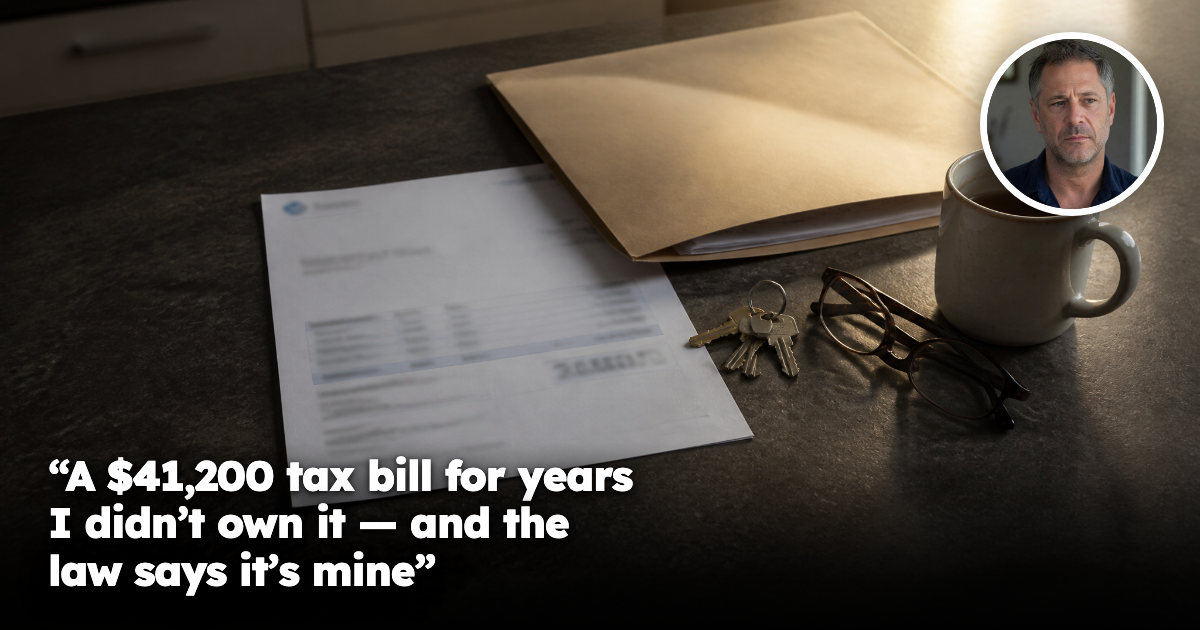
He is 54. He bought his second property in 2019 — a modest place he intended to hold for a decade and eventually hand to his kids. He has never missed a payment in his life.
Fourteen months ago the letter arrived. A tax assessment for $41,200, covering financial years that ended before he had ever set foot on the property.
It was not a mistake. The tax had been imposed while the previous owner held the land. That owner never paid it, then sold up and became unreachable. So the bill came to him. His question was the one anybody would ask:
"I didn't own it. I didn't cause it. I paid the full price and settled properly through a solicitor. How can a debt someone else ran up become mine — and how did it get past settlement without anyone noticing?"
The answer is worse than most owners expect — and it is not hidden. It is written in plain numbered subsections, published free, and it has been there the whole time.
The two hooks
Most people assume a tax debt is personal, following whoever incurred it. Land tax is not built that way. It attaches to the land, and the legislation gives the revenue authority two separate ways to collect it.
The first hook is a personal debt. The Act says that despite a disposition of the land, the commissioner may recover unpaid land tax from the owner of the land for the time being, as a debt. "For the time being" means whoever owns it now — not whoever owned it when the tax was imposed. Selling does not end the exposure. It transfers it.
The second hook is on the title itself. Unpaid land tax is a first charge on the land, with express priority over all other encumbrances — whether they are registered or unregistered, and whether they were created before or after the charge arose.
Which means a mortgage registered years earlier, by a major lender, over that exact title, ranks behind a charge that did not exist on the day the mortgage was written.
Then comes the line that stops people cold. The Act states that this priority applies despite the provisions of the land titles legislation that guarantee registered interests. The indefeasibility of title — the mechanism every buyer is told protects them, the reason we search the register at all — is named in the statute and expressly switched off for this class of debt.
And to close the last gap: the charge is not affected by a disposition of the land. Settlement does not clear it. It crosses to the new owner with the keys.
So how does anyone ever buy safely?
Both hooks have exactly one escape, and it is the same escape.
The personal debt does not apply if the tax was imposed before you purchased and you obtained a clearance certificate stating that, at the time of purchase, there was no unpaid land tax on the land. Both limbs — not one. The charge on title, likewise, has no effect against a purchaser for value and in good faith holding that same certificate.
One document defeats both hooks. Without it, you are exposed to both.
Now read the section that creates it. The owner, purchaser or mortgagee of land may apply. May. It is permissive, and it carries a fee. Nothing obliges a buyer, a lender, or anyone acting for them to obtain it.
That is the whole injustice in one word. The statute builds a complete defence, then makes the step that unlocks it optional — and prices the failure at the entire outstanding debt of a stranger.
He did what almost everyone does: he trusted the process to surface anything that mattered. Nobody ordered the certificate. Nobody was required to.
It can also arrive through your lender
There is a third mechanism most owners have never heard of. The authority can require the mortgagee — your bank — to pay the unpaid land tax for you.
The bank pays, then recovers it from you as a debt — and the amount is taken to be secured by the mortgage in addition to any other amount it secures. Your balance grows, your equity shrinks, and no new document is signed.
And if the debt simply sits, the charge can be registered against the title, with a power of sale available in relation to land subject to it.
What this actually says about buying property
We should be fair about why this exists. If the liability could be extinguished by selling, it would be extinguished constantly. The charge exists so a debt attached to land cannot be walked away from; the certificate exists so a careful buyer is fully protected. Both are sound. The revenue authority did nothing improper, and neither did his lender. The failure was that the one cheap, decisive step was optional, and nobody took it.
This is exactly the kind of risk that never appears in a suburb report — and it is why the suburb is the wrong unit of analysis.
Two houses four hundred metres apart return an identical summary. Same median, same growth rate, same catchment, same council, same vacancy rate. Every number is the same number. Yet one sits on a street where stock is tightly held and tenants stay; the other turns over every year. Across achieved rents rather than asking rents, real vacancy duration and true street-level days-on-market, the spread between the best and worst street inside a single suburb routinely runs 20–30% in effective yield.
A suburb median has never ordered a search.
Property is not a lottery you enter with a postcode. It is an asset you can examine — street by street, title by title, clause by clause — before you commit a dollar.
What he'd tell you
He paid $8,900 in fees over eleven weeks establishing what was owed and negotiating how it would be handled. He is still holding the property, and still believes in it.
The provisions that caught him are published, in force, and written in ordinary language anyone can read. That is the encouraging part. Risk you can read is risk you can price — and a risk you have priced is not a threat, it is an advantage over every buyer who never asked the question.
The right asset, on the right street, bought with the right searches, still outperforms almost anything else you can own. None of this is an argument against investing in property. It is an argument against buying one blind.
He is not angry about the assessment. He is unsettled by how close the fix was — one optional form, one fee, one question nobody asked.
Related reading: what happens when a council sells land out from under an owner over unpaid rates, who ranks where when a lender sells a property to clear a debt, and the council power to acquire land for overdue rates without paying a purchase price.
If there's a specific street you're weighing up right now, check its Street Score first — it's free, takes ten seconds, and tells you whether that street is pulling the suburb average up or riding on it.
Frequently asked questions
How can a land tax debt become the new owner’s problem in Australia if they didn’t own the property when it was incurred?
Under the legislation described, unpaid land tax attaches to the land, not just the person who incurred it. The revenue authority can recover it from the current owner as a debt, even if the tax arose before settlement.
What is the main risk for a buyer who settles a property without checking for unpaid land tax?
The buyer can inherit both a personal liability and a first charge on the title for the unpaid tax. Settlement does not automatically clear the debt, so the new owner may be exposed even though they did nothing wrong.
What document can protect a buyer from an old land tax debt on the property?
A clearance certificate can defeat both forms of exposure if it states that, at the time of purchase, there was no unpaid land tax on the land. The article says this is the one document that can protect a purchaser for value and in good faith.
Can a bank be forced to pay unpaid land tax on a mortgaged property?
Yes. The revenue authority can require the mortgagee to pay the unpaid land tax, and the bank can then recover that amount from the borrower as a debt. The article says the amount is taken to be secured by the mortgage as well.
Does land titles registration or indefeasibility protect a buyer from this kind of land tax charge?
Not according to the article. The legislation expressly gives unpaid land tax priority over registered and unregistered interests and switches off the usual protection of indefeasibility for this debt.
General information only. It does not take your objectives, financial situation or needs into account, and nothing here is legal, financial, taxation or investment advice specific to your circumstances.