News · 17 August 2026 · 5 min read
The builder walked off site and kept trading. That is when I found out the insurance only works if he disappears
A teacher whose builder walked off a half-finished rebuild had a certificate of insurance in his file and could not get a straight answer about whether he could use it. The reason is written into the statute: the trigger is not the defect, it is the builder ceasing to exist.
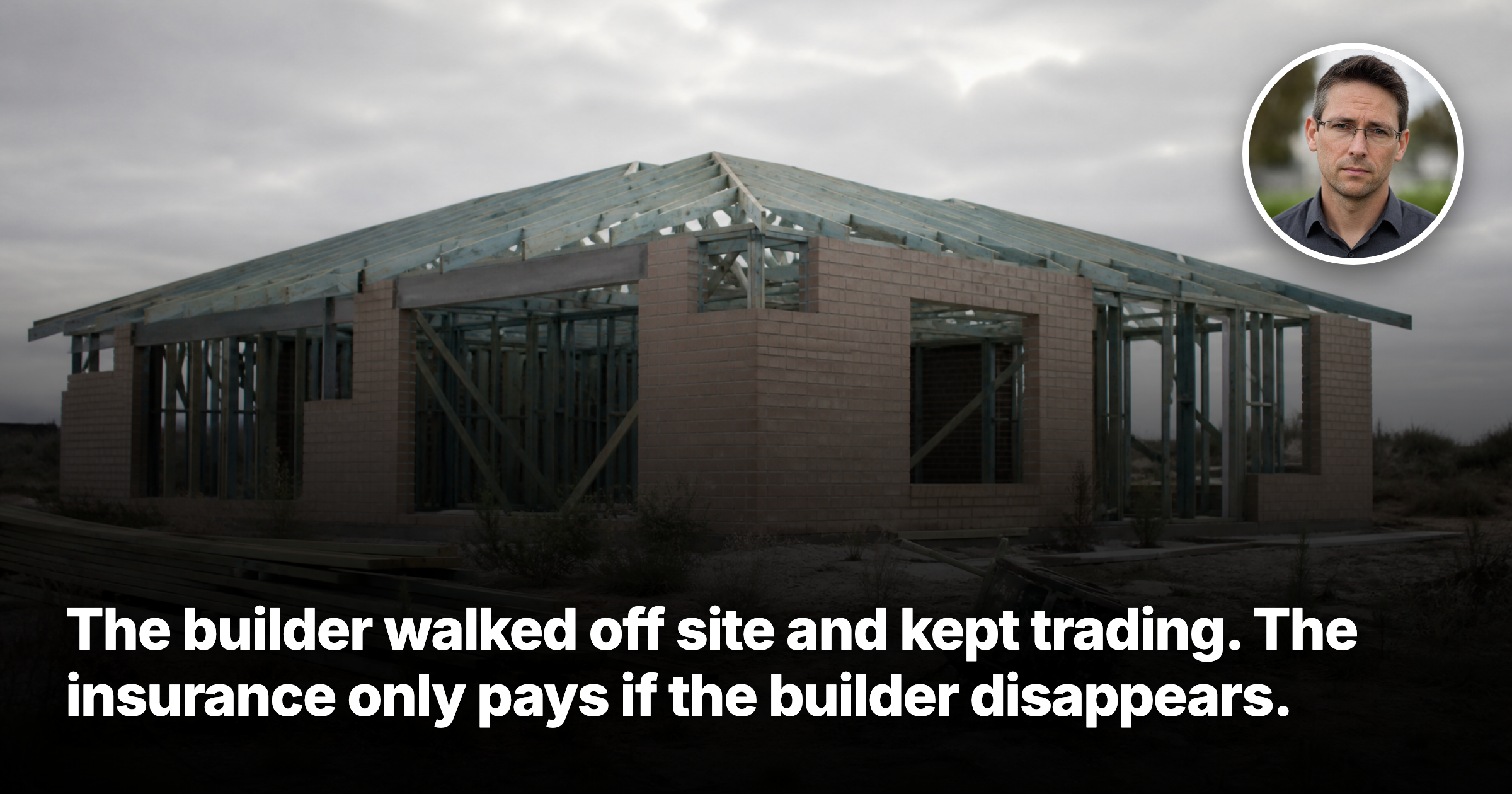
He is 41, teaches high school, and by his own description is the kind of person who keeps everything — every variation, every email, every certificate, filed by date.
He was rebuilding on a block he owned. The builder took the stage payment at roughly lock-up, then simply stopped. Not insolvent. Not dead. Not overseas. Still trading, still winning work — just not returning his calls.
Somewhere in the folder was a certificate of insurance, obtained before a cent changed hands, exactly as required.
His question, asked with more embarrassment than anger:
'I have the certificate. Why can nobody tell me if I can use it?'
It is one of the most misunderstood documents in Australian residential construction, and the answer sits in a single subsection.
What the certificate is actually insuring
Most people read "home warranty insurance" and hear defect insurance: something goes wrong with the build, the insurer fixes it. That is not what the legislation requires it to be.
The statute says the policy must insure the person on whose behalf the work is done against loss resulting from non-completion of the work because of the insolvency, death or disappearance of the contractor — and against being unable, because of the insolvency, death or disappearance of the contractor, either to have the builder rectify a breach of a statutory warranty, or to recover compensation from them for it.
Read the trigger carefully. The insured event is not the defect. It is not the abandonment. The insured event is the builder ceasing to exist as someone you could pursue.
A builder who is alive, solvent, locatable and refusing to come back is, for the purposes of that policy, not an insured event at all. He is a person you sue.
This is why the scheme is called cover of last resort. That phrase is not marketing but a structural description: the cover sits behind your legal rights against the builder, and becomes available only when those rights become worthless because there is nobody left at the other end of them.
The definitions are narrower than the words suggest
The Act does not leave those three words loose.
Insolvent means formal status — insolvency under administration for an individual, or external administration for a company. Not "struggling". Not "slow to pay subcontractors".
Disappearance means disappearance from Australia, and includes where, after due search and inquiry, the contractor cannot be found in Australia. A builder ignoring you from three suburbs away has not disappeared. He has stopped answering.
There is one narrow bridge. Where a builder's licence is suspended under the disciplinary provisions while an order against them remains unsatisfied, that suspension is deemed to constitute insolvency for the policy. But note what that requires first: an order, already obtained, already unsatisfied. You litigate first. The policy waits.
The trap in the timing
Here is the part that catches careful people.
Cover is claims-made: the claim must generally be made during the period of insurance. Where the loss became apparent in that period but the insured event has not yet happened — the builder still exists — a delayed claim is possible afterwards, but only if the loss was properly notified in time and the claimant diligently pursued the enforcement of the statutory warranty.
So the obligation runs in this shape: you must actively chase a builder you cannot yet claim against, in order to preserve a claim that only becomes available if that builder later stops existing. Sit still and wait for the insurer, and you can lose both.
The clocks are equally unforgiving, and they run from completion, not from discovery. Cover for non-completion runs at least twelve months from when work ceased. Other cover runs at least six years for loss from a major defect and two years for anything else. And over all of it sits an absolute long-stop: despite any other provision of the Act, no cover in any circumstances unless a claim is made within ten years of completion.
Why this is an investor problem, not just a builder problem
Two things make this a purchasing fact rather than a building fact.
First, the benefit runs to successors in title. Buy a newish house and you may inherit the policy taken out for the original owner. It also extends by force of statute to a non-contracting owner of the land — the Act says the benefit "is taken to extend (and to have always extended)", irrespective of whether the policy document says so.
Second, and less comfortably: it can arrive already spent. Where a claim for a breach has already been made and paid to you or to a predecessor in title, there is no cover for that same breach again. The remaining protection on two identical houses can differ entirely because of something the previous owner did.
This is exactly the kind of fact our research process is built to surface. Suburb-level data — median price, days on market, vacancy, rental history — measures the asset. None of it measures whether the counterparty behind the asset still exists, when the clocks started, or whether anyone has already drawn on the cover. Those are per-title, per-contract facts sitting underneath two houses that look identical on the same street.
We routinely find effective yield spreads of twenty to thirty per cent between the best and worst streets in a single suburb, and the same principle operates one level deeper. Part of that spread has never been construction quality. Part of it is remaining recourse — and nothing in a suburb report separates a house with eight years of protection left from one with none.
If you are weighing new stock, it pairs closely with understanding how apartment defect protection attaches to the building rather than the builder, what happens when a home is built under a permit that removes construction insurance entirely, and why the date in an off-the-plan contract is a door rather than a deadline.
The part worth keeping
None of this is an argument against building or buying new. It is an argument against buying recourse you assumed you had.
The scheme's narrowness is not hidden. It is published, dated and checkable: one trigger, defined periods running from a knowable date, one long-stop, one prior-claim bar. A risk with that shape is a risk you can price — more than can be said for most things buyers worry about.
Almost nobody checks it. So the market prices the anxiety instead of the fact, and the buyer who does the twenty minutes of work is the one buying the better asset at the ordinary price.
His certificate was real, valid and correctly issued. It had simply never been what he thought it was. It was never a promise that his house would be finished — only a promise about what would happen if the man meant to finish it stopped existing.
If there's a specific street you're weighing up right now, check its Street Score first — it's free, takes ten seconds, and tells you whether that street is pulling the suburb average up or riding on it.
Frequently asked questions
What does Australian home warranty insurance actually cover if a builder walks off a job?
It covers loss from non-completion or from a builder’s breach of statutory warranty only when the contractor is insolvent, dead or has disappeared. If the builder is still trading and can be pursued, the policy generally is not triggered.
Why wasn’t the owner able to claim just because the builder stopped answering calls?
Because silence or abandonment alone is not the insured event. Under the statute, the builder must cease to exist as someone you can pursue, such as through insolvency, death or disappearance from Australia.
Does a builder need to be declared insolvent before the insurance can be used?
Yes, formal insolvency is one of the trigger events, not just financial difficulty. For an individual it means insolvency under administration, and for a company it means external administration.
Can a claim still be made later if the builder is still around when the problem first appears?
Sometimes, but only if the loss was notified in time and the owner diligently pursued enforcement of the statutory warranty. The policy is claims-made, so waiting can cause problems if the insured event has not yet happened.
If I buy a property, can I inherit the previous owner’s home warranty insurance rights?
Yes, the benefit can extend to successors in title and even to a non-contracting owner of the land under the Act. But if a claim for the same breach has already been paid to a predecessor in title, there is no cover again for that breach.
General information only. It does not take your objectives, financial situation or needs into account, and nothing here is legal, financial, taxation or investment advice specific to your circumstances.