News · 19 August 2026 · 5 min read
‘The council took my aunt’s house over $18,600. It was worth $47,000. She was paid nothing’
Her aunt owed about $18,600 in rates. The land was worth around $47,000. The council became the registered owner and she received nothing — because nothing was ever sold. The instrument almost nobody knows about, and what it means for every parcel you buy.
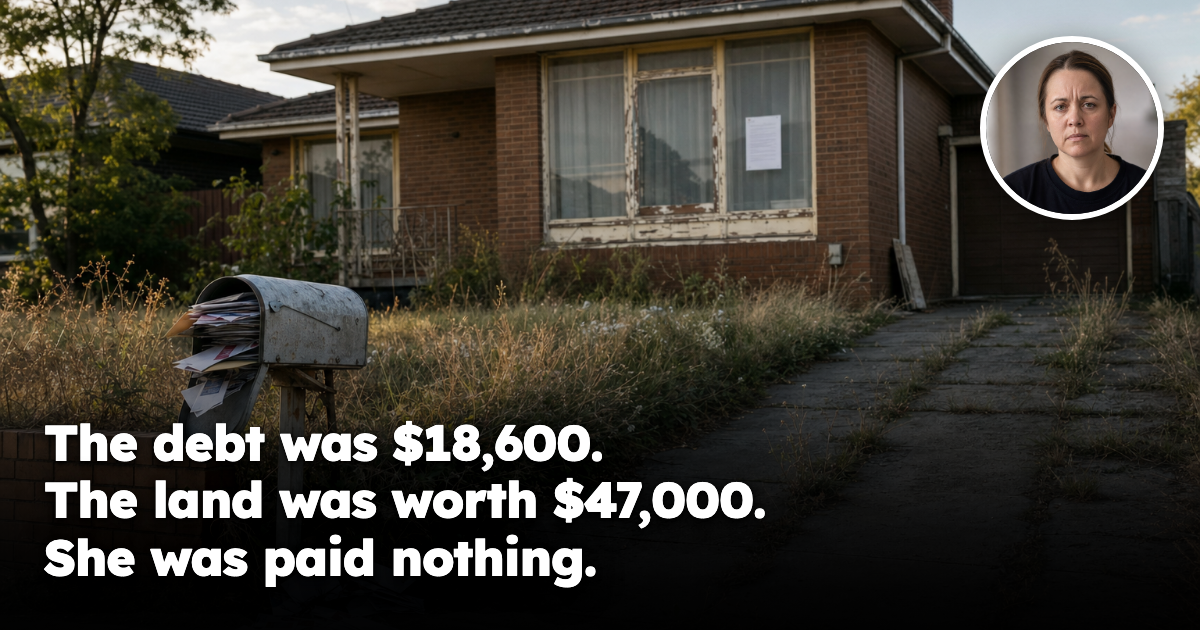
A woman asked us a question last month we could not answer the way she expected. Her aunt's house was gone. The council was the registered owner. The debt had been about $18,600. A local agent had told her the land alone was worth near $47,000.
She wanted to know where the difference went.
The truth was worse than she expected: the difference never went anywhere. It was never created. Nothing had been sold.
The situation
Her aunt bought the house in 1996 — small, fibro and tile, on an oversized fringe block, cheap because it was awkward. She paid it off in 2013. In 2020, dementia moved her into care.
The niece, 41, an aged-care support worker one state away, became the family's informal contact. She was never on the title, never anyone's formal decision-maker. She redirected the mail once, and then nobody opened what arrived. Rates stopped being paid in 2020.
Nineteen months after the first notice, she was told the council was on the title. She had been waiting to hear when the auction was, so the family could bid.
The question
"If the house was worth more than what was owed, where did the difference go?"
It is a bookkeeping question. It assumes a transaction. That assumption is the mistake, because two different instruments sit side by side and almost everybody has only heard of one.
The answer
The one people know is the sale. Rates go unpaid for years, the land goes to auction, a minimum price applies, and the proceeds are distributed in a strict order — costs, taxes, the debt, other charges, registered interests, and then, last, the former owner. Harsh, but a defensible shape. Crucially it produces money, and where there is money there is arithmetic — and the possibility of something coming back.
The second instrument does not. Where some of the rates have been overdue for at least three years, the debt is not before a court, and the amount owing is more than the value of the land, a council may resolve not to sell the land but to acquire it. It gives notice. If the amount is not paid in full within six months, it may begin. The procedure is two steps: discharge the overdue rates, and ask the titles registrar to record the council as the registered owner.
Read that again, because of what is missing.
No auction. No minimum price. No purchase price at all. No proceeds, so no order of distribution. No last place in the queue, because there is no queue. No surplus to claim later, because a surplus only exists once something has sold for more than it owed.
On the sale path the owner is last. On this path the owner is nowhere — not skipped, but because the step they would have occupied does not exist. The owner receives the extinguishment of the debt. That is the whole of it.
And the registrar must make the entry free of encumbrances, may do it without the certificate of title, need not inquire whether the council followed the rules, and is not affected by knowing it didn't. A flawed process does not give the house back — the same protective wall that appears in mortgagee sales under a private loan contract, except there a sale price at least exists to argue about.
Nor is this land taken for a public purpose, where compensation and a right to object both exist. This is land taken for a debt, with no compensation step at all.
The part that deserves attention
Look at what switches this instrument on. Not neglect. Not conduct. Not a dollar threshold. A comparison — debt against value.
The trigger is the asset's own weakness. A parcel that holds its value stays on the sale path, where a price and a distribution exist. One that has drifted below what it owes moves onto the path where neither does. The blocks taken outright rather than sold are the ones the market had already stopped rewarding: the odd shapes, the constrained lots, the fringe land. Her aunt's block was cheap in 1996 for exactly the reasons that put it on the second path in 2022.
Note what the notice must contain: the debt, the interest, how it is calculated, the total, and an outline of the procedure. It need not state the value of the land, attach a valuation, or say what the owner will get — it quantifies one side of the comparison and is silent on the other. Nor is the number that stops it the number on the notice: payment must cover the debt and every expense the council incurs in attempting to acquire, so the figure rises for as long as the attempt runs.
None of this is misconduct. The instrument exists for a real problem: parcels whose debt exceeds their worth cannot practically be sold, and without this power they accrue interest forever against an owner who will never pay. The council did nothing unlawful, rates fund real services, and hardship provisions and payment arrangements genuinely work. This is a system doing what it says it will do, to someone watching the wrong door.
What it means for you
This is not a story about unpaid rates. It is a story about a fact that lives at the level of a parcel, in a market priced at the level of a suburb.
Two houses in one suburb share the median, the growth rate, the school catchment and the postcode. They do not share their rate notice history, their ownership structure, or where the mail goes. And debt exceeding value is exactly the fact a median cannot express, because a median exists to average away the parcels that reach it first.
A suburb median has never once been the number a debt gets compared against.
That is why our research runs at street and parcel level. In a single suburb we routinely measure a 20–30% spread in effective yield between the best and worst street — built from achieved rents rather than asking rents, real vacancy duration, and true days-on-market. Two properties can share every published suburb metric and be entirely different assets, and the market prices them as though they are the same.
Here is the encouraging part. Every element of this was written down in advance: the three years, the comparison, the six-month fuse, what the notice must say, what the registrar must do. And the council's own land record carries, for every rateable parcel, its value, its rating category and any overdue rates — open to inspection, free to an occupier next door.
None of this was hidden. It was unread.
That is the lesson, and a good one for anyone buying property. Risk that is written down is risk you can price, and priced risk is not a threat — it is an edge over every buyer who never asked. The people who do badly in property are almost never the ones who found a problem. They are the ones who assumed the important facts would find them.
She had been waiting to hear when the auction was. There was never going to be an auction.
If there's a specific street you're weighing up right now, check its Street Score first — it's free, takes ten seconds, and tells you whether that street is pulling the suburb average up or riding on it.
Frequently asked questions
Why did the aunt’s house end up with the council instead of being sold at auction?
Because the council used an acquisition process, not a sale process. Where overdue rates have been unpaid for at least three years, the debt is not before a court, and the debt exceeds the land’s value, the council may resolve to acquire the land instead of selling it.
If the land was worth more than the rates debt, why didn’t the family receive the difference?
No money was ever created because nothing was sold. Under the acquisition path there is no auction, no purchase price and no surplus to distribute, so the former owner does not receive the difference.
What notice and timeframes apply before a council can acquire land for unpaid rates?
The council must give notice, and if the amount is not paid in full within six months it may begin the process. The notice must state the debt, interest, how it is calculated, the total and an outline of the procedure.
Does the council have to tell the owner what the land is worth before taking it over for rates?
The article says no. The notice does not need to state the land value, attach a valuation or explain what the owner will get, because the trigger is the comparison between the debt and the land’s value.
What should property buyers in Australia take from this story?
The key lesson is that risk can sit at the parcel level, not just the suburb level. The article says council land records show the value, rating category and overdue rates for each rateable parcel, so those details matter when assessing risk.
General information only. It does not take your objectives, financial situation or needs into account, and nothing here is legal, financial, taxation or investment advice specific to your circumstances.