News · 19 August 2026 · 6 min read
'The council sold my father's house for $310,000. He got back $4,100. Both numbers are legal'
A $21,000 rates debt. A house that sold for $310,000. A cheque back to the owner for $4,100. Every step of it lawful — and the whole outcome turns on one small conjunction buried in the rule that sets the reserve price.
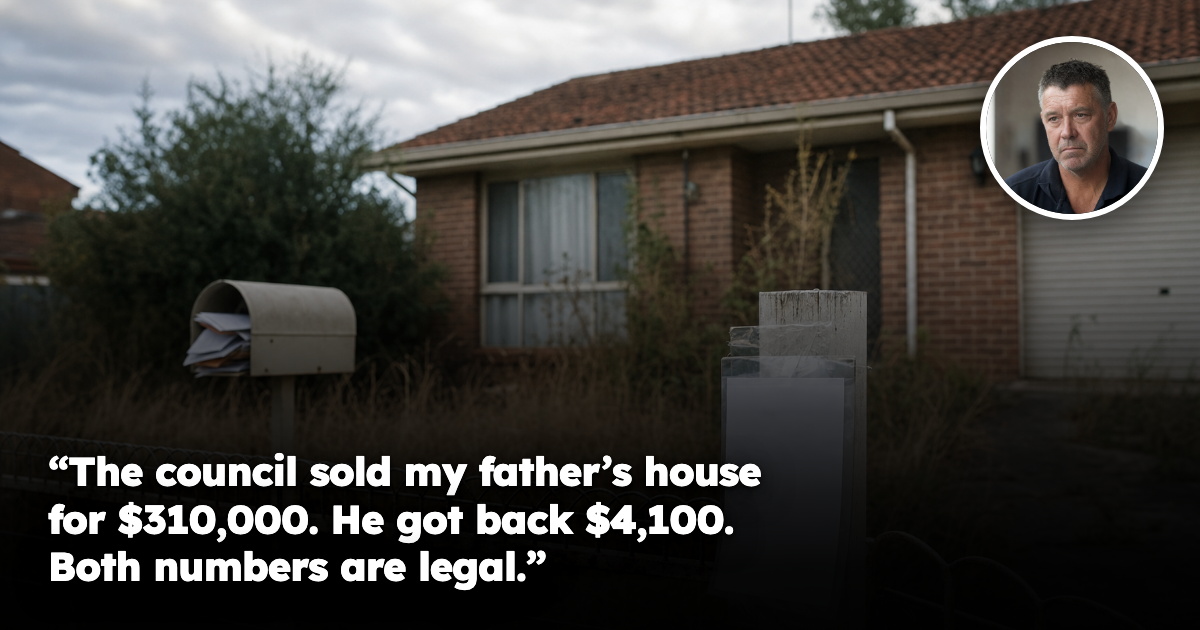
He is 52, a diesel fitter, and he found out the way most people do: a neighbour rang him.
His father had owned the house since 1994. Paid it off in 2011. Then came a stroke, a nursing home, and mail piling up in a hallway nobody walked down. The rates stopped being paid in 2021. Nobody noticed, because the man who used to open the letters could no longer read them.
By the time the son was appointed to manage his father's affairs, the house had already been sold at a council auction. The debt was roughly $21,000. The property made $310,000. The cheque that came back to his father's account was $4,100.
His question was not the one we expected. He did not ask whether it could be reversed. He asked: "Which part of this was illegal?"
Almost certainly, none of it.
The three-year trigger nobody counts
A council can sell a property out from under its owner to recover unpaid rates. That power is neither obscure nor new. What surprises people is how short and mechanical the path is.
Generally the clock is three years. (Separately, we have written on how a rates or levy bill is created and categorised in the first place — this article is about what happens when one is never paid.) Once rates have been overdue that long, and the debt is not already before a court, the council can resolve to sell. There is a shorter version — one year — where the rates were levied on vacant land or land used only for commercial purposes and the council has obtained judgment. Read that twice if you hold vacant land in a company name with mail going somewhere you no longer check.
After the resolution the owner gets a notice of intention to sell, then a three-month window to pay in full. If it is not paid, the council must start the sale procedures within six months.
The mercy in the timetable is thin: the process must end one year after the notice. But ending it extinguishes nothing. The council can simply resolve to sell again. The clock does not run out. It resets.
And there is a detail most people never see coming. If the land is not sold within a year of the notice, the council's own expenses of trying to sell it are folded back into the overdue rates. A failed attempt to sell the house makes the debt that justified selling it bigger. Interest, meanwhile, compounds on daily rests.
The two words that explain the $4,100
Here is the provision that did the damage, and it turns on a single conjunction.
The council must set a reserve price at the auction that is at least: - (a) the market value of the land; or - (b) the higher of — (i) the amount of overdue rates or charges on the land; (ii) the value of the land.
Two limbs. Joined by "or".
Everybody reads limb (a) and relaxes, because "market value" sounds like protection. But limb (a) is not mandatory. It is one of two ways to satisfy the floor. And limb (b)(i) is not the worth of the house at all — it is the size of the debt.
That is the whole story of the $4,100. A reserve is a floor, not a target. A floor set against a $21,000 debt is a very different starting line from one set against a $310,000 asset.
The marketing obligation is minimal too. An auction notice states the day, the time, the place, and a description of the land. That is it. No photographs. No campaign. No price guide.
Why the surplus disappeared
The son assumed the difference between $310,000 and $21,000 would come back. It is the most natural assumption in the world, and where the second shock lives.
The proceeds are applied in a fixed statutory order. Nine steps: any agreed amount to release a State interest, then the expenses of the sale — with administrative costs incurred by the council as the statutory example — then land tax owing on the day of sale, then the overdue rates, then any other amounts owed to the council, then other rates and charges, then registered encumbrances in title priority, then body corporate fees.
Then, ninth and last, the person who owned the land.
The owner is not a party to the distribution. The owner is the residue. Every class above them is a separate way the number shrinks — including the cost of running the sale against them. If the money is never claimed, after two years it goes to the public trustee as unclaimed money.
The door that closes behind it
This is why "which part was illegal?" is the wrong question to fight on.
When the transfer is lodged, the registrar of titles must register it free of all encumbrances — even without the certificate of title. More than that, the registrar need not inquire whether the council complied with the procedure, and is not affected by actual or constructive notice of any failure to comply.
That is the door closing, and it will feel familiar to anyone who has looked at how a lender sells a property to recover its own debt. A defective process does not un-sell the house. A council is not immune from liability for loss caused by its own non-compliance — that avenue exists. But the remedy is a claim about money, not the return of the property. The buyer's title is clean.
Note the contrast with a compulsory acquisition for a public work. There the land is taken for a purpose, with a compensation regime and a right to object. Here it is taken for a debt — and there is no objection process at all. There is only payment.
What this actually means for your portfolio
This is not an argument against owning property. It is an argument for knowing what your address is exposed to.
It is also the most literal possible case for street-level data. Two houses in one suburb share the median, the growth rate, the school catchment and the council. They do not share their rate notice history, their ownership structure, or where the mail goes. A suburb average has never once paid an overdue rate notice.
That is the logic running through everything we do at Ripehouse Advisory. Suburb medians hide enormous variation — we routinely see a 20–30% spread in effective yield between the best and worst streets inside a single suburb, measured on achieved rents, real vacancy duration and actual days on market. The information that decides an outcome sits one level below the number everyone quotes.
And the reassuring thing about this regime is that it is knowable in advance. The three-year trigger, the notice contents, the three-month window, the reserve test, the order of distribution — all published, all readable long before it becomes urgent. Nothing here happens by ambush. It happens by silence.
That is what makes property such a durable asset for people who pay attention. Risk you can read is risk you can price, and priced risk is not a threat — it is an edge over every buyer who never looked. His father's house was never taken by a loophole. It was taken by three years of unopened mail.
He keeps returning to one sentence: the letters were all in the house. They were addressed to a man who was living somewhere else.
If there's a specific street you're weighing up right now, check its Street Score first — it's free, takes ten seconds, and tells you whether that street is pulling the suburb average up or riding on it.
Frequently asked questions
How long do council rates usually have to go unpaid before a property can be sold in Australia?
Generally, the trigger is three years of overdue rates if the debt is not already before a court. There is a shorter one-year path for vacant land or land used only for commercial purposes, but only where the council has obtained judgment.
Why did the owner only get back $4,100 from a $310,000 sale?
The sale proceeds are paid out in a fixed statutory order, and the owner is last. Sale expenses, land tax, overdue rates, other council amounts, and other registered claims are paid first, so the remaining amount can be very small.
Does council have to sell a house for its full market value when recovering unpaid rates?
Not necessarily. The reserve price must be at least either the market value of the land, or the higher of the overdue rates and the land’s value, and the provision is joined by “or.”
Can a former owner get the property back if the council sale process was defective?
Usually no. Once the transfer is lodged, the registrar must register it free of encumbrances and does not need to check council compliance, so the buyer's title is clean. Any remedy is generally about money, not the return of the property.
What is the main risk for owners who stop checking mail or do not manage rates notices?
The process is mechanical and can proceed without much warning if notices are missed. The article’s example shows that unopened mail and unpaid rates over time can lead to a lawful council sale with very little left for the owner.
General information only. It does not take your objectives, financial situation or needs into account, and nothing here is legal, financial, taxation or investment advice specific to your circumstances.