News · 22 August 2026 · 5 min read
I went bankrupt. The trustee handed my investment property back to the bank — and the 30-day notice I was counting on never came
She was made bankrupt over a guarantee, and the trustee handed her investment unit back to the bank. She was counting on the 30-day default notice every borrower gets before a lender can sell — but a separate provision let the bank sell without it, and the $73,000 surplus was paid into court, not to her.
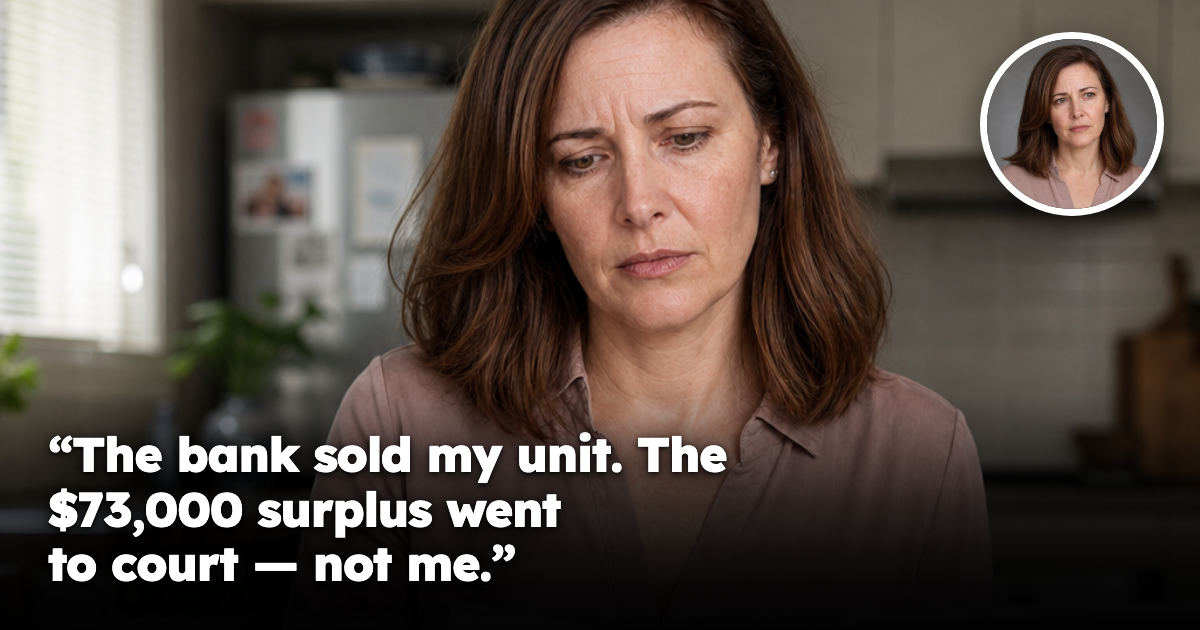
She is 45, a physiotherapy practice manager, and she bought the unit in 2017 as her one investment property. Never a missed payment in eight years.
The trouble was never the unit. It was a guarantee she had signed over her ex-husband's business; when the business failed, a creditor petitioned and she was made bankrupt. She is not asking for sympathy — she owed the money and the process ran its course. What she did not expect was what happened to the property.
She had been talking to her lender for months. She knew, because she had looked it up, that before a lender can sell a mortgaged property it must give the owner a notice stating the default and allowing thirty days to fix it. She read that rule as her floor — a window in which she could refinance, or sell the unit herself rather than at a mortgagee auction. The window never opened.
The question
"The trustee disclaimed the property — handed it back, because it was worth more to the lender than to my estate. I understood that. What I don't understand is why the bank could just sell it. Where was my thirty days?"
It is one of the least-known corners of mortgage law — and it only reveals itself when bankruptcy and a mortgage collide.
The answer
The thirty-day rule she was relying on is real, and it is strong. Before a lender can sell, a default must have happened, the lender must give a notice stating what the default is, and the owner must be given thirty days to remedy it. That protection cannot be contracted out of. But it has a hole, and the hole is bankruptcy.
When a person is made bankrupt, their property vests in a trustee, whose job is to gather what can be realised for creditors. A heavily mortgaged investment property is often worth more to the lender than to the estate, so the law lets the trustee disclaim it — hand it back, on notice, as property of no value to the creditors. That is the moment everything changes.
A separate provision runs on its own track. Once the trustee has disclaimed, the lender may sell if it gives each person with an interest in the land a notice stating that the property has been disclaimed and that it intends to sell on or after a day at least thirty days after that notice. There is a thirty-day period — but it runs from the disclaimer, not from any default. Then comes the line that undid her. The lender may sell even if it has not complied with the default-notice rule at all. The protection she had read about — the notice stating the default, the thirty days to fix it, the right that cannot be contracted away — simply does not apply once the property has been disclaimed. The lender does not have to prove she defaulted, and does not have to give her the window. She had spent months preparing for a process bankruptcy had already switched off.
There is a second surprise, and it is about the money. When a lender sells a mortgaged property, the proceeds are held in trust and paid out in a set order — the costs of the sale, then the debt, then the balance to the owner. She had assumed any surplus would come to her. It does not. Where the property has been disclaimed, the balance is paid into court instead — not to her, not to the trustee, but into court, where it sits until someone applies for an order. Her unit sold for $585,000; the debt was $512,000; the surplus of roughly $73,000 never arrived in any account of hers. Recovering her own money meant a court application, a solicitor, and $11,800 in fees over four months.
None of this means the lender did anything wrong. The disclaimer track exists for a sound reason: once a trustee has handed a property back, someone must be able to deal with it, and the lender holding the security is the obvious party. The thirty-day disclaimer notice is a real protection, and the duty to sell at market value still binds the lender, just as on any mortgagee sale where the buyer need not inquire whether the power was properly exercised. Her lender followed a rule it was entitled to follow.
What she never understood was that she had left the regime she was reading about and entered a different one — the way a borrower who is sued discovers a judgment for the debt cannot be enforced against the property securing it, or a borrower refinancing discovers a stranger can hold a say over her own mortgage. The rules change with the situation, and the situation changed the day the trustee signed the disclaimer.
What this means for you
If you invest, the lesson is not that bankruptcy is coming for you. It is that the protections you rely on are situational, and the situation can change without you feeling it. She was never in default on the unit; the guarantee that brought her down sat in a different document, over a different asset, signed in a different marriage. The property was performing. None of it mattered, because the disclaimer track does not ask whether the property was the problem.
She had assumed that if the worst happened she could sell the unit herself over a proper campaign. A mortgagee sale is a compressed event — a short campaign, a smaller buyer pool, a price that reflects urgency. Whether your asset can absorb that compression is not a suburb trait; it is a street trait. Two units in one postcode share a median, a growth rate, a catchment and a council — and perform completely differently when a sale has to happen in weeks. Achieved rents, real vacancy duration and true days-on-market routinely diverge by 20–30% in effective yield between the best and worst streets of a single suburb. A suburb median has never once told an owner how their asset behaves under a forced sale. That is the work we do at Ripehouse Advisory — reading the street, not the suburb.
The bigger picture
Nothing here was hidden. The default-notice rule, the disclaimer track, the thirty days that run from the wrong event, and the surplus that goes to court instead of to the owner were all published, free and readable, on the day she signed the mortgage and on the day the trustee signed the disclaimer.
She did not lose to a loophole. She lost to a change of regime she never felt happen — and to four months and $11,800 spent recovering money that was always hers.
Property rewards people who know which set of rules they are standing in. A rule you have read in advance is a risk you can price, and a priced risk is an advantage over every buyer who never looked. Her bankruptcy is behind her. She is saving for a deposit again — and this time, she says, she will know which clock is actually running.
If there's a specific street you're weighing up right now, check its Street Score first — it's free, takes ten seconds, and tells you whether that street is pulling the suburb average up or riding on it.
Frequently asked questions
Why didn’t the usual 30-day default notice apply when the bank sold the property after bankruptcy?
Because once the trustee disclaimed the property, a different rule applied. Under that bankruptcy track, the lender could sell after giving a notice of the disclaimer and its intention to sell at least 30 days later, even if it had not given the normal default notice.
What does it mean when a bankruptcy trustee disclaims an investment property?
It means the trustee hands the property back because it is of no value to the bankrupt estate. In this case, the property was considered worth more to the lender than to creditors, so the trustee disclaimed it.
Did the bank have to prove the owner had defaulted on the mortgage before selling?
No. Once the property had been disclaimed, the lender was allowed to sell without complying with the usual default-notice rule. The article says the bank did not have to prove she had defaulted in the way she expected.
What happens to any surplus money after a disclaimed property is sold?
The surplus is paid into court, not directly to the former owner. In the article, the sale left about $73,000 over after the debt was paid, and recovering it required a court application.
What is the main risk for property owners if bankruptcy happens through a guarantee or another debt, not the investment property itself?
The protections they expect on the property can change once bankruptcy and a disclaimer are involved. The article shows that the property can still be sold quickly, and the owner may need legal steps and extra costs to recover any surplus.
General information only. It does not take your objectives, financial situation or needs into account, and nothing here is legal, financial, taxation or investment advice specific to your circumstances.