News · 20 August 2026 · 5 min read
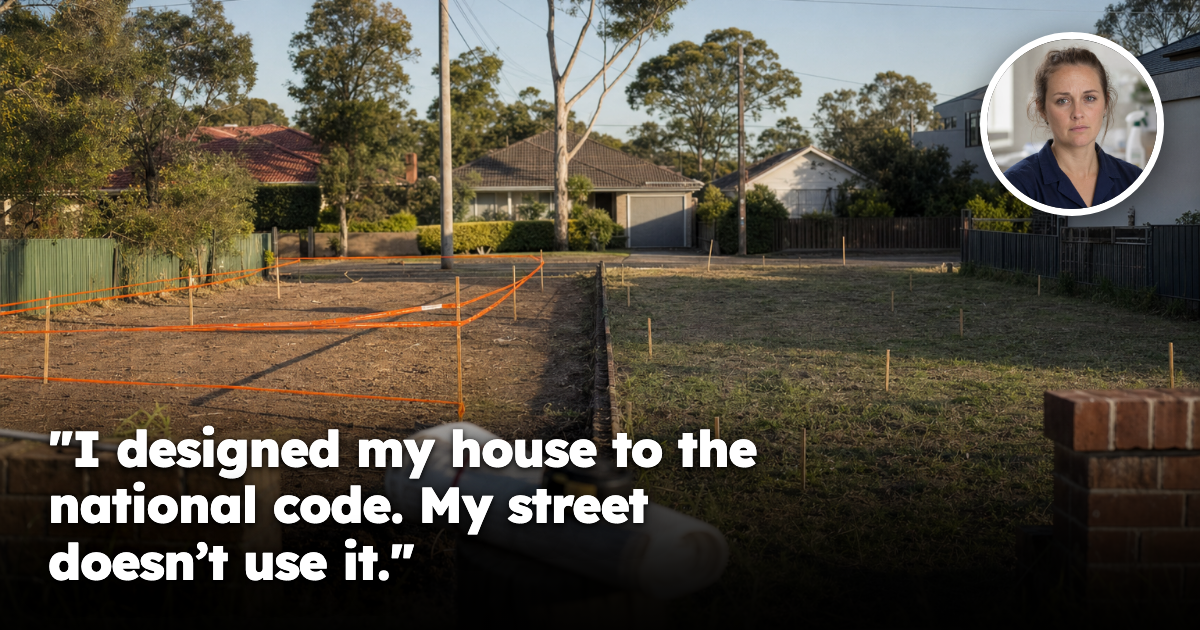
'I designed my house to the national code. It cost me $38,000 to find out my street doesn't use it'
She read the statewide residential design and siting rules herself and had her plans drawn to comply. They were refused — because a local planning instrument had already displaced parts of that code for her block. The redesign cost $38,000, and the clause that caused it says the state rules apply 'only to the extent' the local ones don't.
We get asked a version of this constantly, and it is one of the very few property problems where doing more homework than everyone else does not protect you at all.
A woman in her late thirties came to us after a build that went sideways before a sod was turned. She is a veterinary nurse, and she bought a modest block in 2019 to build one single-storey house on and stay put.
She was careful. Unusually careful. She found the statewide residential design and siting provisions — the published document setting out how far a house must sit from its boundaries, how much of a block it can cover, how high it can go. She read them properly, gave them to her designer, and asked for a compliant plan. It complied. She checked it herself, twice.
It was refused.
Not on drainage or a neighbour's objection. It was refused because the rules she read were not the rules that applied to her block. Her local planning instrument held its own provisions — a larger side boundary clearance and a lower site cover than the statewide code allowed — and those had quietly displaced the ones she'd spent her weekends reading.
The redesign and re-lodgement cost her $38,000 and eleven weeks. The block one street behind hers was not affected the same way.
Her question was short: 'How can there be a national code if my street doesn't have to use it?'
The answer: because the statute says the local instrument wins — but only in patches
The legislation governing building assessment allows a local planning instrument to include its own provisions that are, in the statute's own words, alternative or different to the statewide residential design and siting provisions. They're called alternative provisions, and they reach ordinary houses plus the sheds, garages and pools on the same block.
So far, so understandable — councils have always had local planning powers. Here is the clause that caused her $38,000. The statute says the statewide provisions apply only to the extent that the alternative provisions do not apply to the work.
Read that again. Not replaced. Not switched off. Applying only to the extent the local ones don't.
So the rule set governing any block is not a document. It is a composite — some statewide, some local, stitched together clause by clause, and no single published document states the finished result. You cannot read the state code and know your position, because you cannot see from inside it which clauses have been displaced. Nor the local instrument alone, because it only tells you what differs.
She hadn't skipped a step. She'd completed a step that doesn't produce an answer.
And the standard doesn't have to be a number
There is a second layer. The statute permits an alternative provision only if it is a qualitative statement or a quantifiable standard, and defines the former as a statement about a performance or outcome sought to be achieved when the buildings or structures are completed.
In other words: a sentence describing a desired outcome is a lawful, binding building control. Not a metre figure you can check with a tape. A sentence — about character, or streetscape — carrying the same legal force as the numeric standard it displaced.
The relief that closes exactly where you need it
There is a formal route. Where building work will not comply with a provision, you can apply to have it varied. The decision-maker must decide within twenty business days, asking whether the work substantially complies with everything else, whether compliance is unnecessary in the circumstances, and whether the variation is as effective as, or more effective than, complying. Safety and structural standards are a hard floor.
A fair process. But note two things.
First, the door is barred where the rule is softest. The statute says the variation application cannot be made if the provision permits a decision-maker to exercise discretion about the matter. A hard number can be varied — a subjective, judgement-based control cannot be taken to that process at all. Relief exists for the rules easiest to argue objectively, and vanishes where reasonable people most often disagree.
Second, asking costs time you can't get back. Where an application is already lodged, assessment stops the day the variation application is received and restarts only when the decision issues. There is a two-business-day fast-track, but it carries a fee and can be refused.
None of this is a scandal. Local design control does real work — it is why some streets hold their proportions for fifty years while others turn into a jumble. Alternative provisions are not a defect, and plenty of blocks governed by them are outstanding investments. Her house was built and she is happy in it. The rule was never the problem; it was invisible from where she stood.
What this actually means for you
This is the purest example we see of why suburb-level data cannot answer a buyer's real question.
Her block and the block one street behind share a median price, a growth rate, a school catchment, a council, a postcode and a vacancy rate. Every metric in every suburb report is identical for both. They do not share a buildable footprint. One can carry the house she designed; the other cannot — the difference between a development-capable parcel and a constrained one.
A median never read a planning instrument.
This is why we work at street and parcel level: what the market actually did there — achieved rents rather than asking rents, real vacancy duration, true days on market, supply and demand at street granularity. In a single suburb the spread in effective yield between best and worst streets routinely runs 20–30%. Constraints like this are a large part of why.
The same logic runs through the way an easement holder's signature can outrank a compliant approval — though that is a third party who could have said yes, where here there is nobody to ask. It sits alongside a mapped designation that changes how you must build, an authority's decision on a gazetted line, where this is a displacement with no event at all. And it rhymes with a shared pool definition that captures owners who never expected it.
The part worth keeping
Every one of these documents is public. The local instrument is published. So are the statewide provisions, the variation process, its criteria and its clocks — all readable before you make an offer, not after you get a quote.
Which makes this a knowable risk — and a knowable risk is a priceable one. That is the argument for buying property with data underneath it rather than a median and a hunch. The buyer who checks which rules reach a parcel isn't being cautious. They're the only person at that inspection who knows what they're bidding on.
She would still have bought the block. She would have bought it for less.
She read every rule she could find. Nobody told her the rules she could find weren't the ones that counted.
If there's a specific street you're weighing up right now, check its Street Score first — it's free, takes ten seconds, and tells you whether that street is pulling the suburb average up or riding on it.
Frequently asked questions
Why can a house design that complies with the statewide residential design and siting provisions still be refused in Queensland?
Because a local planning instrument can include alternative or different provisions for a block, and the statewide provisions apply only to the extent those local provisions do not. The final rules for a parcel are a mix of state and local controls, not just the statewide code.
How do you know whether local planning rules override the statewide design code on your block?
You need to check the local planning instrument as well as the statewide provisions, because neither document alone shows the full result. The article says the governing rules are stitched together clause by clause, and some state clauses may be displaced by local ones.
What kind of local rules can change how a house must be built under the Queensland system?
Local planning instruments can set alternative provisions that are either quantitative standards or qualitative statements about the outcome sought. In the article's example, the local instrument required a larger side boundary clearance and lower site cover than the statewide code.
Can you apply to vary a rule if your design does not comply?
Yes, there is a formal variation process for some provisions. The decision-maker considers whether the work substantially complies with the other rules, whether compliance is unnecessary in the circumstances, and whether the variation is as effective as, or more effective than, compliance.
What is the main risk for buyers and builders using only suburb-level data?
Suburb-level data can hide parcel-by-parcel planning constraints that affect what can actually be built. The article says two nearby blocks can have the same suburb metrics but very different buildable footprints, which can materially affect value and development potential.
General information only. It does not take your objectives, financial situation or needs into account, and nothing here is legal, financial, taxation or investment advice specific to your circumstances.