News · 22 August 2026 · 6 min read
'Eleven of my neighbours voted. I now have to hand over the keys to a flat I own outright'
She is 71, owns her unit outright and has never breached a by-law. Eleven of her fourteen neighbours voted to sell the whole block to a single buyer — and she has to hand over the keys. No council, no court, no resumption. Here is the threshold that decided it, and the valuation rule that cost her neighbour $86,000.
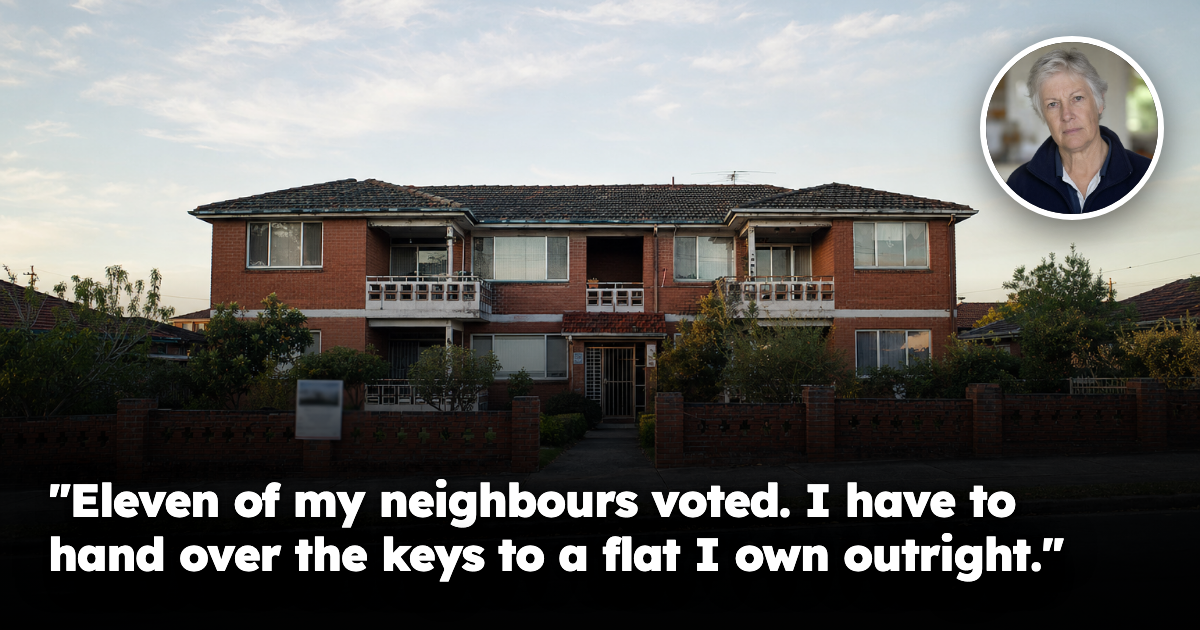
A 71-year-old cabinetmaker rang us in July with a question she was certain had an obvious answer. It did — just not the one she expected.
She has owned the same two-bedroom ground-floor unit since 1994 — fourteen units, low-set brick. She paid it off in 2018 and moved her daughter and grandson in when her daughter's marriage ended. She is the carer in that house. The unit is not an investment. It is the last thing between three people and the rental market.
Eighteen months ago a company began buying units in her block. Then a report landed in her letterbox: valuations of every unit, a structural engineer's assessment of the roof and the concrete cancer in the walkway, a quantity surveyor's costing, and a conclusion the body corporate could not afford the repairs.
Then a meeting. Then a plan. Then a vote. Eleven of the fourteen owners voted to sell the whole site to one buyer. She was one of the three who voted no.
Her question, when she called: "I own it outright. No mortgage, no arrears, never breached a by-law. How can a vote by people who live upstairs force me to sell my own home?"
The short answer
Because in a scheme like hers, the vote is the mechanism. Not a council. Not a court. Not a resumption. A supermajority of her own neighbours.
The legislation governing schemes of this kind contains a relatively new pathway — inserted only in the last few years — allowing a scheme to be wound up and the whole site sold to a single buyer on economic grounds. It is not a loophole. It exists for a defensible reason: ageing blocks with failing structures and owners who cannot fund repairs are a real problem, and trapping every owner in a decaying building because one person will not move is its own injustice.
But the mechanics are worth reading, because almost nobody who owns in a scheme has. Most owners only meet their body corporate through money going the other way — a special levy they never voted for, or a capital works shortfall nobody opened the document to see. This is the opposite direction: not a bill, but the lot.
What actually has to happen
Three things, in order — and the thresholds are not the same.
First, the body corporate must commission a report before it can put the question. That report must value every individual lot and, separately, the land as a whole — two numbers, and the distance between them is the entire commercial reason anyone is in the room.
Second, owners vote on whether economic reasons to terminate exist. The part that surprised her most: those reasons can be established not only by what is true today, but by what will not be affordable within the next five years. A forecast about year four is a present fact.
Third — only after the plan has been circulated well in advance — comes the vote that ends the scheme. That needs 75% or more of all lot owners. One vote per lot. No proxies. And an owner who owes the body corporate money still gets to vote.
One more detail she had not registered: that final meeting may not consider any alternative proposal for ending the scheme. It is a single-option meeting by design.
What she gets paid
This is where most people assume the story turns ugly. It doesn't — not quite.
The plan must guarantee every owner a minimum. That floor is what the person would have received if the land had been compulsorily acquired by government, less any debt they owe the body corporate. Whatever else it is, it is not a token. Her unit was valued at $412,000 in the report; the floor, once her share of the site value was worked through, sat above it.
The proceeds are not split evenly, and this is the sharpest point in the regime: they go by each lot's market value as a proportion of the combined market value of all the lots. Not by floor area. Not equally. Not by entitlement schedule. By valuation. Hers was the only unit with a renovated kitchen and a bathroom done properly in 2019 — which lifted her share to $498,000. Her neighbour two doors up, same footprint, original 1994 fittings, took roughly $86,000 less for an identical-sized home.
And she is not without recourse
An owner who thinks the economic-reasons resolution should never have passed can apply for specialist adjudication within a defined objection window, and while that runs the scheme cannot move to the final vote. An owner can also go to court within 90 days of notice — and if they do, implementation stops.
The costs rule is genuinely protective and almost nobody knows it. Where an owner challenges a plan, the body corporate must pay the reasonable costs of the proceeding, and carries the onus of proving that implementing the plan is just and equitable. The court must weigh nine matters, including the effects on each individual owner and the aggregate value of the lots against the value of the site as a whole.
She had 90 days. She had spent 60 of them assuming there was nothing to argue about.
What this means if you own anything in a scheme
The report that started all this valued each lot separately. Not the suburb. Not the building. The lot. Whether her home was worth $412,000 or $498,000 came down to one kitchen, one bathroom, one aspect — inside a block where every unit shares a postcode, a median, a growth rate, a school catchment and a council.
That is the argument for street-level and asset-level data, written into a statute by accident. Two properties can share every metric a market report will show you and still be priced as different assets — the gap between the best and worst street in one suburb routinely runs to 20–30% on effective yield once you use achieved rents, real vacancy duration and true days on market rather than headline averages. A suburb median has never once been the number anyone was paid.
Note what the trigger is. The same structural condition that quietly reprices a building rather than its builder is, here, the legal event that extinguishes every title inside it.
Nobody here misbehaved. The buyer made a lawful offer. The eleven owners upstairs were, mostly, people who could not fund a roof. The engineer's report was real. And she is not out of pocket — she is up, substantially, because of a renovation she did six years ago and never thought of as a hedge.
Every rule that decided her outcome — the thresholds, the notice periods, the valuation principle, the compensation floor, the objection windows, the reversed onus — was published, free and readable years before it mattered. Not hidden. Unexamined, by her and by almost everyone who bought alongside her. Risk you can read in advance is not risk. It is a line item, and pricing a line item nobody else has read is how disciplined investors keep buying good assets from people who never checked.
She is buying again with the proceeds — and reading the plan before the meeting this time.
If there's a specific street you're weighing up right now, check its Street Score first — it's free, takes ten seconds, and tells you whether that street is pulling the suburb average up or riding on it.
Frequently asked questions
How can owners in an Australian strata scheme be forced to sell their units even if they own outright and have no mortgage?
In this kind of strata scheme, a supermajority vote by the owners can trigger termination of the scheme and a sale of the whole site to one buyer. It is not a council or court resumption; the vote itself is the mechanism.
What vote threshold is needed to sell an entire strata block in this case?
The final vote needs 75% or more of all lot owners, with one vote per lot and no proxies. Owners who owe money to the body corporate can still vote.
How is the payout decided when a whole strata complex is sold?
The proceeds are split according to each lot’s market value as a proportion of the combined market value of all lots, not equally and not by floor area. The plan must also guarantee each owner at least what they would have received under compulsory acquisition rules, less any body corporate debt.
Can a body corporate decide to sell because repairs will become unaffordable in the future?
Yes. The legislation allows economic reasons to be established not only by current conditions, but also by repairs or costs that will not be affordable within the next five years.
What can an owner do if they think a forced sale plan should not have passed?
An owner can apply for specialist adjudication during the objection window, which stops the scheme from moving to the final vote. They can also go to court within 90 days of notice, and that also halts implementation.
General information only. It does not take your objectives, financial situation or needs into account, and nothing here is legal, financial, taxation or investment advice specific to your circumstances.