News · 22 August 2026 · 6 min read
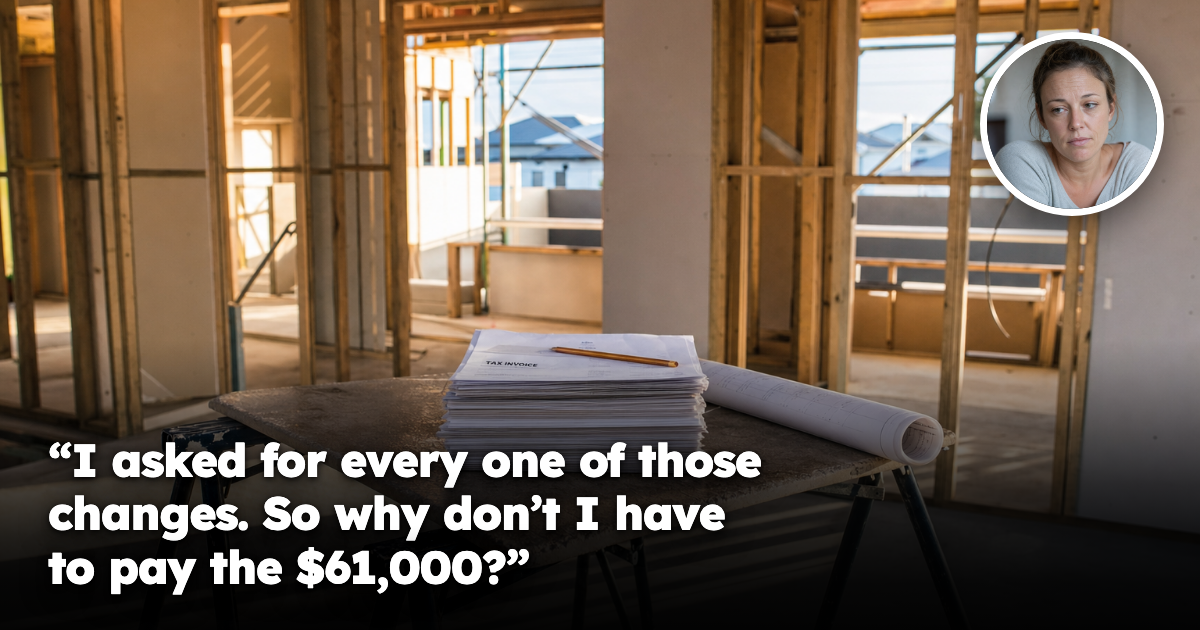
'I asked for every one of those changes. So why is my lawyer telling me I don't have to pay the $61,000?'
She asked her builder for nine changes during her $742,000 build — standing on the slab, every time. Then $61,000 in variation invoices arrived. She rang us apologising, assuming she owed every cent. The legislation puts the paperwork obligation on the builder, not on her.
She came to us apologising.
Most people who ring us about a building dispute arrive angry, or frightened, or holding a folder they have read forty times. She arrived embarrassed — in her own mind, she was the one at fault.
She is 34. She and her partner had spent four years saving for their first proper build, and had done it the way you are supposed to: fixed-price contract, registered builder, a plan redrawn until it fit the block. The contract price was $742,000.
Then the house started going up, and she started seeing things. The kitchen window was smaller in real life than on paper. Once the frame was up she could see that the ceiling she had approved was going to feel low. So she did what almost every owner does: she walked the site on a Saturday, found the builder, and asked.
Nine times over eleven months. Raise the ceiling. Widen that opening. Move the laundry. Extend the alfresco. Every one of those conversations happened standing on a slab, and every one ended with a nod and "yeah, we can do that."
Then the invoices arrived. $61,000 in variations, the largest single item $28,400.
Her question, almost word for word: "I asked for every one of those changes. Nobody forced me. So why is my lawyer telling me I don't have to pay the $61,000?"
The answer she did not expect
Here is what she had never considered, because the guilt of having asked gets in the way of the question. The legislation governing major residential building contracts does not treat a change to the plans as a conversation. It treats it as a document — and it puts the obligation to produce that document not on the person who wants the change, but on the builder who is going to be paid for it.
When an owner asks for a variation, the builder must respond in writing, within a reasonable time, with one of two things. Either a notice setting out the effect on the works as a whole, whether any permit must be varied, a reasonable estimate of any delay, and the cost of the change and its effect on the contract price — or a notice saying the builder refuses or is unable to do it, and why.
Then, critically: the builder must not carry out the change unless the owner has given a signed request, attached to a copy of that notice. Not a text message. Not a nod on the slab. A signature, on a document that already tells the owner what the change costs and how long it will add.
And then the provision that reframed her situation:
A builder is not entitled to recover any money for a variation the owner asked for, unless the builder complied with those requirements.
That is the mirror image of the more familiar fight, where a builder springs a variation the owner never asked for. Read this one with her facts next to it. She asked. She wanted it. She got it. And on the statute's own terms, the money question turns not on what she wanted, but on whether the builder papered it before he swung a hammer.
The narrow door — and it is genuinely narrow
That bar does not reach everything: it does not touch prime cost items and provisional sums, which move the price by an entirely different mechanism. And there is one exception. If the builder reasonably believes a requested change will not require a permit variation, will not cause delay, and will not add more than 2% to the original contract price, the builder can simply get on with it. That is what stops a job grinding to a halt over a repositioned power point.
On a $742,000 contract that is under $15,000 — and the test runs against the original price. Her ceiling height alone required an amended permit. Her alfresco extension added time. That door was never open for the items that mattered.
There is also a safety valve pointing the other way. A tribunal can allow a builder to recover despite the paperwork failure — but only where there are exceptional circumstances or the builder would suffer significant or exceptional hardship, and where recovery would not be unfair to the owner. Both limbs, every time. Then the builder gets the cost of the work plus a reasonable profit.
So this is not a coupon for free renovations, and we told her so. It is a bargaining position with a statutory floor under it, in a negotiation she assumed she could not enter at all.
The part that surprised her more
The same contract also governs when the builder may demand each payment and when the work counts as finished. Her build ran five months past the agreed completion date, and the builder's explanation was always the same: you kept changing things.
Fair enough in ordinary life. But the same legislation says that when plans are varied in accordance with those requirements, the contract price and the completion date are read as adjusted. The extension of time rides on the same paperwork as the money. No compliant variation, no automatic adjustment to the date the builder was contracted to finish by.
And a final twist that cuts against owners. There is a statutory exit when a build blows out — broadly, when the price rises by 15% or more, or the job runs to one and a half times the agreed period, for reasons the builder could not reasonably have foreseen. But increases caused by variations the owner requested are expressly ignored in calculating whether you have hit those thresholds. Your own changes cannot buy you your own exit. Both edges are sharp.
None of it is hidden. She had never read it, because she believed the story she was telling herself: I asked, so I owe.
What this means for anyone building
Get the notice before the work, not the invoice after it. If you ask for a change on site and the answer is "yeah, we can do that," the next sentence should be "great — send it through in writing with the cost and the time." A builder who sends it has protected himself. One who doesn't has, on the statute's own terms, done the work at risk.
And understand what you are buying. Her $61,000 bought a higher ceiling, a bigger window and a wider alfresco. Whether that money comes back at resale is not a question the contract answers — it is a question the street answers.
This is the part most people renovating get backwards. They agonise over the finish and assume the suburb will carry the value. It won't. Two houses in one postcode share the same median, growth rate, school catchment and council — and settle at completely different numbers, because they sit on different streets. We routinely see a 20–30% spread in effective yield between the best and worst street inside a single suburb, once you work from achieved rents, real vacancy duration and true days on market.
A suburb median has never once told anyone what a $61,000 extension is worth on that street.
That is the argument for doing property with data instead of instinct. The rules governing what a builder can charge you were free to read while she stood on that slab feeling guilty. So is the street-level evidence of which addresses actually reward the money you put into them. Risk you can read is risk you can price — and a priced risk isn't a threat, it's an advantage over every buyer who never asked.
She still likes the ceiling. She just no longer believes that wanting it was the same as owing for it.
If there's a specific street you're weighing up right now, check its Street Score first — it's free, takes ten seconds, and tells you whether that street is pulling the suburb average up or riding on it.
Frequently asked questions
If I ask my builder for changes during a fixed-price home build in Australia, do I automatically have to pay for them?
Not automatically. Under the legislation described in the article, the builder must follow a written variation process before they can recover money for a change you requested.
What paperwork does a builder need before carrying out a variation I asked for?
The builder must give you written notice explaining the effect of the change, including cost, likely delay, and any permit implications, and you must sign a request attached to that notice before the work proceeds.
Can a builder just agree to a small change on site and charge it later?
Only in limited circumstances. If the builder reasonably believes the change will not need a permit variation, will not delay the job, and will add no more than 2% to the original contract price, they can proceed without the full process.
Does a requested variation also change the completion date of the build?
Yes, but only if the variation is made in accordance with the required paperwork. The article says the contract price and completion date are adjusted together when the variation is properly documented.
Does asking for my own changes count when deciding if a build is delayed enough to trigger a statutory exit?
No. The article says increases caused by variations requested by the owner are ignored when calculating those delay or price thresholds.
General information only. It does not take your objectives, financial situation or needs into account, and nothing here is legal, financial, taxation or investment advice specific to your circumstances.