News · 20 August 2026 · 6 min read
'I paid $96,000 to fix work a certifier signed off. The rule he broke turned out not to be an offence'
He paid $96,000 to rectify an extension that had been approved, inspected and signed off — then discovered the certifier had also been working for the builder on the same job. That arrangement sits inside a defined statutory conflict-of-interest list. It also carries no fine at all.
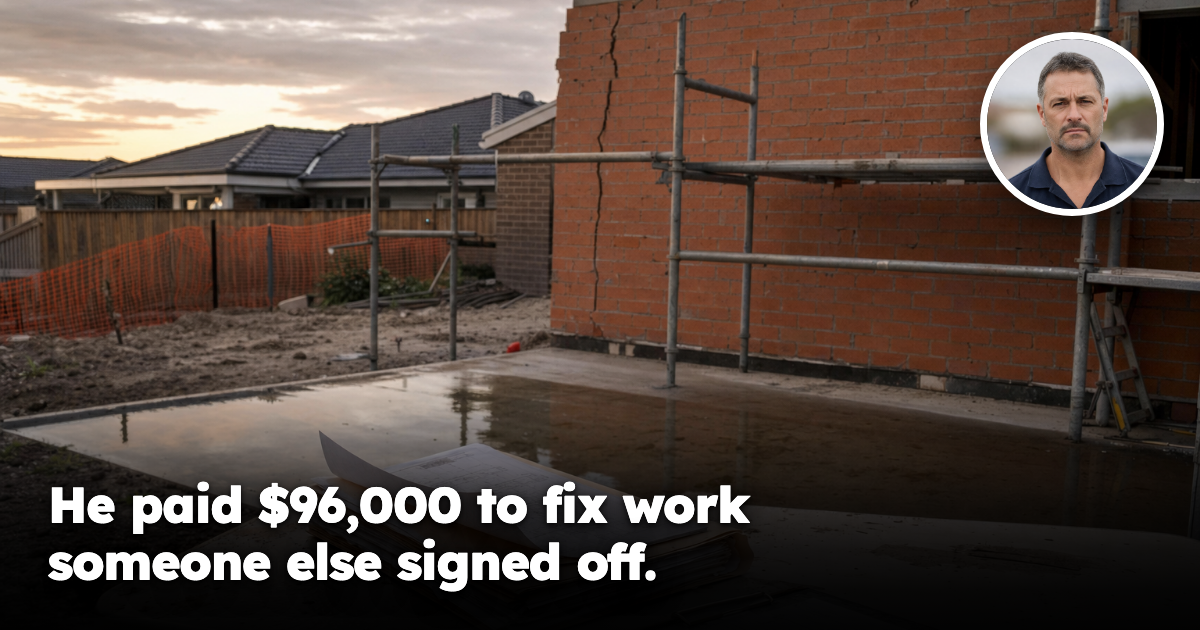
He paid $96,000 to fix work someone else had signed off. When he complained about the person who signed it, he learned the broken rule carried no fine at all.
A client asked us this last week. He is 47, a fleet manager, and owns two properties. The second — a rear extension and converted garage, done in 2019 — is the one that broke him.
The work was approved, inspected and signed off. Nineteen months later the rear wall was moving, there was no adequate drainage behind the garage slab, and an engineer put in writing that the waterproofing under the new wet area could never have worked. The builder had deregistered and moved interstate. The rectification quote: $96,000.
So he looked at the certifier.
That certifier — who approved his plans, ran the inspections and issued the sign-off — had also been engaged by the builder, on the same project, to do work that was not certifying work. That is not a grey area. It sits squarely inside a statutory list of the occasions on which a certifier has a conflict of interest.
His question, word for word: "If that was against the rules, why is nobody fining him?"
The answer: because the prohibition is real, and the penalty is not
The conflict rule is a hard prohibition. A certifier must not perform a certifying function if, in performing it, they have a conflict of interest. The legislation lists the occasions that count — deliberately open-ended, "including but not limited to": where the certifier is to carry out the building work they are certifying; where the certifier is engaged by the owner or the builder to perform some other function that is not certifying work, managing the development application, or giving regulatory advice; and where the certifier has a direct or indirect pecuniary interest in the building. The definition sweeps in the preparation of the design, so a certifier who helped draw the thing is caught as surely as one who swung a hammer. Alongside it sits a duty to act in the public interest that prevails over any other obligation — including the one owed to whoever pays the invoice.
Now the twist. A separate provision deals with a certifier failing to comply with a rule about certifying functions where no penalty is stated. Its own worked examples name the conflict-of-interest sections directly. And it says, in terms: the failure to comply is not an offence. It is instead "taken to be conduct that is contrary to a function under this Act" — feeding the definition of unsatisfactory conduct and routing everything into a complaint process.
So the rule is not toothless. But its teeth are not where a homeowner instinctively reaches. There is no fine. There is a process.
The three clocks — and the one that had already run
A complaint must be in writing, contain particulars of the allegations, and be verified by statutory declaration — not an email, not a phone call. It must also be made before a "cut-off day", written as three clocks starting on three different events:
- Certification of work under a building approval — seven years after a certificate of occupancy or final inspection certificate issues.
- Work where an application was made but that limb does not apply — one year after a private certifier is engaged, or after the council receives the application.
- Otherwise — one year after the complainant becomes aware of the conduct.
Which clock you are on depends on facts about the paperwork, not about your loss — unless the conduct "has or may have caused significant financial loss or other serious harm", the sole gateway past the cut-off. The regulator may also dismiss a complaint without further action if satisfied it is frivolous, vexatious, or lacks substance or credibility. And unproved complaints are not disclosed to anyone — so the register a buyer might check does not show them.
What a win actually pays
Assume he clears every hurdle. If the finding is unsatisfactory conduct, the regulator must choose from a fixed menu: reprimand the certifier; impose licence conditions; direct educational courses; direct them to report on their own practice; require steps to ensure future certification complies; direct enforcement action against the builder or owner; or — the final limb — if satisfied the certifier is generally competent and diligent, advise them no further action is intended.
Look down that list for the line that pays for the $96,000 wall. It is not there. Every limb aims at the certifier's future conduct.
The money limb sits one tier up. Only where the regulator decides the conduct was professional misconduct — the higher finding, covering acting outside power, contravening the code of conduct, or being grossly negligent or grossly incompetent — does it reach a tribunal. Only there can an order be made that, for work defective or incomplete as a result of that misconduct, the certifier rectify it at their own cost or pay the complainant enough to rectify the work.
A monetary penalty is available too, on a rising scale for first, second and subsequent findings. But the legislation directs that it be paid to the person bringing the proceedings. Not to the owner.
What this means for you
None of this makes certifiers villains. Most do careful work under time pressure, the public-interest duty is genuine, and the discipline pathway exists because this work needed oversight. A conflict on one job is not proof of a bad one.
But it reframes what "it was certified" is worth. A sign-off is evidence that a process occurred. It is not a warranty, and the remedy behind it is narrower and slower than almost any buyer assumes — much like a pool certificate that expires on a timer, or a standard you can fall inside without building anything, and different again from which rulebook applied to the siting.
Which is why we push clients back to what is knowable before you sign. Two houses in one suburb share a median, a growth rate, a school catchment and a council. They do not share their approval history, their builder, their certifier, or whether the work behind the plasterboard was ever really looked at. A suburb median has never once read an inspection record. That is why we work at street level — achieved rents, real vacancy duration, true days on market — where the gap between the best and worst street in one suburb routinely runs 20–30% on effective yield.
And it is why this argues for buying property properly, not for buying less of it. The cut-offs, the complaint requirements, the outcome menu and the tribunal's powers are published and readable years before anyone needs them. Risk you can read is risk you can price — and a priced risk is not a threat, it is an edge over every buyer who never looked.
He would still have bought that property. He would have paid less for it, and he would have kept the certifier's engagement letter.
He had a folder of approvals for that extension. What he never had was one page saying who the certifier was working for.
If there's a specific street you're weighing up right now, check its Street Score first — it's free, takes ten seconds, and tells you whether that street is pulling the suburb average up or riding on it.
Frequently asked questions
If a certifier also works for the builder on the same project, is that a conflict of interest in Australia?
Yes. The article says that a certifier must not perform a certifying function if they have a conflict of interest, and being engaged by the builder to do other non-certifying work on the same project is one of the listed conflict situations.
Can a homeowner be fined back money automatically if a certifier signs off defective work?
No. The article says a breach of the conflict rule is not an offence and carries no fine. It is handled as unsatisfactory conduct through a complaint process instead.
What can happen if a complaint against a certifier is successful?
If the finding is unsatisfactory conduct, the regulator can reprimand the certifier, impose licence conditions, require education or reporting, or direct steps to improve future compliance. Those outcomes are aimed at future conduct, not automatically at paying the owner’s repair bill.
When can a homeowner get money for rectification from a certifier?
Only if the matter is taken to a tribunal and the conduct is found to be professional misconduct, such as acting outside power, breaching the code of conduct, or being grossly negligent or grossly incompetent. In that case, an order can be made for the certifier to pay enough to rectify defective or incomplete work.
How long do you have to complain about a certifier’s conduct?
The article says there are three timing rules depending on the facts, including a seven-year period for work certified under a building approval and one-year periods in other situations. A complaint also has to be in writing, set out particulars, and be verified by statutory declaration.
General information only. It does not take your objectives, financial situation or needs into account, and nothing here is legal, financial, taxation or investment advice specific to your circumstances.