News · 22 August 2026 · 6 min read
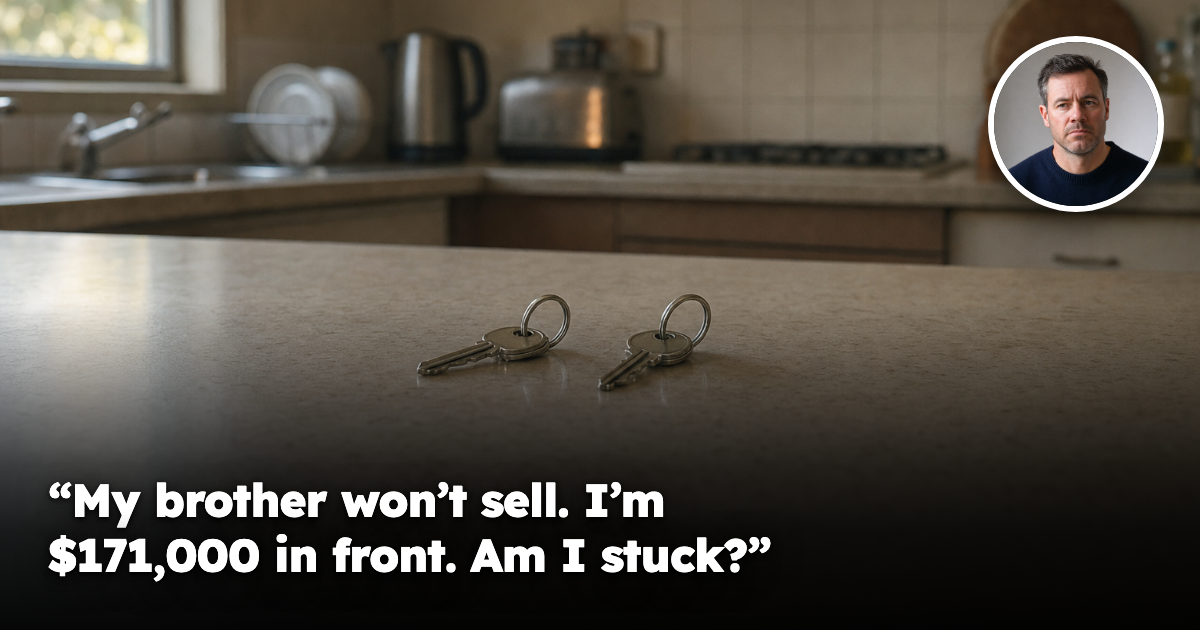
'My brother and I bought a house together in 2018. He won't sell, and I've put in $171,000 more than he has'
He and his brother bought an investment property together in 2018. He has since covered roughly $171,000 more than his brother in repayments, rates and repairs — and his brother refuses to sell. He assumed he needed agreement to act. He was wrong, and one provision means asking to be repaid can create a claim against you.
He has spent seven years believing he was stuck.
He is 44. In 2018 he and his older brother bought an investment property together — two names on the title, a shared loan, a handshake about splitting everything down the middle. For eighteen months it worked exactly as they'd imagined. Then his brother's circumstances changed, and the repayments stopped arriving.
He didn't make a scene. He covered the shortfall, because the alternative was a default on a loan with his own name on it. Then he kept covering it — the rates, the insurance, the roof, the hot water system.
By his own count he is now roughly $171,000 ahead of his brother — about $18,400 of that in repairs and improvements, the rest in repayments, rates and outgoings his brother was liable for and didn't pay. The property is tenanted at around $640 a week. He has asked his brother to sell three times. Each time the answer has been no.
So he put to us the question we hear constantly, phrased almost the same way every time:
"We're both on the title, so nothing can happen unless we both agree. He won't agree. Am I just stuck here until he changes his mind?"
The short answer
No. And that belief is the single most expensive thing about the last seven years.
Where the assumption comes from
It comes from somewhere reasonable. Two people own a thing together; therefore two people decide what happens to it. That's how most shared decisions work, and how almost everyone assumes co-owned property works. Property law doesn't work that way, and hasn't for a very long time.
Property held by two or more people is held in one of two forms, and under both the general law provides a route out that one co-owner can take alone. A co-owner — singular, no minimum share, no requirement to prove fault, hardship or breach — may apply to a court for the property to be sold and the proceeds divided, for it to be physically divided, or a combination. There is no consent requirement anywhere in that power. It is not a remedy for bad behaviour, in the way that a buyer under an instalment contract has a remedy when the seller deals with the land behind their back. It exists because the law's position is that nobody should be locked indefinitely into shared ownership of an asset they want out of.
He didn't need his brother's agreement. He needed to know the power existed.
What actually happens when someone uses it
Two features of the regime surprise almost everyone.
The first is that sale is the default outcome. If a court decides to make an order at all, it must order sale and division of the proceeds unless it considers that physically dividing the property would be more just and fair. The person arguing to keep the asset intact carries the burden of persuasion, not the other way round. In deciding, the court must consider the use being made of the property, whether it can practically be divided, and — this matters more than people expect — any particular links with or attachment to the property, including whether it is unique or has special value to one of the owners. Sentiment isn't a throwaway. It is an express consideration. It just isn't a veto.
The second is that the court can appoint a trustee to run the sale, and the moment it does, each co-owner's interest stops being an interest in land and becomes an interest in the proceeds. The house becomes a number, and the argument moves to how the number is split — the mirror image of a dispute about who gets to direct money that has already arrived.
The lender is largely a bystander — a very different posture from the contest that arises when two lenders are fighting each other over priority. Severing a joint tenancy this way is expressly protected: it cannot breach the mortgage, whatever the loan document says. Security over the whole property survives; security over one owner's share is lifted off the land and attached to the money instead.
The part that would have cost him money
Here is the trap, and it is the reason this question is worth writing about rather than just answering.
When a court sorts out a co-ownership dispute it can adjust the accounts between the owners, and must consider a defined list: money reasonably spent improving the property, maintenance and insurance costs, damage from unreasonable use, and payment by one owner of more than their proportionate share of rates, repayments or other outgoings another owner was liable for. That list is, almost line for line, what he's been doing since 2019. His claim is strong.
But the same provision lets a court order an occupying owner to pay something equivalent to rent to a non-occupying owner — and it sets out exactly when. A court must not make that order unless one of three things is true: the non-occupying owner was excluded from the property; they suffered a detriment because sharing occupation wasn't practicable; or the occupying owner is the one asking to be compensated or reimbursed for what they spent.
Read that third limb again. Stay silent and no occupation rent can be ordered against you. Ask to be repaid for the years of repayments and repairs you covered, and you have switched on a counterclaim that could not otherwise have existed. The act of claiming your money is the act that creates the claim against you.
It doesn't catch him — the property has been tenanted throughout. But if he had moved in during those seven years, as plenty of people do, his own request for reimbursement would have opened a door he'd have preferred stayed shut. And an accounting between co-owners can be sought on its own, without any application to sell. The money fight and the exit are separate levers. Most people never learn either is there.
What this has to do with buying well
The underlying error is one we see constantly, and it isn't legal. It's informational.
Two people co-buy on the strength of a suburb: the median went up, the growth rate looked good, the catchment was fine. Nobody checked what the street was doing. Then the asset underperforms, one party wants out, the other digs in, and a structure nobody stress-tested becomes a seven-year stalemate over a property that wasn't the right buy anyway.
Two houses in the same suburb share a median, a growth rate, a catchment and a council. They do not share achieved rent, real vacancy duration, or true days on market. We routinely see a 20–30% spread in effective yield between the best and worst streets inside a single suburb — same postcode, same headline statistics, two completely different assets. A shared purchase amplifies that gap, because a co-owned property that performs is a partnership, and one that doesn't is a negotiation.
A suburb median has never once settled an argument between two owners.
The reframe
The rules he tripped over weren't hidden. The unilateral application right, the preference for sale, the adjustment factors and the occupation-rent gates were all published, free and readable in full on the day he signed in 2018. He didn't lose to a loophole. He lost seven years to an assumption he never tested — and the assumption cost him more than any clause did.
Risk you can read in advance is risk you can price, and priced risk isn't a threat. It's an edge over every buyer who never asked the question.
He has spent seven years waiting for permission from someone who was never in a position to grant it.
If there's a specific street you're weighing up right now, check its Street Score first — it's free, takes ten seconds, and tells you whether that street is pulling the suburb average up or riding on it.
Frequently asked questions
If two people own an investment property in Australia, can one co-owner force a sale without the other agreeing?
Yes. The article says a co-owner can apply to court alone for the property to be sold and the proceeds divided, or for it to be divided physically, without needing the other owner’s consent.
What is the usual outcome if a court makes an order about co-owned property?
Sale is the default outcome. The court must order a sale and division of the proceeds unless it decides that physically dividing the property would be more just and fair.
Can a co-owner recover money spent on repayments, rates and repairs from the other owner?
Yes. The court can adjust accounts between co-owners and consider reasonable spending on improvements, maintenance, insurance, and one owner paying more than their share of rates, repayments or other outgoings.
Could asking for reimbursement also create an occupation-rent claim against me?
It can. The article says a court must not order occupation rent unless one of three things applies, including that the occupying owner is the one asking to be compensated or reimbursed for what they spent.
Does being stuck in a co-owned property mean the only option is to wait for the other owner to agree?
No. The article says the belief that both owners must agree is wrong, and a co-owner does not need the other’s consent to seek a court order for sale or division.
General information only. It does not take your objectives, financial situation or needs into account, and nothing here is legal, financial, taxation or investment advice specific to your circumstances.