News · 23 August 2026 · 5 min read
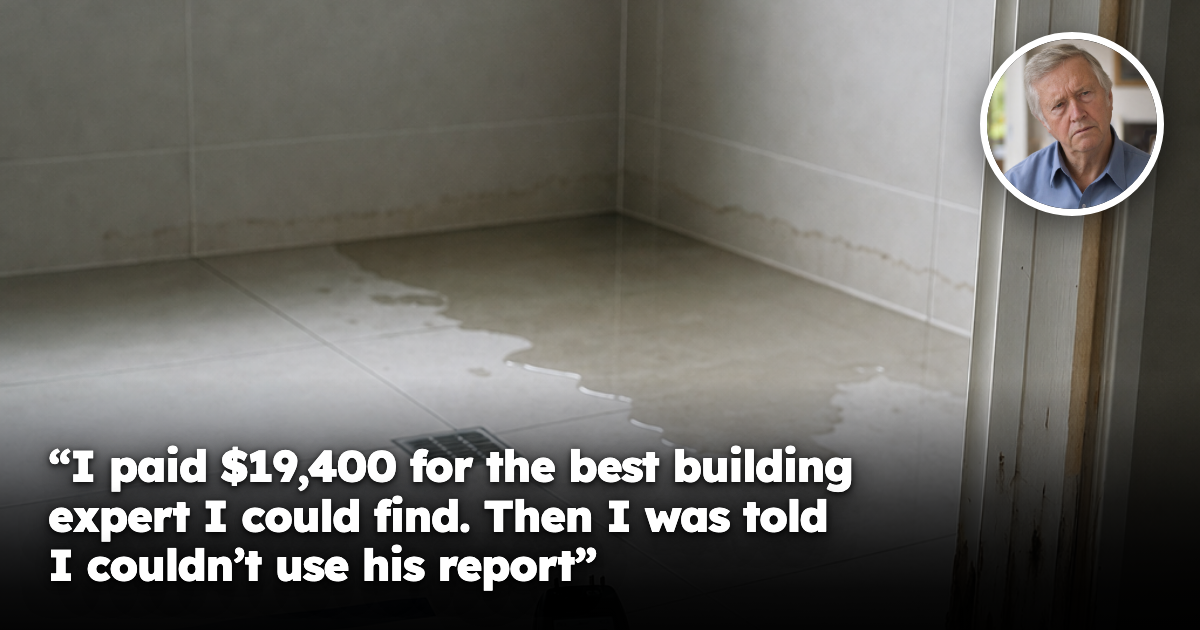
"I spent $19,400 on the best building expert I could find. Then I was told I wasn't allowed to use his report"
He is 71, recently widowed, and did everything right: he read the contract twice, photographed every stage, and when the new bathroom pooled water in the wrong corner he paid $19,400 for the best independent building expert he could find. Then he learned about the rule that decided nobody would ever read it.
He is 71. His wife died two years ago, in the house they had lived in for thirty-one years, and by the following winter he had decided he could not keep it — not for money reasons. He simply could not walk past her chair every morning.
So he bought a smaller single-level place ten minutes away and spent a year having it rebuilt for the body he expects to have at 80: level thresholds, a wider hallway, a bathroom with no step and a fall in the floor to a drain.
He read the contract twice and photographed every stage. When the bathroom floor began pooling water against the far wall instead of running to the drain, and the timber at the base of the door frame darkened, he did not argue. He went and got proof: the most respected independent building expert he could find, $19,400 for a full inspection, moisture mapping and a written report.
Fourteen months later he had spent $31,000 on expert evidence, and the only report the decision-maker could rely on was one he had never commissioned, never chosen, and been required to pay half of.
His question, in his own words: "I paid for the proof. Everyone agreed it was good. How is it possible that nobody was allowed to look at it?"
The rule almost nobody is told about before they spend the money
Here is the part that catches people. It is not hidden — it is written plainly in the legislation governing residential building disputes. Nobody explains it before you write the cheque.
The tribunal hearing a building claim can appoint its own independent expert, drawn from an approved panel, to advise it on any question it chooses to refer. And once it does, the text is unambiguous: in any proceeding for which that expert has been appointed, no party may call any other expert to give evidence, or tender any report prepared by any other expert, except by leave of the tribunal.
Read that again with his $19,400 in mind. Not given less weight. Not considered alongside. Not tendered at all — unless he applies for permission, and wins.
First, the appointment is not his decision. Nothing requires either party's consent, and nothing requires them to be warned — before they invest in their own evidence — that the tribunal might appoint someone and switch that investment off.
Second, the default cost rule for that appointed expert is that the cost is borne by the parties in equal proportions. Fifty-fifty — not by fault, not by outcome. He paid $11,600 as his half of the only opinion that counted, on top of the $19,400 for the one locked out.
Two expert bills. One usable opinion. It was not his.
What the law actually gives him — stated fairly
It would be dishonest to present this as a stitch-up, so let us be precise about the other side of the ledger.
The panel expert exists for a good reason. Duelling paid experts is how a deliberately cheap forum turns into a battle of chequebooks the wealthier party wins on stamina. A single neutral opinion is a real attempt to stop that — and the good-faith immunity the legislation gives that expert is what makes anyone willing to sit on the panel.
He was also not silenced. The same section preserves the right to cross-examine the appointed expert. He used it, putting his own expert's moisture readings to the appointed one line by line.
The wider machinery is generous, too. Any person may apply. The jurisdictional limit runs to $500,000. The tribunal is chiefly responsible for building disputes, so a builder cannot drag an owner into a more expensive court. Its remedial powers are broad, and it may make an order even if it is not the order the applicant asked for, on a stated principle that rectification by the responsible party is the preferred outcome.
Even the harsh cost rule opens with a real safety valve — it applies subject to any order of the tribunal. But a discretion must be asked for and won, and the default is what happens to the person who did not know there was something to ask for. His builder, it should be said, has not been found to have breached anything, and is entitled to that.
This is not a system built to punish preparation. It is one with a default nobody explains to the person paying for it — a pattern we have covered before, in the rectification order that gives rise to no rights or obligations and the contract with an unlicensed builder that binds only one side.
What it means if you own property
Strip out the bathroom and what remains is a pattern worth carrying into every property you buy: the risk that costs you money is rarely the one in the listing. It is the one written down somewhere public that nobody read to you.
Two houses can sit four hundred metres apart, in the same postcode, council area and catchment, with the same median and five-year growth rate — and a suburb report will describe them in identical words. What they do not share is their build history: who did the work, whether it was disputed, and whether a defect was rectified or merely painted over before sale. One is a clean asset. The other, on identical fundamentals, is fourteen months and $31,000 of somebody's life waiting to become yours — arriving with the house, the same way a statutory warranty transfers to the buyer with the clock already running.
A suburb median has never once read a building file.
At street level the picture separates hard. In one suburb the gap between the best street and the worst is routinely 20–30% on effective yield once you use achieved rents rather than asking rents, true days on market, real vacancy duration and genuine street-level supply and demand. The data on the average portal is not poor. The unit of measurement is wrong. Suburbs do not transact — streets do, one build file at a time.
The part that should make you more confident, not less
Every rule that cost him fourteen months was published, free and readable years before he needed it. The panel power, the lockout on other expert reports, the leave requirement and the equal-shares default were all sitting in plain English while he chose tiles.
That is the distinction worth internalising. A threat happens to you. A risk you can read is a line item — something you price, negotiate against, or walk past while the underbidder who never looked pays full retail for it.
Property rewards people who read the boring documents. The headlines will keep telling you the market is the risk; in practice the market is the easy part, and the edge belongs to whoever knows more about the specific street, title and build than the person bidding against them.
He got the bathroom fixed in the end. He never regretted hiring his own expert — he only wishes someone had told him, first, that a rule existed capable of deciding his best evidence would never be read.
If there's a specific street you're weighing up right now, check its Street Score first — it's free, takes ten seconds, and tells you whether that street is pulling the suburb average up or riding on it.
Frequently asked questions
Why couldn’t the tribunal use the building expert report he paid $19,400 for?
The article says that once the tribunal appoints its own independent expert, no party may call another expert or tender another report unless the tribunal gives leave. That means his privately commissioned report could be locked out, even if it was high quality.
Can you still challenge the tribunal’s appointed building expert in a residential building dispute?
Yes. The article says the party can still cross-examine the appointed expert, which he did using his own moisture readings line by line. What changes is that other expert reports are not automatically admissible.
Who pays for the tribunal-appointed expert in a NSW residential building dispute?
According to the article, the default rule is that the cost is borne by the parties in equal proportions. In his case, that meant he paid half of the appointed expert’s fee on top of his own expert costs.
What is the point of the tribunal appointing its own expert instead of using each side’s reports?
The article says the purpose is to avoid duelling paid experts and reduce the chance that a wealthier party wins by spending more on evidence. A single neutral opinion is meant to help the tribunal get an independent view of the dispute.
What should a property buyer learn from this story before spending money on a building dispute?
The main lesson is that important legal rules can be written publicly but still be missed until after money is spent. The article says buyers should read the building dispute rules early, because a tribunal can appoint its own expert and change what evidence is actually usable.
General information only. It does not take your objectives, financial situation or needs into account, and nothing here is legal, financial, taxation or investment advice specific to your circumstances.