
News · 22 August 2026 · 5 min read
'The inspector agreed with me in writing. Then I found out the order he wrote was worth nothing to me'
She complained, an inspector investigated, and the order landed exactly as she hoped. Eleven months and $47,000 later she understood what she had actually been given - and what it cost her to swap it for something enforceable.
She is 26, a single mother of one, and she did everything in the right order.
She bought a small older house in 2023 with a deposit built out of five years of double shifts, and spent most of what was left extending the back of it. Licensed builder. Written contract. Photographs at every stage.
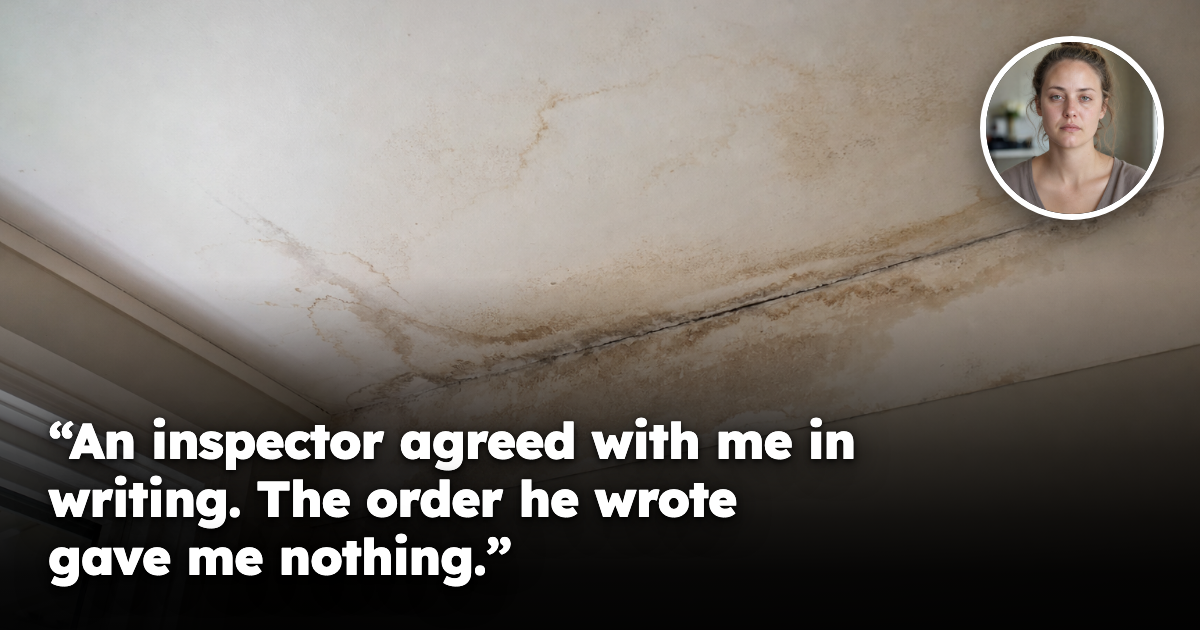
The problem arrived through the ceiling — water in the join between the old roof and the new. A stain that grew, then a smell, then plasterboard that flexed under a thumb. The builder came twice, silicone in hand, then stopped returning her calls.
So she notified the state regulator of a dispute. An inspector was appointed, spent two hours in the roof cavity, and produced a written report saying what she already knew — the work was defective. Then he served a written order on the builder requiring him to fix it by a specified date. She cried in the driveway, and thought it was over.
Her question, eleven months and roughly $47,000 later:
'A government inspector investigated my house, agreed with me in writing, and ordered the builder to fix it. How is it possible that the order didn't actually make him do anything?'
The short answer
Because that order was never made for her.
It was made about her house, at her request, on her evidence. But the statute that creates it contains a sentence most homeowners never see: apart from one narrow carve-out, a rectification order of that kind does not give rise to any rights or obligations.
It is not a judgment and not a debt. It creates no duty the builder owes her and hands her nothing enforceable in a court. It is an instruction from a regulator to a licence holder, and its force runs toward the licence, not the house.
What the order actually is
The carve-out is the key. Complying is a condition of every contractor licence, and a contractor who fails to comply before the specified date — without reasonable cause — is guilty of improper conduct, a disciplinary matter.
So the machinery does bite — just somewhere she doesn't live. If her builder ignores the order, the consequence is a question about his licence, and it repairs nothing above her daughter's bedroom.
And here is the detail proving deliberate drafting rather than oversight: in a neighbouring part of the same Act, failing to comply with a rectification order is an offence, carrying penalties that accrue for every day it continues. The legislature knows how to give an order teeth. In one part it did; in the part governing her dispute, it wrote the opposite.
The trap inside the trap
Here is where it started costing money. The order must state that it will cease to have effect if the matter giving rise to it becomes the subject of a building claim.
A building claim is the enforceable route — the tribunal application that can order money paid or work done. So: she holds an order creating no rights, and the moment she pursues the remedy that does, the order dies. Choosing one extinguishes the other.
Nor is the swap freely reversible. A building claim can normally be withdrawn at any time — but if the claimant was subject to a rectification order immediately beforehand, it may not be withdrawn except with the leave of the tribunal, and while the tribunal may restore that order, the word is "may".
The witness she could not call
She assumed her strongest asset was the inspector, and she keeps his report — the statute requires copies to go to both parties. But in the tribunal that report is something the decision-maker may have regard to, and is expressly not bound by; and the inspector may be called to give evidence only by the tribunal — not by either party. The official who found the defect was not hers to call. She paid her own expert to say what the state's inspector had already found for free.
What the law does give her
The picture is two-sided. Nobody misbehaved: the inspector investigated properly, the regulator did what it is empowered to do, and her builder has not been found by any tribunal to have breached anything — just as a variation the owner asked for in writing can still leave a builder unpaid. The protections are real, too: a tribunal determining a building claim is required to have regard to the principle that rectification of the defective work by the responsible party is the preferred outcome.
This is not a system built to fail people. It is a system with two doors, where almost nobody is told which one they are standing in.
What it means for you
Her real loss was not the water. It was eleven months holding a piece of paper she believed was enforcement. The lesson is the same one running through the warranty that transfers to you with the clock already running and a builder's contract unenforceable in one direction only: the name of a protection tells you nothing about its weight. "Order" sounds heavier than "claim". It isn't. Before relying on any remedy, find out what it creates — a right, or a referral.
This is where a suburb-level view fails most completely. Two houses on one street can share a median, a growth rate, a school catchment and a council, and not share the thing that decided her year: their build history. Who did the work, whether it was disputed, whether an order was made. One is a clean asset. The next, on identical fundamentals, carries an unresolved defect and a builder who has stopped answering.
A suburb median has never once read a building file. That is the gap our work exists to close: measure at street level rather than suburb level and the spread between the best and worst streets in one suburb routinely runs 20–30% on effective yield — achieved rents rather than asking rents, real vacancy duration, true days on market, genuine street-level supply.
The pro-investment close
Every rule that cost her eleven months was published and readable years before she needed it. That such an order creates no rights. That it dies when a claim begins. That the inspector is the tribunal's witness, not hers. She lost time to a knowledge gap, not a conspiracy.
Which means it is available to you in advance, cheaply: ask what the remedy you are offered creates, whether pursuing a second extinguishes the first, and what a defect history looks like over a property before you buy rather than after.
Risk you can read in advance is not a threat. It is a line item, a negotiating position, and an edge over every buyer bidding against you who never looked.
She got the roof fixed in the end. She just paid eleven months and an expert's fee to learn the difference between a document that agrees with you and one that binds someone.
If there's a specific street you're weighing up right now, check its Street Score first — it's free, takes ten seconds, and tells you whether that street is pulling the suburb average up or riding on it.
Frequently asked questions
Why didn’t the inspector’s written order force the builder to fix the defect?
Because the rectification order created by the state regulator was not enforceable by the homeowner. The article says it did not give rise to any rights or obligations for her, so it was an instruction from the regulator to the licence holder rather than a court-enforceable order.
What happens if a building dispute becomes a formal building claim after a rectification order is made?
According to the article, the rectification order must state that it ceases to have effect if the matter becomes the subject of a building claim. That means pursuing the enforceable route can make the earlier order disappear.
Can the homeowner call the inspector as a witness in a tribunal hearing?
No. The article says the tribunal may have regard to the inspector’s report, but it is not bound by it, and the inspector may be called only by the tribunal, not by either party.
What is the practical difference between a rectification order and a building claim?
A rectification order can lead to regulatory consequences for the builder’s licence, but it does not itself create a right the homeowner can enforce in court. A building claim is the enforceable route that can order money paid or work done.
What should a buyer or homeowner check before relying on a building defect remedy in Australia?
The article says to check what the remedy actually creates, whether starting one process ends another, and what defect history exists for the property. It also warns that the label of a protection does not tell you how much legal weight it really has.
General information only. It does not take your objectives, financial situation or needs into account, and nothing here is legal, financial, taxation or investment advice specific to your circumstances.