News · 24 August 2026 · 5 min read
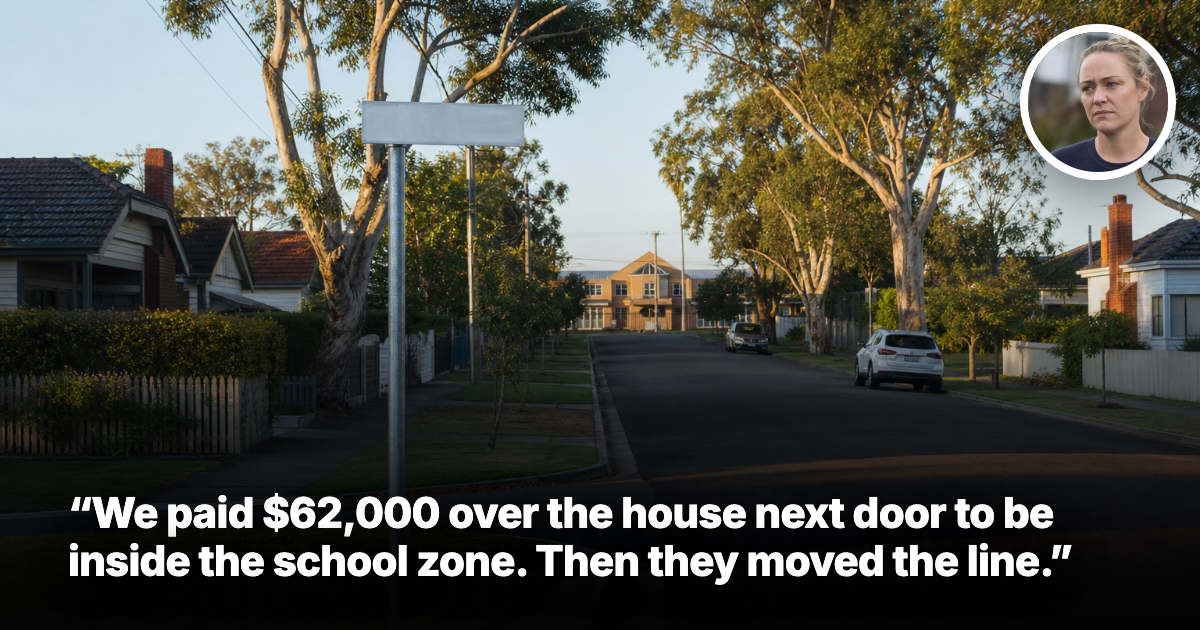
'We paid $62,000 over the house next door to be inside the school zone. Then they moved the line'
She paid $62,000 over the house next door to be inside a sought-after school catchment. Then the department redrew the boundary — and she learned the line is made of policy, not stone: no compensation, no appeal, no guarantee it cannot move again.
She is 36, and she did everything the property advice columns tell young families to do.
In 2023 she and her husband stretched to buy a modest three-bedroom house on the right side of a particular street. The house next door — same vintage, same block size, same orientation — had sold three months earlier for $62,000 less. The difference was not the house. It was the line. Her side of the street sat inside the catchment of one of the state's most sought-after public primary schools. The other side did not. Their daughter was two. The premium was the price of her classroom.
They did the maths the way families do: the premium hurt, but it was cheaper than twelve years of private school fees, and everyone knows catchment property holds its value because the school is always there.
Last month the education department published the new enrolment boundaries. A new school is opening two suburbs away, and the catchments around it have been re-drawn. Her street — her side of her street — is out. The line she paid for has moved a kilometre east, and there is nobody to appeal to, nothing to claim, and no rule that says it cannot move again.
The question
"I get that boundaries have to change when new schools open. But I paid a real, measurable premium for a specific line on a map — a line the government drew and the market priced. How can that line just move, taking the value with it, with no compensation and no appeal? And why did nobody — not the agent, not the conveyancer, not the bank — ever mention that it could?"
The answer
Because of what a catchment boundary actually is — and it is not what most buyers think it is.
A school catchment line looks like a planning instrument. It is drawn on a map, it runs neatly down the middle of streets, and the market prices it as if it were as solid as a zoning overlay. Legally, it is nothing of the kind. In every Australian state, enrolment boundaries are administrative settings — policy decisions made inside an education department about which addresses a school must accept. They are not on your title. They are not in the planning scheme. They do not run with the land, because they were never attached to the land. They attach to the school, and the school can be told to draw a new one.
There is no compensation, because nothing of yours was taken. When a government resumes land or downzones it, the law has compensation regimes — gates, windows, claims processes. A catchment re-draw triggers none of them, because the law does not recognise enrolment eligibility as a property right. What she lost was a market premium attached to a policy setting. The policy changed; the premium went with it.
There is no appeal on the merits, because there is no decision made about her. The boundary was not a decision about her house — it was a decision about a school's capacity. Individual hardship is not a ground for review. The consultation period she may not even have noticed was the entire process.
And there is no grandfathering obligation. Some departments honour existing enrolments and siblings; many do, as policy. But policy is all it is. The family that bought for a child starting in 2030 holds no entitlement at all — only a hope that the line stays put, which is precisely the hope she paid $62,000 for.
None of this makes the department a villain. New schools have to open, and when one opens, the boundaries around it have to move. The unfairness is not that lines move. It is that nobody tells buyers, at the moment they pay the premium, that the line is made of policy, not stone.
What it means for her
The honest answer is uncomfortable: the premium is gone, and it is not coming back through any process she can start. What she still owns is a good house in a good suburb with a good school two kilometres away instead of one. The loss is real but financial, not educational, and it is a paper loss unless she sells.
Her next move is the one available to every owner on the wrong side of a moved line: hold, and let the new equilibrium price itself in. Catchment premiums re-form around new boundaries faster than most people expect, because the buyers who pay them are buying a setting, not a guarantee. ## What it means for you
The lesson is not "don't pay catchment premiums." Families will keep paying them, because the alternative is private school fees and the maths often still works. The lesson is to price the premium for what it is — a bet on an administrative setting with no compensation regime behind it — and to size it accordingly. A premium treated as permanent equity is one thing. A premium treated as prepaid school fees, recoverable only while the line holds, is quite another.
This is also where suburb-level thinking breaks completely. A catchment boundary does not run around a suburb — it runs through it, down the middle of streets, sometimes through the middle of a single block of units. Two houses four hundred metres apart can share a median price, a growth rate, a council, a vacancy rate and a school catchment right up until the day the line moves, and then they share nothing. It is not the only boundary that can shift under a property without compensation — coastal lines have done the same to entire lots. The gap between the best and worst streets in a single suburb already runs at twenty to thirty per cent of effective yield once you measure achieved rents, real vacancy duration and true days on market — and a boundary re-draw can redraw that gap overnight, in either direction. A suburb median has never once read an enrolment map. The data that matters lives at street level, because that is where the lines are drawn.
Every part of this story was knowable before she signed the contract: that catchments are policy, that policy moves, that new schools trigger re-draws, and that the premium is priced by the market but guaranteed by nobody. A threat happens to you. A risk you can read in advance is a line item — something you price, something you discount, something you step past while the buyer next to you pays full freight for a line made of paper. The investors who compound quietly over decades rarely found a secret. They asked what the premium was actually buying.
She is not selling, and the new school her street was re-zoned to is, by every early measure, a good one. What she will never do again is pay a premium for a line on a map without first asking who drew it, what would make them move it, and what she gets back if they do.
If there's a specific street you're weighing up right now, check its Street Score first — it's free, takes ten seconds, and tells you whether that street is pulling the suburb average up or riding on it.
Frequently asked questions
Why did the buyer lose the school catchment advantage after paying more for the house?
Because school catchment boundaries in Australia are administrative policy settings, not part of the property title. When the education department redrew the boundary for a new school, the house moved out of the catchment and the premium attached to that policy setting went with it.
Can a homeowner get compensation if a school zone changes after they buy?
Not in the situation described in the article. The boundary change did not take land or alter title rights, so there was no compensation regime triggered for the lost catchment premium.
Is there any appeal if a school catchment boundary moves and your house is excluded?
The article says there is no appeal on the merits for an individual home. The boundary change was a department decision about school capacity, not a decision about that specific property.
Are school catchment protections ever guaranteed for existing buyers or siblings?
Some education departments may keep existing enrolments and siblings in place as policy, but the article says that is not a legal entitlement. It can be changed because the boundary itself is only a policy setting.
What should buyers think about before paying extra for a house inside a school zone?
They should treat the premium as a bet on an administrative setting, not permanent equity. The article says buyers should ask who can move the line, what would trigger a redraw, and what happens if it changes.
General information only. It does not take your objectives, financial situation or needs into account, and nothing here is legal, financial, taxation or investment advice specific to your circumstances.