News · 24 August 2026 · 5 min read
'The builder said a fixed price was impossible. Eight months and $61,000 later, I found out the contract itself was the problem'
She signed a cost-plus renovation contract because the builder said a fixed price would be dishonest. Eight months and $61,000 later, she learned the law only allows cost-plus in narrow circumstances — and a builder who breaks those rules cannot enforce the contract at all.
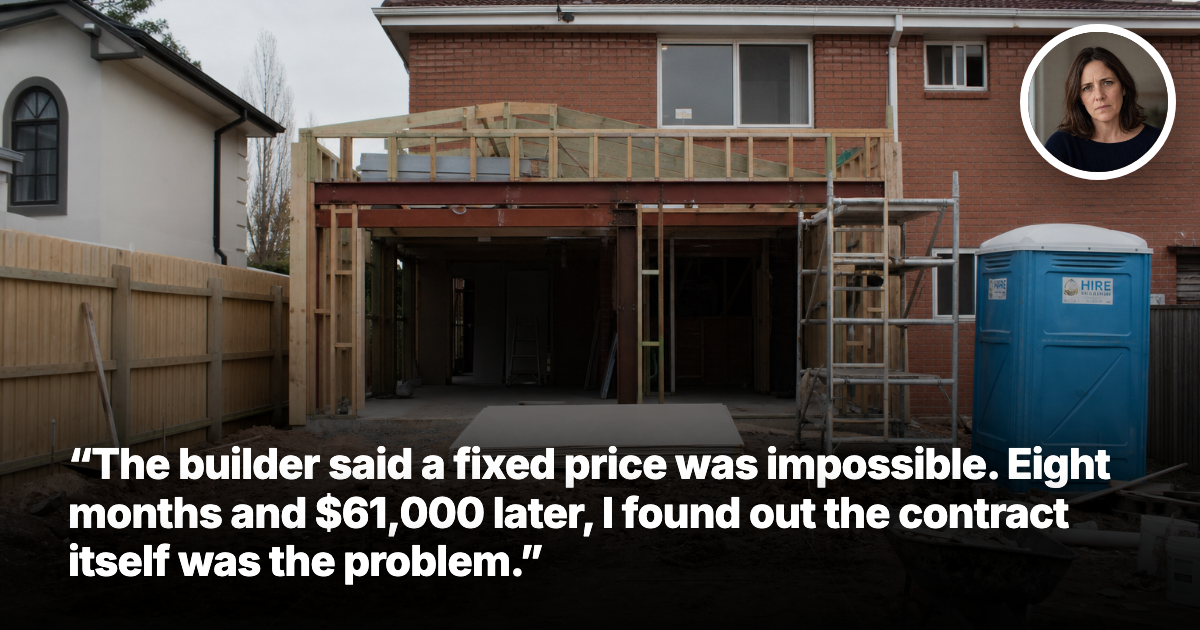
She is 44, and until last year the biggest thing she had ever renovated was a bathroom vanity.
She and her partner bought a solid 1970s brick house on a good street — wide block, tired lean-to laundry that was always going to come off. The plan was a rear extension: new kitchen, new living room, a proper laundry, a deck. They interviewed four builders. Three gave fixed quotes. The fourth walked through, shook his head, and said a fixed price would be dishonest.
"Too many unknowns," he said. "Once we open up a house this age, nobody can tell you what's there. Anyone who fixes a price is guessing, and they'll make it back on variations. The honest way is cost-plus. You pay what it actually costs, plus my margin. You'll come out ahead."
It sounded like integrity. They signed.
Eight months later the estimate — a single figure on page three — had been passed by $61,000, the invoices kept arriving, and when she asked a lawyer friend to look at the contract, the friend went quiet and asked one question back: "Do you know this contract might never have been allowed to exist?"
The question
"I thought cost-plus was just a type of contract. More honest, even. Now I'm told the law has rules about when a builder can use one at all — and that if he broke them, I might not have to keep paying. Is that real? And if it is, why did nobody mention it before I signed?"
The answer
It is real, and it is written down.
Australian building law does not treat cost-plus as just another pricing option. It treats it as the exception — a structure a builder may only reach for in narrow circumstances, because every dollar of risk in it sits on the owner.
The starting rule is blunt. A builder must not enter into a cost-plus contract at all unless one of two things is true: the contract belongs to a class the regulations allow, or the work is the renovation, restoration or refurbishment of an existing building and it is genuinely impossible to calculate the cost of a substantial part of that work without doing some of it first. Read that second limb twice. It is not "the builder felt uncertain." It is a two-part test — and many cost-plus contracts on ordinary extensions meet neither part.
Even when cost-plus is allowed, it must contain a fair and reasonable estimate by the builder of the total he is likely to receive. Not a range. An estimate.
Then comes the part that changes the kitchen-table conversation. If a builder fails to comply, the contract does not just attract a fine. The builder cannot enforce the contract against the owner. She can stop performing, and he cannot sue her on it. His only route back is to ask the tribunal for the cost of the work plus a reasonable profit — and the tribunal only awards it if that would not be unfair to the owner. The contract dies in one direction. His lifeline is discretionary.
None of this makes the builder a villain. There are genuine renovations — termite-riddled frames, fire damage, heritage fabric — where nobody can price the work until the walls come off, and cost-plus is the only honest structure. What the law does not say is that "we'd rather not commit to a number" is the same as "a number is impossible." That difference is the whole contract.
The deposit is capped. Before work starts, a builder cannot demand or receive more than five per cent of a contract price of $20,000 or more (ten per cent below that). If he takes more, the owner may avoid the contract entirely at any time before completion — and a court can order some or all of what she paid refunded. A twenty per cent "booking deposit" is not commitment. It is a breach.
The contract price is a ceiling, not a floor. A builder must not demand, recover or retain more than the contract price unless the Act itself authorises it. Every invoice above the number must trace to a lawful variation, not to confidence.
An escalation clause is void unless it was explained and initialled. A clause letting the price rise with labour or material costs is only allowed above a high threshold or in an approved form — and even then it is void unless the builder gave a prescribed notice explaining its effect before signing, and the owner initialled right next to it. Buried on page eleven, it does not exist.
Two quiet protections sit underneath. A building contract gives the builder no interest in the land — he cannot caveat her title over a payment dispute. And paying an invoice does not waive her right to dispute it.
What it means for her
The first step is unglamorous: pull the contract, find the estimate, and ask whether the two-part test was ever met. If the honest answer is no, the conversation changes tone, because the law has already changed it for her. Owners have unwound entire contracts over a missing warning discovered years after the work finished, and a tribunal win is only the beginning — some builders simply never pay, which carries its own leverage. A lawyer who does residential building work can read the contract in one sitting; that read is the cheapest money in the project.
What it means for you
The pattern is not "avoid builders." It is that the structure of the contract decides who carries the risk, and the law has already picked a side — the owner's — in more places than most owners realise. The investors who come out ahead are not the ones who found a trustworthy smile. They read the contract type before they signed it.
This is also where suburb-level thinking breaks. Two houses four hundred metres apart can share a median price, a growth rate, a school catchment, a council and a vacancy rate — every number on a suburb report identical — while one is a clean, certifier-documented build and the other carries forty years of owner-built additions and handshake contracts. The gap between the best and worst streets in a single suburb runs at twenty to thirty per cent of effective yield once you measure achieved rents, real vacancy duration and true days on market — and it widens the moment something structural goes wrong, because rectification cost is a street-level fact. A suburb median has never once read a building contract.
Every rule in this story was published, in force and written in ordinary language before her deposit cleared. A threat happens to you. A risk you can read in advance is a line item — something you price, something you negotiate against, something you step past while the next buyer never looked. Property rewards the people who ask one more question than the person across the table expects.
She is still negotiating with her builder, and the renovation will finish. What will not happen again is her signing a contract whose type she did not understand because someone described risk as honesty.
If there's a specific street you're weighing up right now, check its Street Score first — it's free, takes ten seconds, and tells you whether that street is pulling the suburb average up or riding on it.
Frequently asked questions
When can an Australian builder legally use a cost-plus renovation contract?
Australian building law treats cost-plus as an exception, not a standard pricing option. It can only be used in limited circumstances, including some approved contract classes or when renovating, restoring or refurbishing an existing building and it is genuinely impossible to calculate the cost of a substantial part of the work without starting it.
What happens if a builder uses a cost-plus contract when the law does not allow it?
The builder cannot enforce the contract against the owner. The owner may not have to keep paying under that contract, and the builder’s only fallback is to ask the tribunal for the cost of the work plus a reasonable profit, if that would not be unfair to the owner.
Does a cost-plus contract have to include an estimate in Australia?
Yes. Even where a cost-plus contract is allowed, the builder must include a fair and reasonable estimate of the total amount likely to be received. The article says it must be an estimate, not just a range.
How much deposit can a builder ask for before work starts on a building contract?
For a contract price of $20,000 or more, the deposit cannot be more than 5 per cent. For contracts below $20,000, it is 10 per cent. If a builder takes more, the owner may be able to avoid the contract before completion and seek a refund.
Can a builder keep charging more than the contract price in a renovation?
Not unless the extra amount is authorised by the law, usually through a lawful variation. The article says the contract price is a ceiling, and an escalation clause is void unless it was properly explained, notified and initialled before signing.
General information only. It does not take your objectives, financial situation or needs into account, and nothing here is legal, financial, taxation or investment advice specific to your circumstances.