News · 24 August 2026 · 5 min read
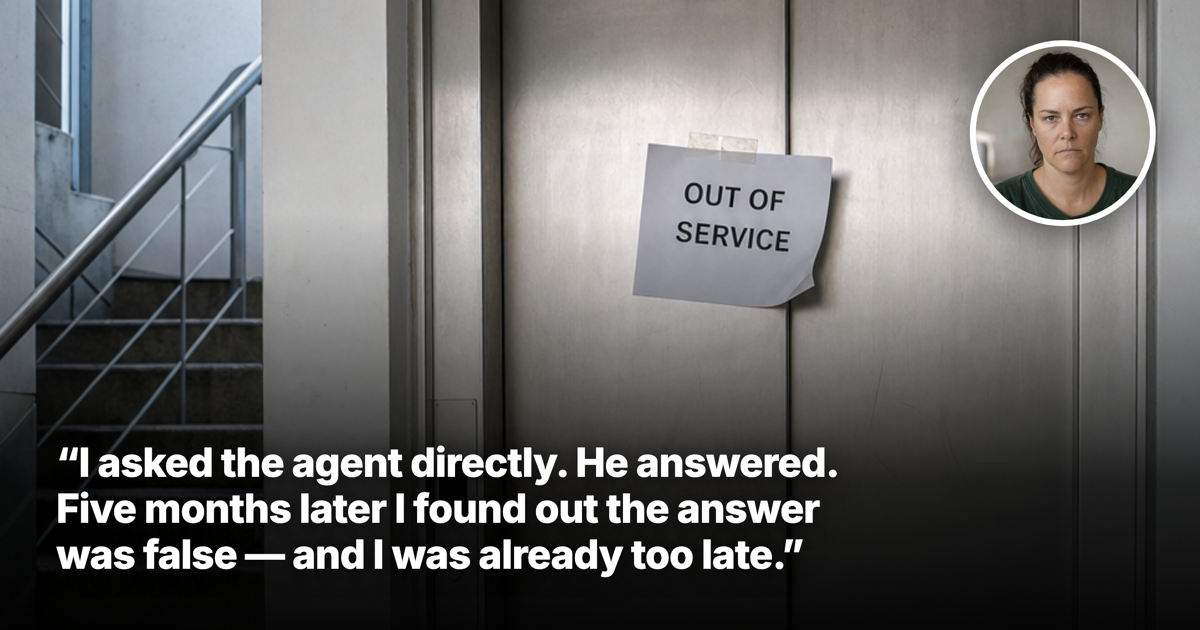
'I asked the agent directly. He answered. Five months later I found out the answer was false — and I was already too late'
She asked at the inspection whether the lift and the garage came with the unit and was told yes to both. Neither was true. By the time she found out in month five, the law's remedy for being misled had already closed — because the three-month clock runs from the day she moved in, not the day she discovered it.
She did not raise her voice once while she told us. That was the part that stayed with us. She is 37, a single mother, and her nine-year-old son has a disability that makes stairs a genuine daily problem rather than an inconvenience. When their old place was sold out from under them, she searched for eleven weeks, and she searched for two things: a lift, and a lock-up garage close enough to the door that she could get him from the car to the couch without a negotiation.
She found a ground-floor unit in a small block that had both. The listing said so. She asked the question out loud at the inspection, because she had learned by then not to assume: is the lift part of the tenancy, and is the garage mine? She was told yes to both.
She signed that afternoon.
What she found out in month five
The lift had been out of service when she inspected it, and a decision had already been made — before she ever saw the building — that it would not be repaired. It was to be decommissioned.
The garage was not part of her unit at all. It belonged to another lot, under an informal arrangement with someone who had since moved on.
By the time she pieced this together it was month five. Her son had been managing a flight of stairs for twenty weeks, and she had been paying for taxis on the days he could not. When she added it up, the number was $14,800.
So she went looking for the provision that deals with being told something false about a property before you sign.
She found it. It is a good one. And it had closed thirteen weeks earlier.
The question she asked us
"I asked the question. I got an answer. The answer was wrong. Why does the law only care if I worked that out in the first twelve weeks?"
The answer
There is a specific remedy for exactly her situation, and it is stronger than most renters realise.
A tenant may apply to the tribunal to terminate the agreement because the lessor or the agent gave them false or misleading information. The grounds are broad: the condition of the premises or inclusions, the services provided for the premises, any matter likely to affect their quiet enjoyment, the documents that must be given to them, and even the rights and obligations of either party. She was misled on at least two of those limbs. It is also one of the few applications a tenant can bring without first giving notice.
The tribunal must then have regard to the extent to which the false information induced her to enter the agreement, misrepresented the condition or the services, or affected her quiet enjoyment — and to any adverse effects likely to be suffered by the tenant or other persons if the agreement were not terminated. Her son sits squarely inside that last phrase.
None of it helped her, because of one line at the front.
The application must be made within the first three months on which the tenant occupies the premises.
Not three months from when she found out. Three months from the day she moved in.
Why that single word matters so much
Read that clock against the others in the same body of law and the asymmetry is stark. The general right to bring a claim for a breach of a tenancy agreement runs for six months after the person becomes aware of the breach. That clock waits for you to find out.
The misrepresentation clock does not. It runs from occupation — from the day you carry the boxes in, which is necessarily before you could have discovered anything.
The practical effect is uncomfortable to state plainly: the more effective the misrepresentation, the more likely its remedy has already expired. A lie spotted in week two costs the person who told it. A lie spotted in month five costs you.
And this is not a deadline you can argue around. The tribunal may only consider an application if it is satisfied the applicant is entitled to make it. It is a door, not a discretion.
The shape recurs: a database listing where the warning owed to you is a fine, not a precondition, or a reletting clause producing two very different numbers.
What we told her she does still have
We want to be fair about this, because the law is not stacked against her everywhere — it failed her in one specific place.
The six-month-from-awareness route is open. That clock started when she found out, and runs during the tenancy or after it ends. The tribunal's powers there are wide: payment of money, compensation, orders requiring performance, and orders directing rent into the tribunal until things are put right.
The obligations at the start of a tenancy are real and ongoing. Premises must be clean, fit to live in, in good repair and compliant with minimum housing standards — a duty that continues for the whole tenancy, with no three-month gate on it.
There is also a repeated-breaches route for things like quiet enjoyment and the lessor's general obligations, with no equivalent window — one of many clocks that run whether or not anyone watches them, like the short notice after which a tenant's goods can be sold with good title.
Nobody hid the three-month rule. It was published, free, and readable on the day she signed. It simply never occurred to her to check the expiry date on a protection she did not yet know she would need.
What this means if you own property
This is where it stops being a tenant story.
Two units in the same suburb share a median, a growth rate, a school catchment, a council and a headline vacancy rate. Every number in the summary is identical. They are not the same asset — because one has a working lift and secure parking, and the other has a decommissioned lift, contested parking, and a tenant who leaves in month five and tells twelve people why.
That does not appear in a suburb metric. It appears in achieved rents rather than asking rents, real vacancy duration rather than a quarterly average, true days-on-market, and genuine street-level supply and demand — the column where holding cost lives. Measured that way, the spread between the best and worst street in a single suburb runs to 20–30% on effective yield. The data is not poor; the unit of measurement is wrong.
Read at street level, you are buying the building that keeps its tenants. Read at suburb level, you are buying an average that has never once ridden the lift.
Her problem was never that the rules were unfair — it was that she met them late. A threat happens to you. A risk you can read in advance is a line item, a negotiating position, and an edge over every buyer at that inspection who never looked.
She never needed the law to be kinder. She needed twelve weeks she did not know she was spending.
If there's a specific street you're weighing up right now, check its Street Score first — it's free, takes ten seconds, and tells you whether that street is pulling the suburb average up or riding on it.
Frequently asked questions
If a tenant is given false or misleading information about a rental property in Australia, what can they usually do?
In this article, a tenant may apply to the tribunal to terminate the agreement because the lessor or agent gave false or misleading information. The misinformation can relate to the premises, inclusions, services, quiet enjoyment, required documents, or the rights and obligations of either party.
Does the three-month deadline start when the tenant discovers the lie or when they move in?
It starts from the day the tenant occupies the premises, not from when they discover the false information. That is why the tenant in the article was already outside the time limit by month five.
What made the tenant’s case serious enough to fall within the misrepresentation rules?
She was told the lift was part of the tenancy and the garage was hers, but neither was true. The article says those false statements affected the condition or services of the premises and likely influenced her decision to sign.
What remedies can a tenant still rely on if the three-month misrepresentation window has already closed?
The article says the six-month-from-awareness route for breach of tenancy agreement is still open. It also says tenants can rely on ongoing obligations, such as premises being clean, fit to live in, in good repair and compliant with minimum housing standards.
Why does this article say the issue matters for property owners as well as tenants?
Because what looks like the same unit on suburb averages can be very different in practice if it has real access, secure parking or a working lift. The article says street-level factors show up in achieved rent, vacancy duration and days on market, and can affect effective yield.
General information only. It does not take your objectives, financial situation or needs into account, and nothing here is legal, financial, taxation or investment advice specific to your circumstances.