News · 6 August 2026 · 10 min read
‘We found the same house on two streets. One is $380,000 more. The only difference is a line on a map’
Two houses, same suburb, same era, four bedrooms each — and a $380,000 gap explained entirely by which side of a school catchment boundary they sit on. The premium is real. But some of the most contested school-zone markets in Australia are built around selective-entry schools that have no zone at all, the boundary is often drawn by straight-line distance rather than roads, and zones are reviewed every year. The reframe that settles it: a premium is a price, not a value — so what is left when the benefit expires?
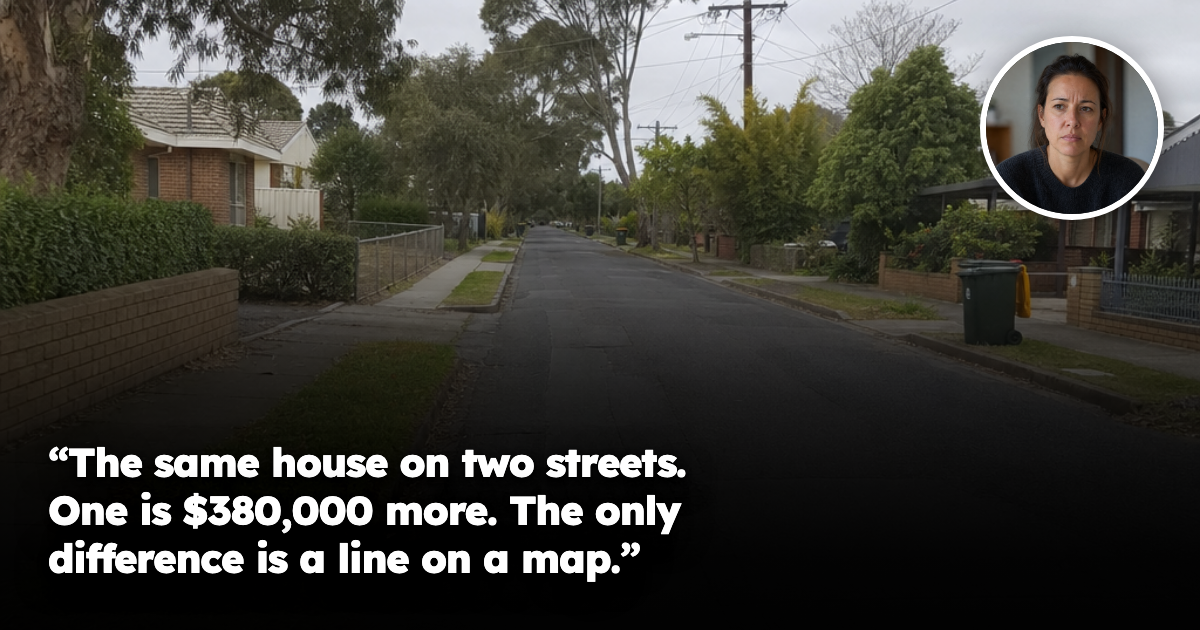
She sent us the two listings side by side, because she wanted someone to tell her she wasn't losing her mind.
Two houses. Same suburb in Melbourne's east. Same era, same brick, four bedrooms each, both needing a kitchen. One had a slightly better backyard. The other was $380,000 more expensive.
The only material difference between them was which side of a boundary they sat on. One address fell inside the zone for the local secondary college. The other, about six hundred metres away, did not.
Her eldest starts Year 7 in eighteen months. She and her husband have been saving for six years. And she asked us the question we get more often than almost any other at this time of year, and one that almost nobody answers honestly:
Is a school zone actually worth paying that for?
First, the uncomfortable part: the premium is real
There is a temptation in our industry to tell people that school-zone premiums are hype. They are not.
Ask anyone who works in Victorian real estate and they will tell you the same thing: properties inside desirable catchment zones consistently command a premium, and that zoning effectively creates its own little economy — pushing prices well above comparable homes in the streets just outside the line.
Note the precision in that. Not "above other suburbs." Above the streets just outside. Sometimes the next street. Sometimes the other side of the same road.
Recent analysis of Australia's strongest-performing government schools found suburbs built around them carry median prices spanning from around $437,000 to nearly $3.6 million, with the most contested postcodes in the country attracting more than fifteen thousand interested buyers at a time. Victoria alone accounted for eight of the twenty most in-demand school locations nationally.
And it is showing up in how families are compromising. In one prized Melbourne secondary zone right now, buyers priced out of houses are being openly sold townhouses as a $300,000 to $400,000 shortcut into the catchment — trading away the land and the backyard for the sole purpose of staying inside the line.
So no, she wasn't imagining it. The market really will charge you a few hundred thousand dollars for a boundary.
The question is what you actually receive for it.
What almost nobody checks before they pay
Three things. We ask them in every single conversation like this one, and in a decade of doing it, it is genuinely rare that a buyer has checked all three.
1. Is the school even zoned?
This is the one that stops people cold. A number of Australia's most prestigious and most sought-after government schools — the ones that drive the fiercest buyer competition and the biggest suburb premiums — are selective entry schools. Selective entry schools do not have catchment zones at all. Neither do specialist schools, language schools or flexible learning schools.
Living across the road from a selective school confers no enrolment right whatsoever. Your child sits the same exam as a child two hours away. You can pay a very large premium for proximity to a school your child has precisely the same statutory claim on from any address in the state — which is to say, none.
Some of the most competitive "school zone" property markets in the country are built around schools that have no zone.
2. Do you know where the line actually is, and how it was drawn?
Buyers assume catchment boundaries follow the things they can see — main roads, suburb borders, a creek, a railway line. Frequently they do not.
In metropolitan Melbourne and several of the larger Victorian regional centres, your designated local school is generally the nearest government school measured in a straight line from your permanent address. Elsewhere in the state, it is the nearest school by the shortest practical route by road.
Those two methods produce different maps. A straight line does not care about the freeway between you and the school, or that the only way to get there is a fifteen-minute detour. It draws a boundary that can cut through the middle of a block, along the back fences of a street, or down the centre line of a road — putting the odd numbers in and the even numbers out.
And the boundary is the thing that carries the legal weight. Where a child lives inside the zone, the school must offer them a place — that is a statutory right, not a courtesy. Live outside it, and you are applying for a place that exists only if one is spare.
There is a free, official, state-government map that will tell you exactly where the line falls for any address, for this year and next. It costs nothing. The relevant education department also states plainly that it does not endorse zoning advice from real estate agents or third-party websites — which should tell you how often the map and the marketing disagree.
3. Do you know the line can move?
It can. School zones are reviewed and a small number of them change every year. New schools open. Existing schools relocate or change what they offer. And — the important one for anyone paying a premium — boundaries get adjusted specifically to manage enrolment demand.
Think about what that means in the direction of travel. The more families that move into a catchment to access an in-demand school, the more pressure builds on that school's enrolment numbers, and the greater the likelihood the boundary is eventually tightened. The premium you pay is partly what creates the condition that can erode it.
Nobody is suggesting this happens often, or that it should stop you. But if you are paying $380,000 for a line on a map, you are entitled to know that the line is redrawn on an annual cycle by a government department managing capacity, and that nothing about your purchase price gives you a vote in it.
The part that actually decides this — and it isn't the school
Here is where our answer diverges from what she'd been told by everyone else.
A school catchment boundary is the purest example we have ever come across of something we spend our working lives arguing: the suburb is the wrong unit of analysis.
Consider what that boundary does. It runs through a single suburb. Both sides share a postcode. Both sides share a median price, the same council, the same shops, the same train station, the same census profile. Two houses can sit sixty metres apart, on the same street, looking at each other across the road — and one of them carries a legal entitlement to a school place that the other does not, worth a few hundred thousand dollars.
Every suburb-level number you can find is structurally incapable of seeing that. A suburb median is an average of both sides of the line. Suburb growth rates, suburb rental yields, suburb days-on-market — all of them blend two populations of housing that the market prices as fundamentally different assets. If you are researching this decision at suburb level, you are looking at a number that has averaged away the exact thing you are being asked to pay for.
This is precisely why our research runs at street level rather than suburb level. It is not a stylistic preference. It is because effects like this one — legal, geographic, invisible on a median — routinely produce spreads of 20 to 30 per cent in effective yield and materially different growth and days-on-market outcomes between two streets that every dataset in the country files under the same name. We have written before about why the real story is almost always in the streets rather than the suburb.
A school zone is simply the most legible version of a thing that is true everywhere, for reasons that are usually far less obvious than a government boundary: aspect, slope, road hierarchy, lot geometry, what backs onto the rear fence, the construction era of the subdivision, buyer depth. The zone is visible. Most street-level value drivers are not. If you accept that a line on a map can be worth $380,000 inside one suburb, you have already accepted the entire argument.
The test we gave her: a premium is a price, not a value
The most useful reframe we can offer anyone in this position is this.
A school zone premium is not the value of the zone. It is the price the market is charging for it today. Those are different numbers, and they are set by different things — the second one is set by how many other anxious parents are bidding this year.
And it is a price being paid for a benefit with a finite life. Your child is enrolled for six years, or twelve if you have two. You will hold the house for twenty, thirty, possibly forever. The zone benefit switches off long before the asset does.
So the real question is never "is the school zone worth $380,000." It is:
What is left when the benefit expires?
If the streets inside that line are also the better streets on the fundamentals — bigger land, better orientation, deeper buyer pool, tighter days on market, genuine scarcity — then the zone is a bonus sitting on top of an asset that stands up perfectly well without it. You will be fine. You would have wanted that street anyway.
If the only thing the premium is buying is the boundary, you have paid a large, permanent, capitalised sum for a temporary benefit on an ordinary asset — and your exit depends entirely on the next buyer having a child the right age, in the right year, with the same conviction, in whatever market exists then.
That is a much narrower buyer pool than she realised. And narrow buyer pools are exactly what punish you when conditions turn.
They have turned. National home values fell 0.7 per cent in July, the sharpest monthly drop since December 2022. Sydney fell 1.4 per cent and Melbourne 1.2 per cent. The downturn has now reached Brisbane and Adelaide. Upper-quartile values are down 3.2 per cent over three months while the lower price tier has actually risen 0.3 per cent — a split we examined in detail in why the average is lying about this market. Capital city auction clearance rates have sat below 50 per cent since late May.
In that market, the premium is being tested in real time. A well-presented period home inside a popular Melbourne school zone was passed in at auction just last weekend. The zone did not save it, because a school zone is a demand driver, not a floor under the price. Those are also different things.
So what did we tell her to do?
Four steps, in order, before the offer:
1. Check the official government zoning map for both addresses yourself — not the listing, not the agent, not a portal's school tab. Print it. Check next year's zone as well as this year's, because both are published. 2. Confirm the school is actually zoned, and that the school driving the premium is the one your address is designated to — not simply the one nearby with the reputation. 3. Price the two streets on their fundamentals with the school removed entirely. Land size and shape, orientation, what the street backs onto, how long comparable homes take to sell, how deep the buyer pool is, how much competing supply is coming. This is the same discipline that separates two suburbs that look identical on paper. If the expensive street still wins with the school taken out of the equation, the premium is defensible. If it only wins because of the school, you are buying a boundary. 4. Then decide what the difference is worth to you as a family — which is a genuine, legitimate, personal answer that no data set can give you. Some families will happily pay it, and they are not wrong to. Just pay it knowing precisely what you bought.
She went and did step one that afternoon. The cheaper house was out of the zone, as she'd been told. What she hadn't been told was that the boundary ran along the rear boundary of the more expensive street — meaning three of the recent comparable sales the agent had used to justify the price were themselves outside the zone.
That is not a scandal. It is just what happens when a decision worth several hundred thousand dollars is made using a number drawn at suburb level.
The bottom line
School catchments are one of the most durable, most under-appreciated demand drivers in Australian residential property. They are geographic, they are legally enforceable, they are backed by a statutory right to a place, and they are published free of charge on a government map. Very little else about location advantage is that concrete. Buying inside a good one is a perfectly sound decision and often an excellent one.
But it is worth being clear about what is being purchased. In a market where the top quartile is falling three per cent a quarter and half the auctions are passing in, the buyers who get hurt will not be the ones who paid a premium. They will be the ones who paid a premium for something they never actually verified, on a street they never actually researched, on the strength of a suburb median that could not see the line they were paying for.
The mistake is not paying more to be in a school zone.
The mistake is buying the line instead of the street.
If there's a specific street you're weighing up right now, check its Street Score first — it's free, takes ten seconds, and tells you whether that street is pulling the suburb average up or riding on it.
Market data & R-Scores for locations in this article
Drill Down Into the Markets Mentioned Above
Inspect live monthly R-Scores, median prices, rental yields, and street-by-street scores for the cities and council areas referenced in this article:
Frequently asked questions
How can a school zone add $380,000 to the price of a house in Melbourne or elsewhere in Australia?
The article says desirable school catchment zones can create their own market, pushing prices well above similar homes just outside the line. In some Melbourne zones, buyers are even paying a $300,000 to $400,000 shortcut through townhouses just to stay inside the catchment.
What should I check before paying a premium for a school-zone property?
First, confirm whether the school is actually zoned, because selective-entry schools, specialist schools, language schools and flexible learning schools do not have catchment zones. Then check the official government zoning map for the exact address and compare both this year’s and next year’s zone.
Do school catchment boundaries always follow roads or suburb borders?
No. In metropolitan Melbourne and some Victorian regional centres, the local school is generally the nearest government school measured in a straight line, while elsewhere in Victoria it is often the nearest by the shortest practical road route. That means the boundary can cut through streets, blocks or even down the centre of a road.
Can a school zone boundary change after I buy a house?
Yes. The article says school zones are reviewed every year and some change annually as new schools open, schools relocate, or boundaries are adjusted to manage enrolment demand. That means the line you pay for is not fixed forever.
Is a school zone premium the same thing as value?
No. The article says the premium is a price the market is charging today, not the value of the zone itself. It is also a temporary benefit, because a child’s enrolment advantage ends long before you own the home.
General information only. It does not take your objectives, financial situation or needs into account, and nothing here is legal, financial, taxation or investment advice specific to your circumstances.