News · 24 August 2026 · 5 min read
She signed as guarantor for $522,000. Seven years later the bank said she owed $610,000
A 68-year-old woman guaranteed her daughter's $522,000 home loan in 2019. It was topped up twice without her being asked. Why a guarantor's liability does not automatically follow the loan upward.
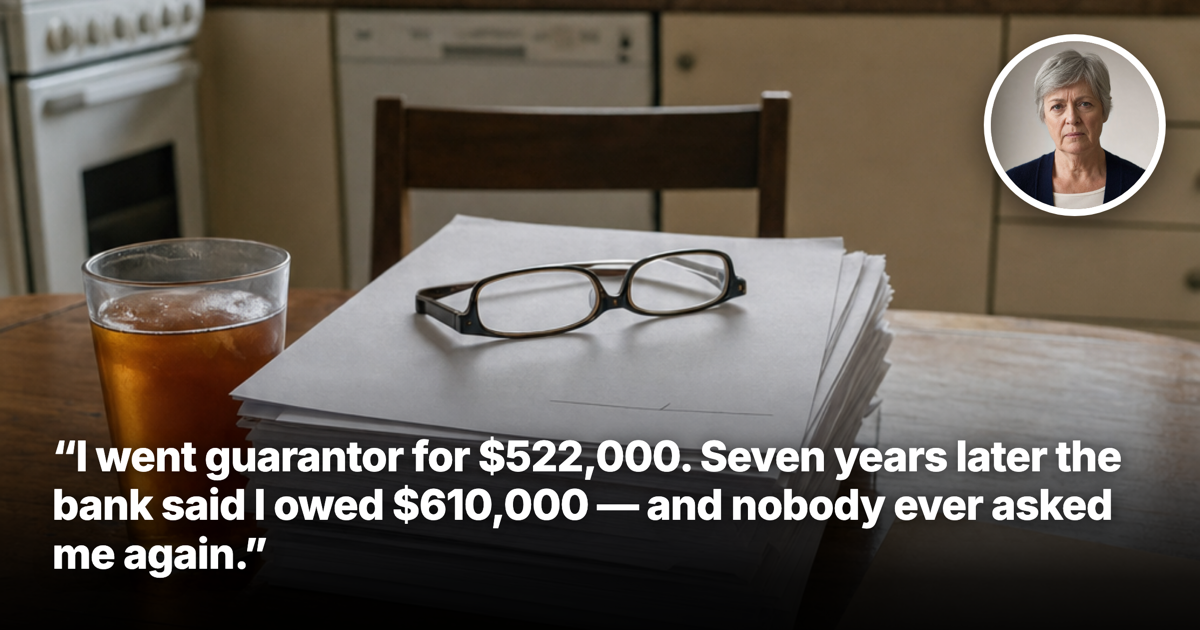
She signed as guarantor for $522,000. Seven years later the bank told her she owed $610,000 — and nobody had ever asked her again.
We get this question constantly, and it almost always arrives the same way: not at signing, but years later, when someone finally reads a letter properly.
The situation
She is 68. In 2019 she went guarantor so her daughter could buy her first home. The loan was $522,000. She read the papers at the kitchen table, understood exactly what she was agreeing to, and signed. Her own house — paid off, worth about $740,000 — was the security. She had decided that if the worst happened, she would carry it.
What she had not decided was to carry anything larger.
Over the following seven years the loan was topped up twice: once for a renovation, once to consolidate other debts. Her daughter signed for both. The balance is now around $610,000. She was not asked, and received no document she recalls signing.
Eleven weeks ago, after her daughter's circumstances changed, she was told her guarantee stood behind the full current balance — $88,000 above the number she had budgeted for.
Her question, exactly as she put it to us:
"I agreed to a specific loan, for a specific amount, in a specific year. It has been increased twice since and nobody asked me. How can I be liable for money I was never told about, let alone agreed to?"
The answer
Here is the part almost nobody knows, and it is written plainly in the law that governs consumer credit in this country.
A guarantor's liability does not automatically follow the loan upward.
Where the terms of a credit contract are changed to increase — or to allow for an increase in — the liabilities owed, the liabilities of a guarantor are not increased unless the credit provider has done two things:
- given the guarantor a written notice setting out particulars of the change; and
- subsequently obtained from the guarantor a written acceptance of the extension of the guarantee to those increased liabilities.
Both. In that order. The word subsequently is load-bearing: an acceptance gathered in the same bundle, before the particulars were disclosed, does not do the job. Sequence is part of the requirement, not a technicality about it. The same two-step shape governs how far a lender's security can stretch across a borrower's own properties — a clause that is lawful and disclosed still has to be activated by something a human being actually does.
This is the opposite of what almost every guarantor assumes. People sign believing they have handed over an open-ended commitment that tracks whatever the loan becomes. In fact the exposure is pinned to the obligations as they stood, and each step upward is a separate act of consent somebody has to actually obtain.
There are limits. The rule does not reach increases already ascertainable from the contract — a scheduled rate movement, a repayment increase the contract itself spells out — nor certain changes carrying their own notice regime. And it does not reach an increase resulting from a deferral or waiver of the borrower's obligations for a period not exceeding 90 days, which tells you precisely how much short-term forbearance can be extended without going back to the guarantor.
A deliberate top-up for a renovation is not a scheduled rate movement.
Three more things sitting in the same division
A guarantee can be withdrawn from later than people think. The right to withdraw by written notice before credit is first provided is reasonably well known. The second limb is not: a guarantor may withdraw after credit has been provided if the credit contract actually made differs in some material respect from the proposed contract they were shown before signing. The comparison is against the document you were given, not the one that ended up executed.
A guarantee is not enforceable unless a copy of the contract document was given to the guarantor before signing. This is a gate, not a formality — the same distinction that decides whether a lender can call a loan in once its term has quietly expired. Two documents must be handed over — the contract, and a prescribed explanation of a guarantor's rights. Only one of them carries the unenforceability consequence. It is worth knowing which is a gate and which is merely a duty.
Any clause limiting a guarantor's right to be repaid by the borrower is void to that extent. The law protects the conversation that happens inside the family afterwards, not just the one with the bank. Families lending against a home should also understand what protection an occupant actually has when a loan against that home falls due — often far less than assumed.
Nobody has behaved badly here. Top-up facilities exist for sensible reasons, guarantees are lawful and useful, and there may well be a signed acceptance sitting in a file somewhere — plenty of lenders obtain one properly, and if hers did, the increase holds. The point is structural, not accusatory: the question is never "is this fair?" but the colder "show me the written acceptance."
What it means for you
Her guarantee quietly changed what her house was. She thought she owned an unencumbered home carrying a known, capped risk. She may in fact have owned one standing behind a number she had never seen.
This is the same problem we solve at street level every day, in a different costume. Two houses four hundred metres apart return an identical summary — same median, same growth rate, same catchment, same council, same headline vacancy rate. Every number the same number. Yet one street holds stock tightly with tenants who stay, and the other turns over every year. True days-on-market at nineteen on one street sits beside seventy on another in the same postcode. We routinely find a 20–30% spread in effective yield between the best and worst street inside a single suburb.
A suburb median has never once told anybody what their guarantee secures. It has never read a loan variation either. Averages describe a postcode; they do not describe an asset, and they certainly do not describe a document.
The close
Every rule described here was published, in force, and free to read on the day she signed in 2019, and on each day the loan was increased afterwards. None of it was hidden. It was simply never the thing anyone thought to check.
That is the whole opportunity. Risk you can read in advance is not risk — it is a line item, a negotiating position, and an edge over every buyer bidding against you who never looked. Property remains one of the few assets where diligence is genuinely rewarded, because the rules are written down and most people never open them. The investors who compound quietly over decades rarely found a secret. They read the second half of the sentence.
She is helping her daughter refinance now. Before anything is signed, she is asking one question in writing: exactly what amount does my guarantee stand behind today, and what did I sign to make that true?
If there's a specific street you're weighing up right now, check its Street Score first — it's free, takes ten seconds, and tells you whether that street is pulling the suburb average up or riding on it.
Frequently asked questions
If I guaranteed my child’s home loan in Australia, does my liability automatically increase when the loan is topped up later?
No. A guarantor’s liability does not automatically follow the loan upward when the credit contract is changed to increase the amount owed. The lender must give the guarantor written notice of the change and then obtain the guarantor’s written acceptance of the increased liability.
What has to happen before a bank can make a guarantor cover a larger loan balance?
Two things must happen in order: the guarantor must be given written notice setting out the change, and the lender must then obtain the guarantor’s written acceptance of the extension of the guarantee. Without both steps, the guarantee is not increased to cover the extra amount.
Are there any loan changes that do not require a new guarantor acceptance?
Yes. The article says the rule does not apply to increases that were already ascertainable from the contract, such as a scheduled rate movement or a repayment change spelled out in the contract. It also does not apply to some short-term deferrals or waivers of the borrower’s obligations for up to 90 days.
Can a guarantor withdraw from a guarantee after the loan has already been provided?
In some cases, yes. The article says a guarantor may withdraw after credit has been provided if the actual credit contract differs in some material respect from the proposed contract shown before signing. The comparison is made against the document the guarantor was given before the contract was executed.
What should a guarantor in Australia ask for before agreeing to a loan variation?
They should ask in writing exactly what amount their guarantee stands behind today and what they signed to make that true. The article also stresses that a guarantee is not enforceable unless the guarantor was given a copy of the contract document before signing.
General information only. It does not take your objectives, financial situation or needs into account, and nothing here is legal, financial, taxation or investment advice specific to your circumstances.