News · 13 August 2026 · 6 min read
My apartment is fine. I've just realised that's no longer the point
New apartment buyers are about to get a decade of insured cover against major structural defects — attached to the building, so it transfers to the next owner. One investor asked us what that does to the apartment she already owns. The answer is not about defects at all.
A client asked us this last week, and it is the most interesting question we have been asked
about apartments in years — because nothing has gone wrong.
She is in her late thirties and owns one investment property: an apartment she bought off the
plan in 2019 in a mid-rise building, settled in 2021, held ever since. No cracking. No
waterproofing bill. No special levy. No building report she has had to hide from a buyer. By
every measure that apartment owners lose sleep over, she has been lucky.
Then she read that buyers of brand-new apartments are about to get something she will never
have: a ten-year insurance policy against major structural defects, attached to the building
itself.
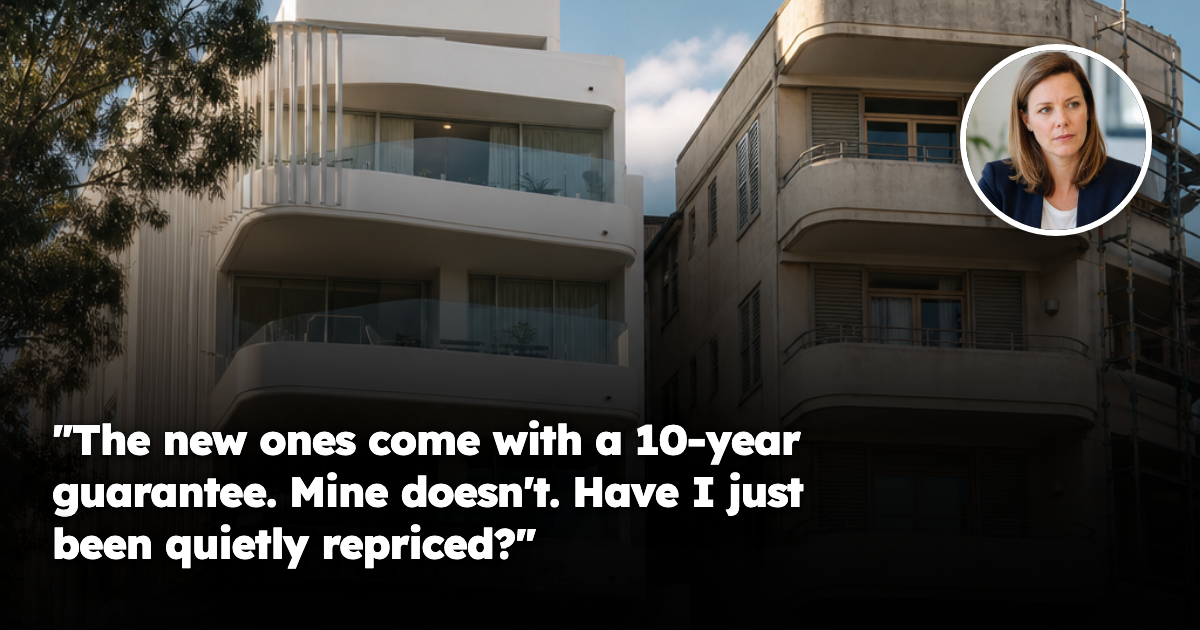
Her question was blunt. **"If the new ones come with a decade of cover and mine doesn't, have
I just been quietly repriced?"**
What actually changed
One state has just passed legislation laying the final groundwork for a product called
decennial liability insurance. It is a nation-first. It covers repair costs arising
from serious structural defects, for ten years.
One design detail is doing all the work, and almost every report has buried it.
The insurance attaches to the building, not to the builder.
That single line reverses the logic of the last two decades. Until now, an owner's protection
against a serious defect was really a claim against the people who built it — a developer, a
builder, a certifier. Which meant that protection was only ever as durable as those companies.
The two towers everyone remembers were not failures of engineering alone; they were failures of
recourse. Buildings do not dissolve. Companies do.
Cover that sits on the asset survives the liquidation of whoever created it. And because it
sits on the asset, it does something else nobody is talking about: it transfers. The buyer
who purchases that apartment in year four inherits the remaining six years.
That is not a consumer protection. That is an asset characteristic.
The same legislation quietly closes other exits. Private certifiers can no longer surrender
their registration to escape disciplinary action — a provision that tells you, rather
precisely, what some of them were doing. It is a different mechanism from the one that left one homeowner holding a signed rectification order that a tribunal confirmed created no enforceable right at all, but the lesson is the same: a written finding is not the same thing as a remedy.
The answer she didn't expect
Her instinct was that she had lost something. She hadn't. Her apartment is exactly as good as
it was the week before.
What changed is the comparison. Assets are never priced in isolation; they are priced
against the alternatives available to the same buyer on the same weekend. A buyer who
previously chose between two uninsured apartments will increasingly choose between an uninsured
one and an insured one. Her building didn't get worse. The set it competes in got better.
Here is the part investors should sit with. This is already being priced, and we can prove it,
because a version of it exists.
Australia already has an independent ratings agency that scores developers, builders,
certifiers and engineers on track record, financial backing, credentials, capability and
integrity. Not marketing — an assessed, published, per-business rating. Roughly nine in ten
buyers surveyed said they wanted exactly that kind of register.
And the people who lend against these buildings have been unambiguous about what it does.
Where a developer or builder carries an independent rating, financiers say the market's
willingness to look at the deal improves — which lifts the availability of capital and
drives the cost of it down. Insurers use the same signal to decide which practitioners
they will write a building for at all.
Read that again, because it is the whole argument. When an independent, building-specific
signal exists, capital moves toward it and prices it. Not suburb-specific. Not
postcode-specific. Building-specific.
Why a suburb median cannot see any of this
Take two apartments. Same suburb. Same median. Same postcode, same station, same school
catchment, same census profile, same views over the same park. One carries a decade of insured
structural cover that runs with the building and passes to the next owner. The other doesn't.
A suburb median averages both and reports one number.
That is not a flaw you can patch with better suburb data. It is what an average is. And it
is the same structural blindness we measure every day one level further up: between the best
and worst streets inside a single suburb, the spread in effective yield — built from achieved
rents, actual vacancy duration and real days on market, not advertised rents — routinely runs
20 to 30 per cent. Same median. Same postcode. Same laws to the letter.
Apartments push the resolution one level deeper again, because for a unit the asset is not
really the street. The asset is the building. Two towers can face each other across one
road and be entirely different investments: different sinking fund health,
different levy history,
different builder, different certifier,
different remediation exposure,
and now, different insured status. Who delivered it has become a critical
question — not just the finishes and the floorplan.
Nothing about that is visible in a median, a listing photo, or a suburb report.
What she should actually do
Four things, in order.
Find out who built it, and what they are worth now. Developer, builder and certifier are
findable, and so is whether those companies still exist and hold ratings. It is the
highest-value hour available to an apartment owner and almost nobody spends it.
Read the sinking fund like a balance sheet. An underfunded fund is a future special levy
with a date on it. That is the risk her building does carry, insured or not.
Get an indicative insurance quote on the building. An underwriter is the only participant
who has to put money behind an opinion of a specific address, in writing. It is the
an owner will ever get, and it is free.
Then price the exit against insured stock. Not against last year. Against what her buyer
will be able to choose from.
The part that should encourage investors
More than 75,000 homes are under construction in the state this legislation covers, and other
states will watch what it does to buyer confidence. Insured buildings are coming, in volume,
and that is unambiguously good — for buyers, and for the credibility of an asset class that has
spent five years apologising for itself.
But understand what is really happening. The market is building a per-building information
layer and attaching a price to it. Lenders will use it. Insurers already do. Buyers will learn
to ask. Every one of those forces sorts good buildings from bad ones below the suburb level.
Which means the discount is moving to the buildings nobody has checked, and the premium is
moving to the ones somebody has. That is not an argument against owning apartments. It is an
argument against owning an unexamined one.
Her apartment is fine. She just needs to be able to prove it — and the owner who can prove it
will sell to the buyer who couldn't be bothered checking the one across the road.
*General information only, not financial or legal advice. Consider your own circumstances and
seek professional guidance before making property decisions.*
If there's a specific street you're weighing up right now, check its Street Score first — it's free, takes ten seconds, and tells you whether that street is pulling the suburb average up or riding on it.
Frequently asked questions
What is decennial liability insurance for new apartments in Australia?
It is a nation-first insurance product that covers repair costs arising from serious structural defects for 10 years. The cover is attached to the building itself, not the builder.
Does this new insurance apply to an apartment I already own?
No. The article says the insurance is for new apartments and attaches to the building, so an existing owner's apartment does not suddenly gain that cover.
Why does it matter that the insurance stays with the building instead of the builder?
Because the protection survives if the builder or developer no longer exists. It also transfers to the next owner, so a buyer can inherit the remaining years of cover.
Could an older apartment be worth less now that new apartments have this cover?
Not because the apartment itself got worse. The article says the comparison set changed: buyers may increasingly choose between uninsured and insured apartments, which can affect how the market prices the exit.
What should an apartment owner check if they want to understand their building's risk?
The article suggests finding out who built the building and whether those companies still exist and are rated, reading the sinking fund like a balance sheet, getting an indicative insurance quote for the building, and then pricing the exit against insured stock.
General information only. It does not take your objectives, financial situation or needs into account, and nothing here is legal, financial, taxation or investment advice specific to your circumstances.