News · 13 August 2026 · 5 min read
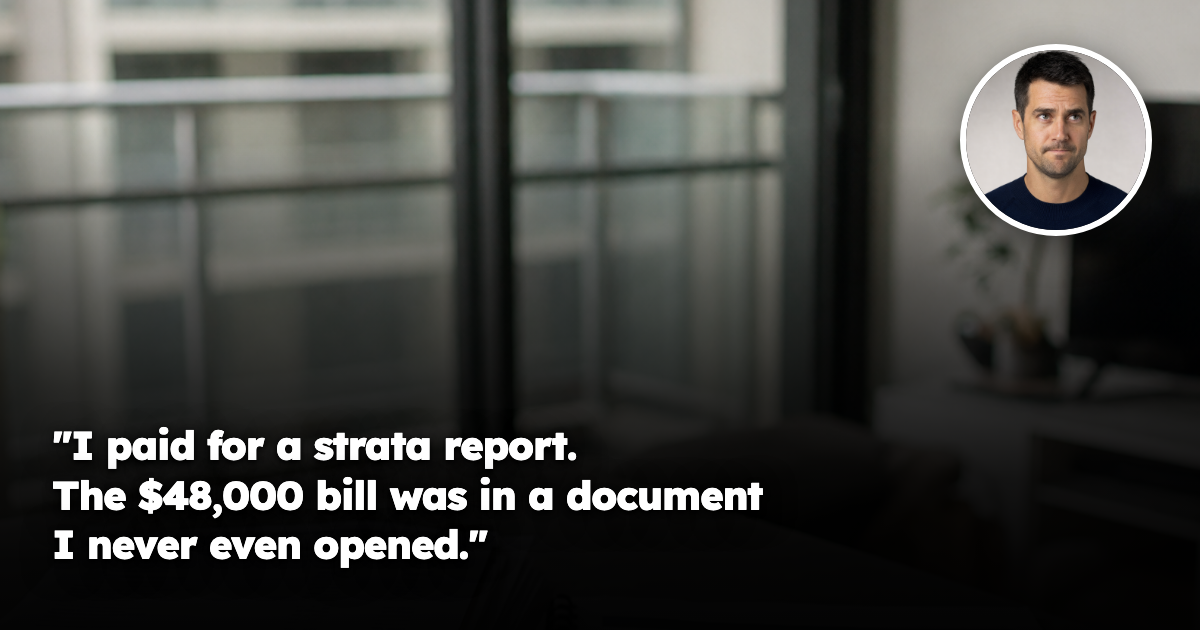
'I got a strata report before I bought. Eleven months later I was hit with a $48,000 bill that was already written down in a document I never opened'
He did the due diligence and still got hit with a $48,000 special levy eleven months after settling. The concrete, the waterproofing and the lift were already scheduled and costed in a document he was legally entitled to inspect before making an offer. He never opened it — and he read the building's low levies as a good sign, which is the most expensive misreading in apartment buying.
He did the due diligence. He paid for the report. He read it.
And he still walked into a $48,000 special levy that was sitting in plain sight, in a document the owners corporation was legally required to have, and that he was entitled to inspect before he signed anything.
That is the part he cannot get past.
The situation
He is 38, an engineer, and bought a two-bedroom apartment eighteen months ago — his first purchase inside a strata scheme. Early 2000s building. Nine storeys. Lift. Basement carpark.
He was careful. He ordered a strata report, skimmed the minutes, checked the levies and the insurance, and noted there were no disputes pending. The quarterly levies looked reasonable — cheaper than two other buildings he'd looked at, which he read as a good sign.
Eleven months later: notice of a general meeting. Concrete remediation and waterproofing, plus a lift near end of life. Total works, roughly $2.1 million. His unit entitlement puts his share at about $48,000, payable over two years, on top of normal levies.
His question wasn't "can they do this" — he'd worked out that they could. It was: "How was I supposed to know?"
The answer
He could have known — not by guessing, but by reading one document.
Every strata scheme runs two pots of money. An administrative fund for everyday costs — cleaning, insurance, power, the strata manager. And a capital works fund for the big, once-a-decade items: repainting, roofing, lifts, concrete, waterproofing. Most people still call that second one the sinking fund.
That fund is not allowed to be a vibe. The scheme must have a 10-year capital works fund plan — a written schedule of what will need repairing or replacing over the next decade, item by item, with cost estimates against each one. In most states it must be reviewed at least every five years, and when owners set next year's levies they must take the plan into account.
Put plainly: somewhere in that building's records was a document saying the concrete, the waterproofing and the lift were coming, roughly when, and roughly what they'd cost. It existed before he made an offer.
And a buyer can get to it. A pre-purchase strata report is meant to cover the scheme's finances, its planned works and its defect history. You can also inspect the records yourself. In some states you can obtain a certificate from the owners corporation which must set out the levies payable and the proposals for funding the matters in the 10-year capital works plan.
That phrase does enormous work, and almost nobody reads it. It is the building telling you, in writing, how it intends to pay for what it knows is coming.
The signal he read backwards
He treated the low levies as a positive. This is the most expensive misreading in apartment buying.
The regulator's own buyer guidance is about as blunt as a government website gets: low levies could mean a steep rise in future fees, and special levies may be needed if there isn't enough money for large capital works.
A levy is not a price. It is a funding rate. Two buildings with identical costs ahead of them can quote wildly different levies, because one is collecting steadily and the other is deferring until the invoice lands. The second looks cheaper right up to the moment it becomes dramatically more expensive — and whoever is standing there when the bill arrives pays for years of deferral they were never part of.
The mechanics have a quiet cruelty. Capital works contributions are not refunded to an owner who sells; the money stays with the building. Buy into a well-funded scheme and you're buying a share of savings other people made. Buy into an underfunded one and you inherit their deferral.
It compounds beyond cash. Deferred maintenance also changes the insurance position: premiums rise for every owner, and cover narrows, because insurers often won't pay for damage caused by a lack of maintenance — the same repricing logic that shows up when an insurance renewal triples on a property that has never claimed.
Why this is a street-level problem in a building-level costume
Suburb research cannot see any of this. In strata, the building itself is the asset you are buying, and two buildings can sit 200 metres apart, share a postcode, a median unit price and a station — and be completely different assets. One has a reviewed plan, a funded balance and a levy that reflects reality. The other has a stale plan, a thin balance and a $2.1 million invoice arriving in year three of your ownership.
No median tells you which is which. A median averages them.
This is the same dispersion we measure between streets, expressed vertically. Inside a single suburb we routinely find a 20–30% spread in effective yield between the best and worst streets, using achieved rents, real vacancy duration and real days-on-market rather than advertised figures. For units the analysis goes one level deeper again, to the building. Your apartment cannot outperform the balance sheet it's attached to.
And unlike most risks we write about — flood mapping, or the way defect liability attaches to a building rather than the builder who left — this one isn't hidden or modelled. It's written down, and somebody has already costed it. The regulator's own guidance says implementing the plan has flow-on impacts to insurance, future repair costs and asset resale value.
The asymmetry here isn't between buyer and seller. It's between the buyer and the filing cabinet.
What to actually do
Get the plan itself, not a summary. Check when it was last reviewed — a plan untouched for eight years is priced in a different construction market.
Compare the plan to the balance. Total the works scheduled in the next five years, then look at the fund balance and the contribution rate. If the gap is large, you've found your special levy before it finds you.
Read the minutes for the words nobody wants to write down. Engineering report, remediation, defect, investigation, quotation.
Treat low levies as a question, not a discount. There are good answers. "Nobody has looked at this since 2018" isn't one.
The case for buying anyway
None of this is an argument against apartments, or against property.
It's the opposite. This is one of very few risks in Australian property that is fully knowable in advance, documented by law, disclosed on request — and priced by almost nobody. So the market frequently prices two buildings the same when their balance sheets are nothing alike, and the buyer who reads it gets paid for an afternoon's work.
He didn't make a bad purchase, incidentally. The building is sound and it will be a better asset afterwards. He simply paid $48,000 for information he could have had for a fee and an hour.
He researched the suburb. He researched the apartment. He never researched the building. Almost everyone does it in that order.
If there's a specific street you're weighing up right now, check its Street Score first — it's free, takes ten seconds, and tells you whether that street is pulling the suburb average up or riding on it.
Frequently asked questions
What strata document would have shown that major works like concrete repairs, waterproofing and a lift upgrade were already coming?
The building’s 10-year capital works fund plan should list major repairs and replacements item by item, with cost estimates. In most states, it must be reviewed at least every five years and used when setting levies.
Why can a building with low strata levies still be a risky purchase in Australia?
Low levies can mean the owners corporation is not collecting enough for future capital works. The article says that can lead to a steep rise in fees or a special levy later when the bill arrives.
What is the difference between an administrative fund and a capital works fund in strata?
The administrative fund pays for day-to-day expenses like cleaning, insurance, power and the strata manager. The capital works fund, often called the sinking fund, is for big items such as roofing, lifts, concrete and waterproofing.
How can a buyer check whether a strata building is likely to need a special levy soon?
The article says to get the actual capital works plan, compare the scheduled works over the next five years with the fund balance and contribution rate, and read the minutes for clues such as engineering reports, remediation or defect investigations.
Can a capital works contribution be refunded if you sell the apartment?
No. The article says capital works contributions stay with the building, not the individual owner, so a buyer can inherit the cost of earlier deferral while the money remains in the scheme.
General information only. It does not take your objectives, financial situation or needs into account, and nothing here is legal, financial, taxation or investment advice specific to your circumstances.