News · 5 August 2026 · 8 min read
‘I got an email on the way to work saying I owe $64,000. I never voted for it and I can’t sell — is this legal?’
She read the email on the train and had a panic attack. Her share of a $7.5 million repair bill was $52,500 — $64,000 once the loan interest landed. She could have paid cash but wasn’t allowed to. Here’s the part that should worry every unit investor: none of this was unpredictable.
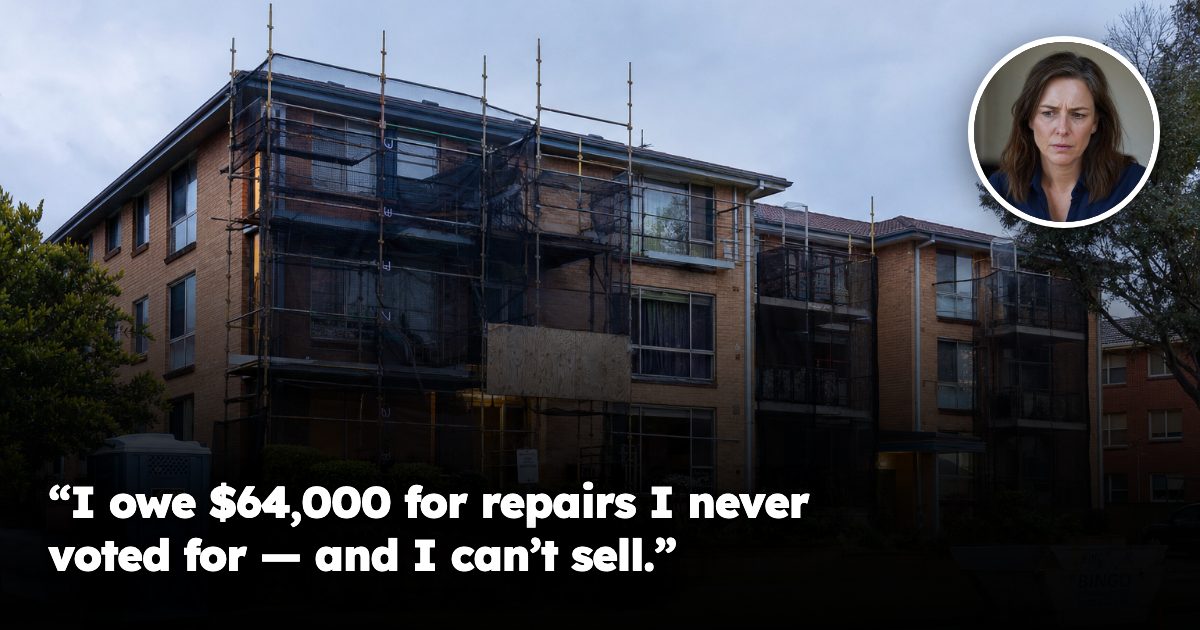
'I got an email on the way to work saying I owe $64,000. I never voted for it and I can't sell \u2014 is this legal?'
She was on her way to work when she opened the email. By the time she got there, she was having a panic attack.
Her apartment complex \u2014 more than 120 units, built in the late 1990s \u2014 needed waterproofing. She'd known repairs were coming. What she hadn't known was the number: the works came in at close to $7.5 million across the scheme, and her individual share was $52,500.
Then came the part that turned a bad year into a five-year problem. She could have paid her share upfront. She wasn't given the option. The owners corporation voted to fund the works with a four-year strata loan, repaid in sixteen quarterly instalments \u2014 so her $52,500 became $64,000, with roughly $12,000 of that being interest on money she never wanted to borrow.
Her quarterly outgoings now look like this: $2,150 in ordinary strata levies \u2014 itself a 76% increase \u2014 plus $4,028 a quarter servicing the loan. $6,179 every three months.
In her words: the amount she has to set aside each payday is more than her mortgage.
This is one of the most common questions we're asked by people who own units, and it has arrived in our inbox in some form every month this year. So let's answer it properly \u2014 because there are two questions buried in it, and only one of them has a legal answer.
The question
"Can an owners corporation really borrow money in my name, bill me for it, and refuse to let me pay cash? And if my building is now unsellable, what am I supposed to do?"
The short answer: yes, it's legal \u2014 and that's the problem
In New South Wales, under section 100 of the Strata Schemes Management Act 2015, an owners corporation can borrow money on an ordinary majority vote. Just over 50% of those present and voting at a general meeting is enough. Once it passes, every owner pays their proportional share of the resulting levies.
There is no opt-out. The loan sits with the owners corporation as a collective entity \u2014 not as individual owner debt \u2014 and the corporation raises regular or special levies to repay it. Strata lawyers describe the principle bluntly: one in, all in. A handful of lenders offer "hybrid" facilities that let individual owners choose between a lump sum and borrowing, but they're rare, and strata managers generally avoid them because the levy accounting becomes a mess.
So the frustration is real, and legitimate, but the mechanism is working exactly as legislated. Owners corporations do have to offer a payment plan before taking recovery action, and give 30 days' notice before chasing unpaid levies. Beyond that, the majority decides.
Which means the interesting question isn't the legal one. It's this: how did a completely predictable expense arrive as a shock?
Waterproofing on a building of that age and type is typically a 25-year job. The building was late-1990s. The bill landed almost exactly on schedule. The owner's own question is the sharpest one in the whole story \u2014 if it deteriorates after 25 years, why wasn't it in the budget?
It wasn't in the budget because sinking funds are chronically underfunded, and because underfunding them is popular. Every year a committee holds levies flat is a year the building looks cheap to own and easy to sell. The cost doesn't disappear; it compounds quietly and then arrives all at once, payable by whoever happens to own the lot on the day the vote passes. That may not be the person who benefited from two decades of artificially low levies.
And it isn't only deferred maintenance. In a separate case, an owner in a seven-unit boutique block discovered a leak from his own oversized roof-terrace balcony had caused damp in the apartment below. The membrane had failed and the balustrade didn't meet modern height standards. The repair bill was $105,000 \u2014 split equally across all seven apartments, roughly $15,000 each, because the terrace was part of the building's external structure and therefore common property rather than his private responsibility. The tenant downstairs found the works so disruptive she moved out mid-repair.
Two different buildings, two very different scales, one identical lesson: in strata, your capital exposure is not limited to your own four walls, and you don't control the vote.
The part almost nobody prices in
Read the first owner's situation again and find the sentence that actually matters to an investor. It isn't the $64,000.
It's this: she can't sell. Nobody wants to buy into a building mid-levy, and if she sold now she'd lose more than she's paying.
That is the real risk, and it's the one that never shows up in a yield calculation. A special levy is a cash-flow problem you can, in principle, survive. A special levy that simultaneously destroys your exit liquidity is a different category of problem \u2014 because it removes your ability to make any decision at all. You can't refinance out of it, you can't sell out of it, and you can't wait it out, because the levy schedule doesn't care about your circumstances. Around 15% of Australians now live in strata, so this is not a fringe exposure \u2014 it's a mainstream one, and it's growing.
This is the same structural trap we've written about in other contexts: what happens when a life event forces a sale on a timeline you don't control. A special levy does the same thing from the opposite direction \u2014 it doesn't force you to sell, it forbids you from selling well.
The answer: this is a due-diligence failure, not bad luck
Here's where we'll be unpopular. Almost every case like this was visible before settlement \u2014 to someone who looked.
The information exists. Minutes of general meetings show what's been deferred and how many times. The capital works fund balance shows whether the building is saving or pretending. A ten-year plan shows what's scheduled and what it's costed at. The by-laws and the strata plan show what's common property and what's yours \u2014 the distinction that turned one owner's private balcony into seven owners' shared bill. Building age plus construction type tells you where you sit in the waterproofing, lift, roof and fa\u00e7ade cycles. Every one of those is knowable, and almost none of it gets read properly in a competitive market where buyers are afraid of missing out.
This is why our research runs at the street and building level rather than the suburb level, and strata is the clearest illustration of why suburb-level data is close to useless here. Two complexes can sit on the same street, in the same postcode, sharing the same suburb median and be completely different assets. One was built in a well-documented era by a builder whose work is holding up, has a properly funded capital works fund, and turns over regularly to owner-occupiers. The other was delivered in a supply spike, has a sinking fund covering a fraction of its ten-year plan, and a levy history that's been suppressed for a decade. The suburb median reports them as identical. They are not remotely the same investment \u2014 and the gap between them is not a valuation gap, it's a liquidity gap.
That's what we're actually measuring when we grade a location: the depth and quality of the buyer pool, days on market, vacancy, supply pipeline, owner-occupier versus investor mix, and how tightly held individual streets are. Those metrics answer the only question that matters when something goes wrong \u2014 if I need to get out, who is on the other side of the trade? On a tightly held street with a deep owner-occupier base, a building with a funded capital works fund and a clean levy history sells in a normal campaign at a fair number, even in a soft market. In a saturated pocket where most buyers are yield-driven investors running the same spreadsheet you are, a levy notice removes your entire buyer pool at once. Same suburb. Same median. Opposite outcome.
You can't diligence your way out of every risk in strata. You genuinely can't control the vote, and you can't stop a membrane failing. But you can decline to buy into a building that has been quietly deferring a known, dated, expensive obligation \u2014 and you can refuse to buy into a pocket where a single bad quarter leaves you with no buyers.
What this means for you
If you already own a unit, do three things this month. Read the last two years of general meeting minutes, not the summary. Compare the capital works fund balance against the ten-year plan \u2014 if it's covering a fraction of what's scheduled, you're not looking at low levies, you're looking at a deferred bill with your name on it. And find out where your building sits in its major-works cycles, because the age tells you more than the paint does.
If you're buying, treat the strata report as the most important document in the transaction, ahead of the contract. And treat the building's location the way we do: not as a suburb, but as a specific street with a specific buyer pool and a specific exit.
The bigger picture
It would be easy to read all this as an argument against apartments, or against property. It isn't.
What these stories actually demonstrate is that property returns are decided at the asset level, and risk is priced by whoever bothers to look. The owner facing $64,000 isn't a victim of the property market \u2014 she's carrying the cost of a decade of decisions made in rooms she wasn't in, in a building nobody had assessed properly on her behalf. That's not an indictment of unit ownership; it's an indictment of buying on median price, rental yield and a photograph.
Strata is also where genuine mispricing lives right now. Buildings with funded capital works accounts, clean levy histories and sensible by-laws are trading in the same market \u2014 and often at the same headline price \u2014 as buildings quietly carrying seven-figure liabilities. That spread is an opportunity for the buyer holding the better information, and this is exactly the market where the difference between two apparently identical suburbs comes down to what's happening street by street. With construction costs where they are and new apartment supply stalling, well-maintained existing stock in genuinely tightly held locations is getting harder to replace, not easier \u2014 and rents in every capital are at record levels.
The mistake isn't buying an apartment. The mistake is buying an average \u2014 and then finding out, via an email on the way to work, exactly which half of the average you bought.
The information in this article is general in nature and does not take into account your personal objectives, financial situation or needs. It is not financial, legal or tax advice. Strata legislation differs between states and territories. Consider your own circumstances and seek appropriate professional advice before acting on any information here.
"If there's a specific street you're weighing up right now, check its Street Score first — it's free, takes ten seconds, and tells you whether that street is pulling the suburb average up or riding on it.
Frequently asked questions
Can an owners corporation in New South Wales borrow money for repairs without every unit owner agreeing?
Yes. Under section 100 of the Strata Schemes Management Act 2015, a NSW owners corporation can borrow money on an ordinary majority vote, meaning just over 50% of those present and voting is enough. Once approved, all owners pay their proportional share through levies.
Can I refuse to pay a strata loan if I would rather pay my share in cash?
The article says there is no opt-out once the owners corporation has voted to borrow. A few lenders offer rare hybrid facilities, but they are not common and strata managers generally avoid them because the accounting becomes difficult.
Why did a $52,500 strata bill become about $64,000 in this example?
Because the owners corporation funded the waterproofing works with a four-year strata loan repaid in 16 quarterly instalments. About $12,000 of the final amount was interest on money the owner did not choose to borrow.
What is the biggest risk for an apartment owner when a large special levy is announced?
The article says the main risk is not just the cash flow hit, but losing the ability to sell. A levy can scare off buyers, reduce exit liquidity, and leave an owner unable to refinance or sell well.
What should I check before buying a unit in a NSW strata building?
Read the general meeting minutes, compare the capital works fund balance with the ten-year plan, and check the by-laws and strata plan to see what is common property. The article also says building age and construction type matter because they help show when major works like waterproofing, lifts, roofs or façades may be due.
General information only. It does not take your objectives, financial situation or needs into account, and nothing here is legal, financial, taxation or investment advice specific to your circumstances.