News · 22 August 2026 · 6 min read
'I bought the house for $61,000 under market. Nineteen weeks later I found out why — and the tenant who caused it had moved out in 2023'
She bought a tenanted house $61,000 under market and thought she'd found a bargain. An order made for a tenant who left two years earlier was still running on the building — and it doesn't appear on a title search.
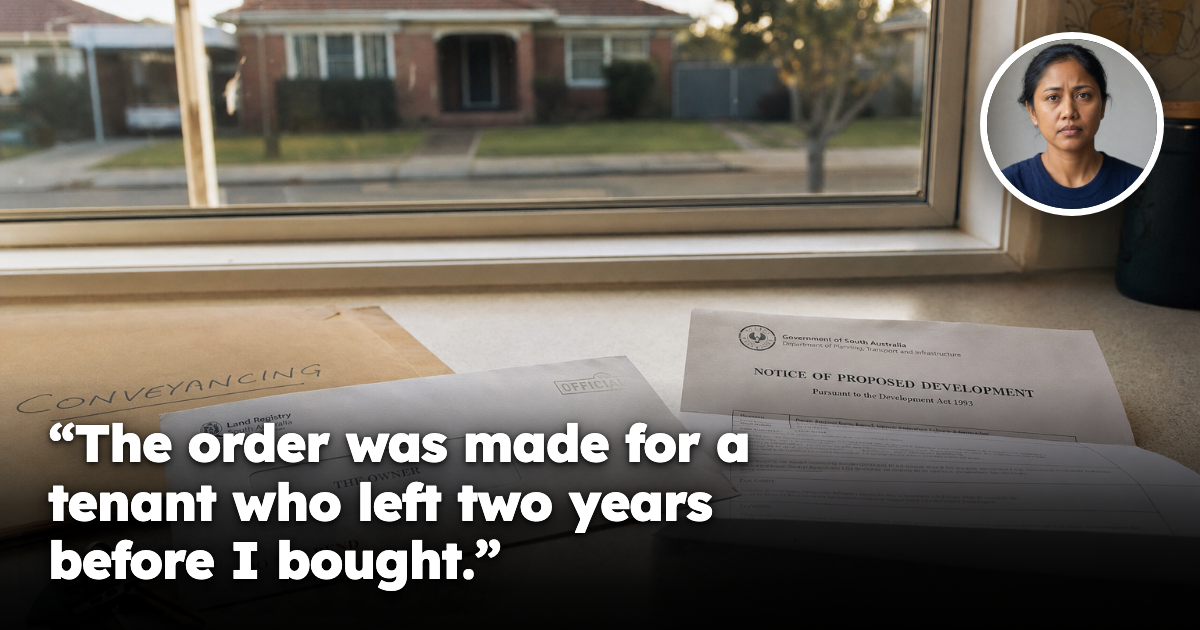
She had done the sums four times before she signed, because it was the first thing she had ever bought in this country and she did not want to get it wrong.
She is 41, arrived here nine years ago, spent six of them renting, and put every dollar of the rest into a deposit. The property was a low-set three-bedroom brick house on a quiet street — tenanted, tidy from the road, and listed at what looked like a mistake. Comparable sales on the same street said one number. The contract said $61,000 less.
Her building and pest inspection came back with the usual list — guttering, perished seals, one tired bathroom. Nothing structural. Her conveyancer ran the searches a conveyancer runs. Nothing came back.
She settled, kept the sitting tenants, and for nineteen weeks she was a landlord who could not believe her luck.
Then a letter arrived addressed to "the owner", referring to an order she had never seen, about a house she now owned, on the application of a tenant who had moved out in 2023.
The question she asked us
"The tenant who did this doesn't live there any more. The landlord who ignored it doesn't own it any more. The tenancy ended two years before I made an offer. How is it still mine?"
We are asked a version of this every few weeks, and it exposes the most misunderstood thing about rental law: almost all of it governs the relationship, and a small part of it governs the building. People assume it all works one way. It does not.
The answer: this particular order is attached to the house, not to anybody in it
An order of this kind is what a tribunal may make when a tenant has told the landlord something needs repairing, a reasonable time has passed, and it has not been done — the machinery that also sits behind the four-week cap on what a tenant may spend on emergency repairs.
What almost nobody expects is the sentence that follows. Until the order is complied with, it continues to apply in relation to the premises — and it does not end with any particular residential tenancy agreement.
Read that twice. It detaches the remedy from the parties and pins it to the property. The tenant who obtained it can move out. The tenancy can be terminated. New tenants can move in knowing nothing about it. The place can be sold to somebody who has never met any of them. None of that stops the clock.
The design is deliberate. If it worked the other way, any order could be extinguished by ending the tenancy that produced it.
What such an order can actually require
The menu is wider than most owners realise. A tribunal may specify what is to be repaired, fix a date, decide who pays, authorise the tenant to arrange a suitably qualified person, order reduced rent until the work meets its standard, order compensation for loss of amenity, or provide that the tenancy ends if the work is not finished on time.
There is one more, and it turns a maintenance problem into a valuation problem. Where the premises are vacant, the tribunal may order that they not be occupied under a residential tenancy agreement at all until the repairs are done. Not reduced rent. No rent — because no lawful tenancy.
In deciding, the tribunal must weigh the conduct of the landlord and their agent, the risk of injury, and the loss of amenity.
The part that has no ceiling
Failing to comply is an offence — and a continuing offence, chargeable for the periods it continues, with a further penalty for each week it runs on after a conviction.
There is no total. The exposure is not a fixed sum a buyer can price into an offer; it is a rate, multiplied by however long it takes the new owner to discover the order and do the work.
Extensions exist, but only on three named grounds: hardship, a shortage of a needed material, or the property's remote location. "I bought it four months ago and nobody told me" is not on that list. And where the stated day passes, a tenant who never applied for the order acquires a right to walk.
Why her searches came back clean
The tribunal must give a copy of the order to the relevant authority, and notify it of any extension. So the record exists, held by a real body.
But nothing requires it to be noted on the register of titles, where a purchaser's search looks. It is a transferring, weekly-accruing obligation on the building, living in a filing system a routine conveyancing search does not touch — the same structure as a tree order that transfers to the buyer at settlement, and the mirror image of a tenancy database listing, which attaches to a person rather than to land.
Her searches were not done badly. They were done correctly, against the wrong registry — because nobody had told her there was a second one.
What this means for you
This is the clearest possible example of why we do not value property at the suburb level.
Two houses four hundred metres apart in the same postcode return an identical summary. Same median, growth rate, school catchment, council, vacancy rate. Every number is the same number. One has a live order running against it with a weekly rate attached. The other does not.
A median has never once been served with anything.
Street-level data is the only level at which that distinction is visible — the same reason the gap between the best and worst street in one suburb routinely runs to a 20–30% spread in effective yield: achieved rents rather than asking rents, real vacancy duration, true days on market, genuine street-level supply and demand. An unresolved order takes a property to the far end of that spread, because an asset that cannot lawfully be let earns nothing.
The part that should make you more confident, not less
Every provision described here is published, stable and in force, with an identified authority holding the record. Nothing about it is secret or unfair in principle — a house that injures somebody is worse for the owner than for anyone else, and an order a landlord cannot cancel by ending a lease is the only version of the rule that would work.
The practical move costs one extra line on a pre-purchase list: ask whether any order has ever been made about repairs to this property, and whether it has been complied with. Ask the agent in writing, before you make the offer rather than after you get the letter. That is the whole edge — a question that takes ten seconds and almost nobody asks.
She would still have bought the house. The building is sound, the street is good, and the numbers work even now. What she wishes she had understood is that $61,000 under market is never a gift; it is always an answer to a question nobody thought to ask.
She did not lose money to a dishonest vendor, a careless conveyancer or a bad tenant. She lost it to a piece of paper sitting in the correct place the entire time — a place she did not know to look.
Risk you can read is risk you can price. Priced risk is not a threat; it is an advantage over everyone else standing at that inspection.
If there's a specific street you're weighing up right now, check its Street Score first — it's free, takes ten seconds, and tells you whether that street is pulling the suburb average up or riding on it.
Frequently asked questions
How can an old tenant repair order still affect a house after the tenant has moved out?
The order is attached to the premises, not to the tenant or the tenancy agreement. According to the article, it continues to apply until it is complied with, even if the tenant has left and the property has changed hands.
Why didn’t this show up in a normal title search before settlement?
Because the order is not necessarily recorded on the title register that buyers usually search. The article says the record exists with the relevant authority, but a routine conveyancing search may not find it.
What can a tribunal order if a landlord doesn’t do the repairs?
The tribunal can specify the repairs, set a deadline, decide who pays, allow the tenant to arrange repairs, reduce rent, award compensation, or even end the tenancy. If the premises are vacant, it may also stop them being occupied under a residential tenancy agreement until the repairs are done.
What is the main risk for a buyer if one of these orders is still running on the property?
The risk is ongoing compliance exposure, including a continuing offence and penalties that can apply week by week. If the property cannot lawfully be let until the order is resolved, that can also affect the property's value and rental income.
What should a buyer ask before making an offer on a tenanted property?
The article suggests asking, in writing, whether any repair order has ever been made about the property and whether it has been complied with. It recommends doing this before making the offer, not after settlement.
General information only. It does not take your objectives, financial situation or needs into account, and nothing here is legal, financial, taxation or investment advice specific to your circumstances.