News · 21 August 2026 · 5 min read
'I bought the house. Two weeks later I found out I'd also bought a court case about a tree I've never seen'
She paid $31,000 more than she needed to for a house that came with an obligation nobody mentioned — not the agent, not the contract, not the searches her conveyancer ordered. The register that would have found it in ninety seconds is public, electronic and free. Almost no buyer in the country knows it exists.
We get asked a version of this several times a year, and it is one of the very few property problems where every professional in the transaction can do their job properly and the buyer still inherits somebody else's fight.
A woman in her early forties came to us in the winter. She is a pathology collector, she had saved for six years, and this was her first house. She was not careless. Building and pest came back clean. She ordered the standard searches and read the contract twice.
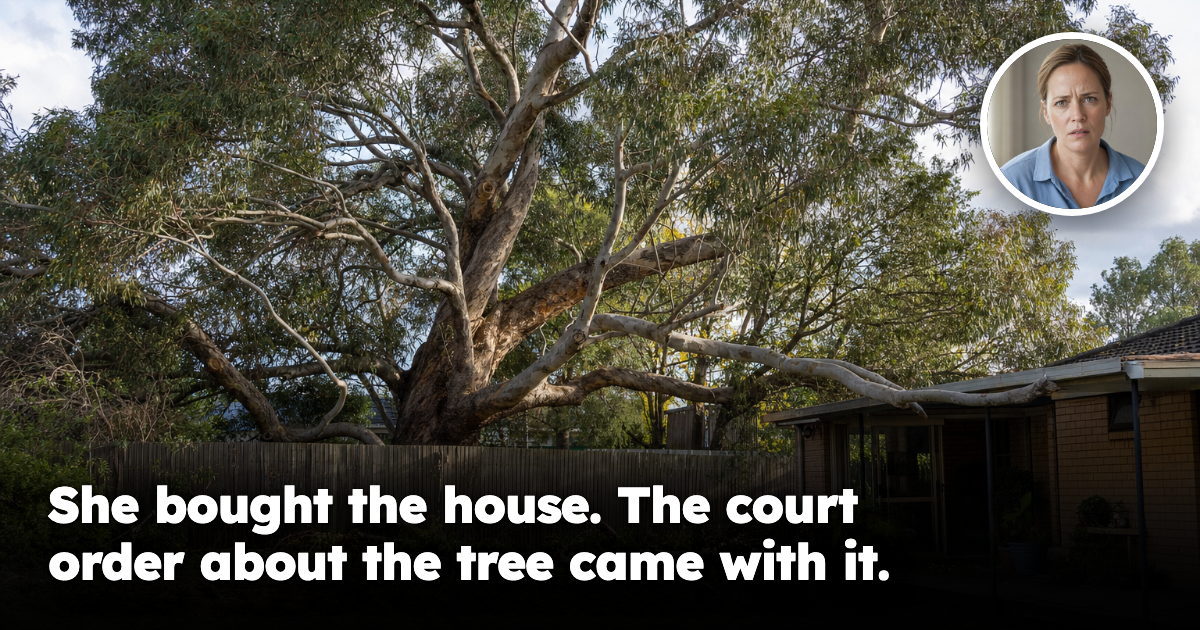
Sixteen days after settlement, an envelope arrived addressed to the previous owner. Inside was a tribunal order about a large tree on the boundary — requiring work, within a stated period, at the owner's cost. It had been made months before she inspected the house. The work, the arborist's report and the advice she needed came to just over $31,000.
Her question was the one we get every time:
"Nobody hid anything from me. I asked the right questions. So how did a court order about a tree become mine the day I picked up the keys?"
The answer: it did not become hers. It transferred to her — and the statute says so in plain words
Most people assume a dispute is personal: two neighbours argue, a tribunal decides, and the decision binds the two who turned up. That is not how these orders work.
The legislation dealing with trees on adjoining land treats an order as attached to the land, not merely to the person who lost. Where a seller gives a buyer a copy of an order before contract, the statute provides that on the transfer day the buyer becomes bound by the order — to the extent the seller has not done the work — as if the buyer were the person named in it.
And a second limb most people miss: any period stated in the order is taken to commence on the transfer day. The buyer inherits the obligation — but not one day of the delay the seller already used. A clock that had almost run down starts again, in full, against someone who has never met the neighbour.
The part that turns a dispute into a purchase: you can be joined by signing
There is a version that catches people even earlier. Where the matter has not yet been decided — an application still on foot, not dismissed, not withdrawn — and the seller gives the buyer a copy of it, the statute provides that the buyer is joined as a party to the proceeding when the buyer enters into the contract of sale.
Not on settlement. Not by filing anything. Not by choosing to. By signing the contract. You are not asked whether you want to be a litigant. Executing the contract makes you one.
And the orders are broader than almost anyone expects
An order is not limited to "trim that branch". On the statute's own terms it can require work on an ongoing basis — the published examples include removal within twenty-eight days, maintenance in a particular season every year, and keeping a tree at a nominated height, width or shape indefinitely.
It can also do something that surprises every owner who hears it: where the application arose from a genuine dispute, an order can require the work even though a vegetation protection order withholds consent, or a local law prohibits it — and the work is then lawful despite that local law. The protective instrument most owners treat as the final word can be overridden.
The register that costs nothing, and almost nobody searches
Here is the part that should change how you buy.
The tribunal must keep a register of these orders. Not a filing cabinet — an electronic register, kept so that a search for particular land returns the existence of an order affecting it, the time for carrying it out, and the person responsible.
Any person may search it, and obtain a certified copy that stands as evidence. No fee is payable.
So the information that cost her $31,000 was public, electronic, searchable by address and free — for the entire period she was deciding whether to buy.
A quiet asymmetry makes searching it matter more still. The disclosure duty is defined by reference to the land the tree stands on. The register is wider: land is captured if, when the order was made, an owner or occupier was the tree-keeper or the neighbour. The record is broader than the duty. A seller on the complaining side of a live dispute may owe you nothing — while the register still shows it.
Why this is a street-level question, not a suburb one
Two houses in one suburb share a median, a growth rate, a school catchment, a council and a postcode. They do not share what is growing behind their back fence, who has complained about it, or whether a tribunal has made an order that will land on the next owner.
A suburb report cannot see any of that. The data is not poor — the unit of measurement is wrong. Amenity, disputes and boundary conditions are street- and parcel-level facts, and averaging them across thousands of dwellings destroys exactly the information that decides your return. Inside one suburb we routinely measure a 20–30% gap in effective yield between the best and worst streets, on achieved rents, real vacancy duration and true days on market. A median has never once searched a register.
We have written before about how much a single boundary condition can cost — when a neighbour's trees block the light, the consent rule that lets a neighbour have a finished carport taken down, and the third party whose missing signature can stop an approved build.
What this actually means if you are buying
None of this is a reason to be afraid of buying. It is the opposite.
Every mechanism described here is published. The transfer of an order on settlement, the joinder on signing, the restarting clock, the disclosure duty and the free searchable register are all written down for anyone who looks — long before any of it becomes urgent.
These rules also exist for a reason. Trees cause real damage and real danger, and a tribunal must weigh safety first, avoid destroying a living tree where the issue can be resolved another way, and consider its contribution to biodiversity, privacy and soil stability. Nobody in her transaction behaved badly.
The buyers who lose money to this are not unlucky. They are the ones who never knew there was something to look at. The ones who do well treat a purchase as a parcel-level investigation — what is on the boundary, what has been argued about, what is already on a register — rather than a suburb-level bet.
Risk you can read in advance is not a threat. It is a line item, and a negotiating position.
She kept the house. It has performed well. She just paid $31,000 for a search that was free.
If there's a specific street you're weighing up right now, check its Street Score first — it's free, takes ten seconds, and tells you whether that street is pulling the suburb average up or riding on it.
Frequently asked questions
Can a tribunal order about a tree transfer to the buyer when a house settles in Australia?
Yes. Under the legislation described in the article, a tree order can bind the buyer on transfer day as if they were the person named in it, to the extent the seller has not done the work. Any time period in the order also starts again on settlement.
What happens if there is still a tree dispute on foot when I sign the contract?
If the seller gives you a copy of a live application or proceeding, the article says you are joined as a party when you enter into the contract of sale. That means you can become involved before settlement, simply by signing.
Is there a public register I can search for these tree orders before buying a property?
Yes. The tribunal keeps an electronic register that can be searched for particular land, and any person can search it and get a certified copy. No fee is payable.
Why wasn’t this picked up by normal conveyancing searches and building reports?
The article says the standard searches ordered by the buyer did not reveal it, because the relevant information sits in the tribunal’s free register. It is a parcel-level issue, not something a suburb report or ordinary inspection would usually show.
Can a tree order still require work if local laws or a vegetation protection order would normally stop it?
Yes, if the application arose from a genuine dispute. The article says an order can require the work even where a vegetation protection order withholds consent or a local law prohibits it, and the work is then lawful despite that restriction.
General information only. It does not take your objectives, financial situation or needs into account, and nothing here is legal, financial, taxation or investment advice specific to your circumstances.