News · 23 August 2026 · 6 min read
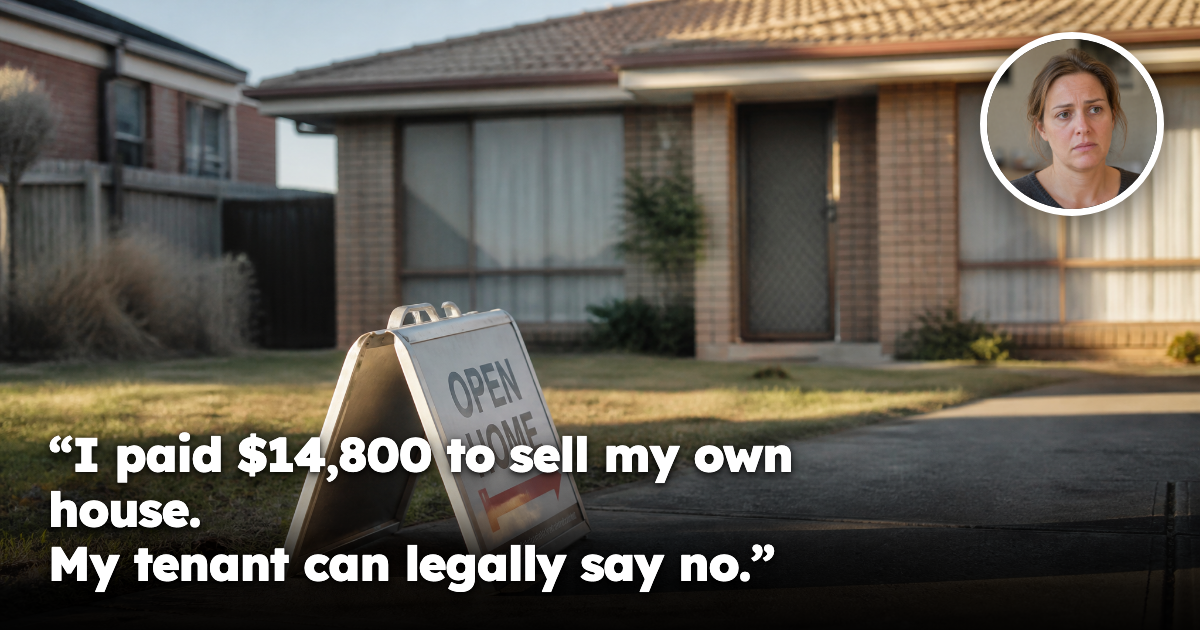
"I own the house. I'm selling the house. And I found out my tenant can legally refuse to let anyone through it — the day after I paid $14,800 to launch the campaign"
She paid $14,800 up front to sell her only investment property, then found out her tenant could lawfully refuse the open homes, the on-site auction and the marketing photographs. Three written-consent vetoes sit between an owner and the sale of their own asset — and almost nobody prices them in.
She is 37, and she is not a portfolio investor. She has one property, bought at 29 with a deposit she saved across six years of share-housing, and she is selling it because she and her partner want a second bedroom before their daughter starts school.
She did everything in the right order. She gave her tenant the courtesy of a phone call before the agent was appointed. She agreed to a marketing package — photography, portal listings, signboard, a four-week auction campaign — and paid $14,800 for it up front, because that is how marketing is billed. She booked the photographer for the following Tuesday.
Then her tenant, politely and in writing, said no.
Not "no, please reschedule". No to photographs of the living room while her furniture was in it. No to the open home. No to the on-site auction.
The agent came back and told her something she did not believe until she read it herself: the tenant was entitled to say all three.
The question she asked us
"It's my house. My name is on the title, I pay the mortgage, I pay the rates, I'm the one selling it. How can a person who rents it from me have the power to stop me showing it to buyers — and why did nobody mention this before I paid for a campaign that can't legally run?"
It is one of the most common questions we get from owners selling a tenanted property, and it almost always arrives after the money is spent.
The answer
A residential tenancy does not just transfer the right to live somewhere. It transfers possession. Once possession has moved, the owner's right to walk into their own building stops being a property right and becomes a statutory permission — one with edges, a timetable, and in three places a hard requirement for the tenant's agreement.
Start with entry itself. Access is not general. It is a closed list of purposes: inspection, routine repairs and maintenance, a follow-up look at those repairs, smoke alarm and safety switch compliance, showing the place to a prospective buyer or tenant, allowing a valuation, a belief the premises have been abandoned, checking whether a significant breach has been remedied, tenant agreement, an emergency, and protecting the property from imminent damage.
Notice what is missing: there is no "any other reasonable purpose" limb. A purpose that is obviously sensible but is not on the list is simply not a lawful reason to enter. "I want to walk a buyer's builder through" is not on the list. Neither is "I want to see how it's presenting."
Then the timetable. A routine inspection needs seven days' notice. Everything else needing notice takes 48 hours. Entry must happen at a reasonable time, and unless the tenant agrees otherwise, not on a Sunday, not on a public holiday, and not after 6pm or before 8am — which quietly removes the two windows most buyers are free.
There is more. A routine inspection cannot be repeated less than three months after the last one. Buyer inspections are governed by a deliberately looser test: a reasonable time must have elapsed since the previous one. And each entry notice must state a window of up to two hours inside which the entry must occur — a rule that switches off entirely if the agent brings another person along, such as a tradesperson.
Before a single buyer can be shown through, the owner must also give the tenant a notice of intention to sell in the approved form, at or before the first entry notice — and that stands whether or not the tenant has already agreed to the entry.
The three vetoes
All of the above is a schedule. Onerous, but workable. The part that stopped her campaign is different in kind, because it cannot be scheduled around at all.
An on-site auction requires the tenant's written consent. An open house requires the tenant's written consent — an open house being an advertised period in which the property may be entered and inspected by buyers generally. And a photograph or image showing something belonging to the tenant must not be used in an advertisement without the tenant's written consent.
Three of the four things her $14,800 bought — the open homes, the auction on the front lawn, the styled interior photographs — were conditional on the agreement of a person with no financial interest in the sale price.
None of this is a loophole. It is the deliberate architecture of the statute, and there is a fair reason for it: a person's home should not become a public thoroughfare, and their possessions should not be broadcast to strangers, because their landlord chose a particular month to sell. A tenant being reasonable will usually consent. Hers did, eventually, in exchange for a rent reduction across the campaign and a fixed schedule of inspections. That negotiation cost her six weeks.
The failure here is not the tenant's, and it is not the law's. It is that nobody priced the tenancy as part of the asset before the campaign was booked.
What this actually means for investors
This is the part most owners miss: the saleability of a tenanted property is not a legal question, it is a data question.
A tenant's willingness to cooperate correlates almost perfectly with how good the tenancy is — and that depends on the street, not the suburb. Two houses four hundred metres apart in the same postcode return an identical summary. Same median, same growth rate, same school catchment, same council, same headline vacancy rate. Every number in the report is the same number. Yet one sits on a street where quality tenants compete for a listing and stay four years, and the other where they turn over annually and treat every inspection as an intrusion.
A suburb median has never once had to ask a tenant for permission.
That is why we work at street level: achieved rents rather than asking rents, real vacancy duration, genuine days-on-market, actual depth of demand on that specific run of houses. The spread between the best and worst street inside one suburb routinely runs 20–30% on effective yield — and it shows up again at exit, because the street that attracts a stable, long-term tenant is the street where selling with a tenant in place costs you nothing.
The fix is not complicated. Before you list, ask three things: when does the tenancy end, what is the tenant's history, and will they consent in writing to open homes and marketing photographs? Ask before you sign a marketing agreement, not after. And before you buy, look at the street's tenant profile, not the suburb's — you are not just buying a rental income, you are buying the conditions under which you will one day be allowed to sell.
Every rule here is published, stable and in force — knowable before you spend a dollar. Risk you can read is risk you can price, and a priced risk is not a threat: it is an advantage over every owner who never asked.
She did not lose six weeks to a difficult tenant. She lost them to a marketing invoice she signed before she found out who actually controlled the front door.
If there's a specific street you're weighing up right now, check its Street Score first — it's free, takes ten seconds, and tells you whether that street is pulling the suburb average up or riding on it.
Frequently asked questions
Can a tenant in Australia legally stop an owner from running open homes, an on-site auction or using marketing photos?
Yes. The article says open homes and on-site auctions require the tenant’s written consent, and photos or images showing the tenant’s belongings cannot be used in an advertisement without written consent.
What can a landlord legally enter a tenanted property for when selling it?
The article says entry is limited to a closed list of purposes, including showing the property to a prospective buyer, valuation, inspections, repairs, compliance checks and emergencies. There is no general “reasonable purpose” right to enter.
What notice does an owner have to give before showing a tenanted property to buyers in Australia?
For entry that needs notice, the article says 48 hours’ notice is required, except routine inspections which need seven days. The notice must be for a reasonable time, and a notice of intention to sell must be given in the approved form at or before the first entry notice.
What are the main risks of paying for a sales campaign before checking the tenancy?
The article says the owner paid $14,800 up front for a campaign that could not legally proceed without the tenant’s consent. The practical risk is delays, extra negotiation and spending money before knowing whether the tenant will agree to open homes, photos and an auction.
What should an owner check before listing a tenanted property for sale?
The article says to ask when the tenancy ends, what the tenant’s history is, and whether they will give written consent to open homes and marketing photographs. It also says to consider the street-level tenant profile before buying, because that affects how easily the property can later be sold.
General information only. It does not take your objectives, financial situation or needs into account, and nothing here is legal, financial, taxation or investment advice specific to your circumstances.