
News · 20 August 2026 · 5 min read
'Eleven landlords rejected me in nineteen months. The reason was a $340 argument I'd already won'
She lost eleven rental applications in nineteen months and nobody would tell her why. A tenancy database had been told about a $340 bond dispute she thought was settled — and the fourteen-day review right meant to protect her was switched off because she had moved house.
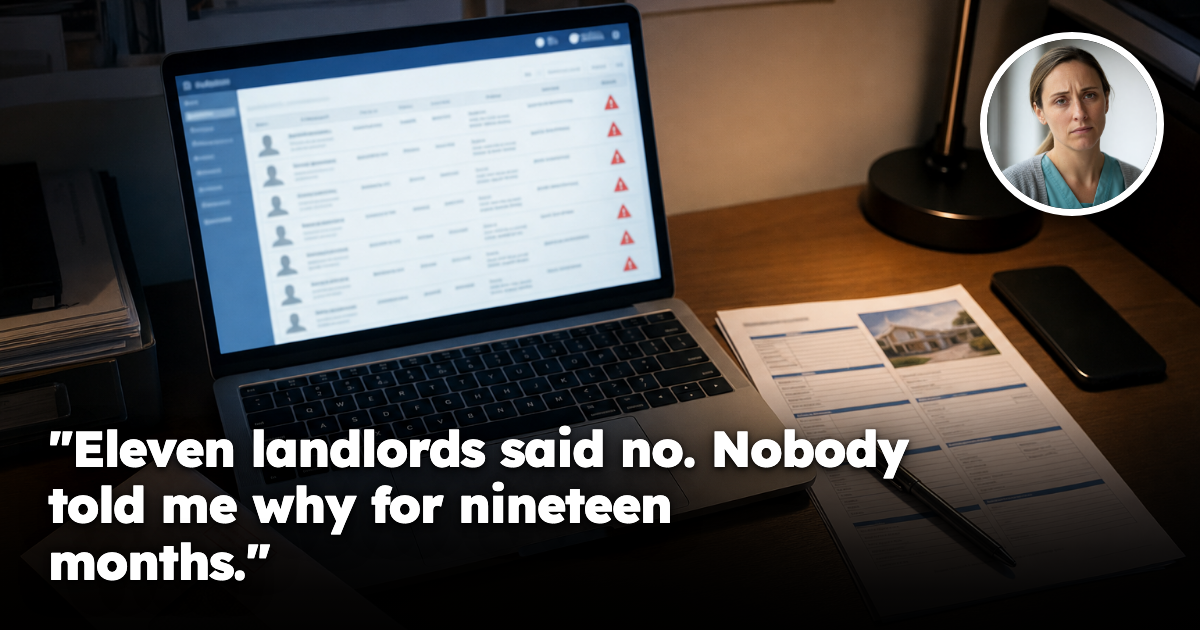
We get asked a version of this constantly, and it starts the same way: someone who has never missed a rent payment suddenly cannot get an application approved, and nobody will say why.
A paediatric nurse in her early thirties came to us after the eleventh rejection. Nineteen months ago she moved out of a two-bedroom unit, and the move ended in a disagreement over $340 — a carpet clean the agent wanted taken from her bond. She disputed it, and as far as she was concerned it was settled.
Then she tried to move again. Application after application came back declined. No interview, no callback, no reason — until one agent, bound by a disclosure rule most renters never hear of, told her the truth.
She was listed on a tenancy database. The entry named her old agency, cited an unpaid amount, and had been sitting there over a year. She had never been shown it. The reason, when she traced it back, was that the agency had recorded it could not locate her — because she had moved house.
Her question to us was short: 'How can a stranger cost me eleven homes over $340 I didn't owe — and I only find out now?'
The answer: the blacklist is real, it's legal, and the safeguard has a hole in it
Most renters have heard of a credit check. Far fewer know there is a parallel system recording your rental history — private databases landlords and agents consult before deciding whether to offer you a home. Being listed is formal, regulated, and follows you for years.
The law does try to fence it in.
You can't be listed while you live there. A listing is only lawful once the tenancy has ended, and only for a prescribed reason.
Before you're listed, you're supposed to get a say. The person listing you must first give you a copy of the information free of charge, at least fourteen days to review and object, and genuinely consider what you send back. That's the safeguard, and it's a good one.
Here is the hole. That entire protection switches off if the landlord "cannot locate" you after reasonable enquiries. No offence is committed; the listing proceeds without you ever being told.
Now think about when a listing becomes possible. It's the moment the tenancy ends — also the moment you've handed back the keys and moved somewhere the old agent has no reason to know. The protection depends on the one thing least likely to be true when it matters: that you're findable.
She wasn't hiding. The system read her absence as permission.
And once it's there, it stays
A listing can be kept for three years — not from when you find out, but from when it goes on. In her case over a year had already run while she quietly lost eleven homes she never knew she'd been ruled out of.
There is a way to fight it, on a clock most people never hear ticking. You can apply to have a listing removed or corrected where the information is wrong or where keeping it there is simply unjust. The law's own examples of "unjust": a person listed for damage caused by someone they lived with during an incident of domestic violence, and a person listed for rent unpaid while in hospital after a serious accident.
But the right to challenge a listing as unlawfully made expires six months after you become aware of it. Awareness doesn't arrive in a letter. It arrives in a rejection. If you stop applying, you never find out — and the three years run their full course in silence.
The only knock on the door is the refusal itself
The only reason she found out is a disclosure duty most renters have never heard of. If an agent checks a database and finds you in it, they must tell you within seven days: the database name, who listed you and how to get it removed. But that duty is triggered by the agent using the database and finding you — so the notification arrives with the rejection it caused. You're told, politely, as the eleventh door closes.
None of this makes databases illegitimate. Bad tenants exist, and landlords have a reasonable interest in not handing a $700,000 asset to someone with a trail of unpaid rent. The problem is that a person can be placed on one without being told, on the say-so of a party they may already be in dispute with, and carry that mark for three years.
What this actually means for you
Databases are one of the tools separating a well-screened tenancy from a costly one. But they are blunt. A listing tells you a dispute happened; it does not tell you who was right. The landlord who treats a flag as an automatic rejection will occasionally screen out exactly the reliable, long-term, low-turnover tenant every investor wants — and that tenant ends up in someone else's property.
This is why tenant quality is not a suburb-level fact and never has been. Two streets in the same postcode, same headline yield, same median rent, can carry completely different tenant profiles — one a street of four-year stayers who renew without negotiation, the next a transient strip where turnover and arrears are an operating cost. None of that shows up in a suburb average. It shows up only in achieved rents rather than asking rents, real vacancy duration, true days on market and genuine street-level supply and demand — where the effective-yield spread between best and worst streets in one suburb routinely runs 20–30%.
A suburb average never read a tenancy database.
The same logic runs through the way a tenant's silence can be read as abandoning a home they never meant to leave — that is about your possessions when you can't be reached, this about your name after you've gone. It sits alongside what a debt can do to your land when the letters go unopened and a charging rule inside a tenancy most people never read.
The part worth keeping
All of this is knowable before it bites. You can ask, in writing, whether you're on a database, and the fee is capped. The fourteen-day review right survives if the landlord can reach you, so the most protective thing a renter can do is the simplest: make sure you can be found, and check the way you'd check a credit score.
For an investor the lesson runs the other way and is worth more. Screening tools are necessary but not sufficient — investors who consistently land the best tenants read the whole street with real data underneath it, not a single flag and a suburb median. Risk you can read is risk you can price, and priced risk isn't a threat — it's an edge over every buyer who never looked.
She kept every receipt, photo and email from that unit. The one thing she never checked was the list she didn't know she was on.
If there's a specific street you're weighing up right now, check its Street Score first — it's free, takes ten seconds, and tells you whether that street is pulling the suburb average up or riding on it.
Frequently asked questions
What is a tenancy database and how can it affect a renter in Australia?
A tenancy database is a private rental history record that landlords and agents may check before approving an application. If you are listed, it can follow you for up to three years and may lead to repeated application rejections.
Can a renter be listed on a tenancy database before they leave the property?
No. Under the article, a listing is only lawful once the tenancy has ended and only for a prescribed reason.
What notice is a renter supposed to get before being listed on a tenancy database?
The person listing you must give you a free copy of the information, allow at least 14 days to review and object, and genuinely consider your response. That safeguard is meant to let you challenge incorrect information before the listing goes on.
Why might someone be listed without ever being told?
The article says the protection switches off if the landlord or agent cannot locate you after reasonable enquiries. In that situation, the listing can proceed without the renter being notified.
How can a renter challenge a tenancy database listing once they find out about it?
A renter can apply to have a listing removed or corrected if the information is wrong or if keeping it there is unjust. The article says the right to challenge an unlawfully made listing expires six months after you become aware of it.
General information only. It does not take your objectives, financial situation or needs into account, and nothing here is legal, financial, taxation or investment advice specific to your circumstances.