
News · 20 August 2026 · 5 min read
'I paid $2,180 to fix a landlord's hot water. The law says I could have spent $2,760 — and so could his agent'
She went four days without hot water, paid a plumber $2,180 on her own credit card, and was told the repair was never authorised. The four-week ceiling she was terrified of crossing turned out to be the exact same limit her agent could have spent without making a single phone call.
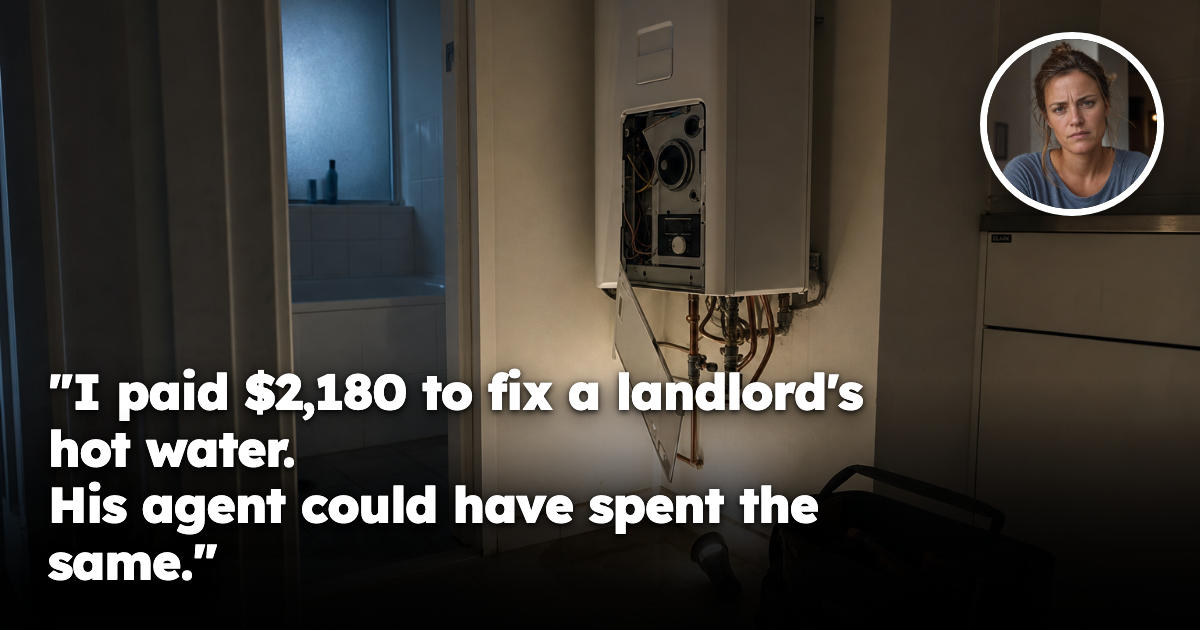
She is thirty-six, a dental hygienist, five years in the same unit without a late payment. In February the hot water system failed — not leaked, failed, on a Thursday night, with a six-year-old in the house.
She rang the agent. Voicemail. She emailed. Nothing. She rang again Friday, and Saturday. By Sunday, four days without hot water, she made a decision that felt obvious and turned out to be legally complicated: she called a plumber herself, paid $2,180 on her own credit card, and sent the invoice through on Monday.
The reply took eleven days. It said the repair had not been authorised.
Her question, when it reached us, is one we get nearly every week: "Was I allowed to do that?"
The answer is yes — almost certainly. But the reason she nearly lost the money has nothing to do with the plumber or the price. It has to do with a number that appears twice in the legislation, doing two opposite jobs.
The category she had to guess
Repairs split into two boxes, and the split decides everything.
The first box is defined with unusual precision — twelve limbs, including a burst water service, a blocked lavatory, a serious roof leak, a gas leak, a dangerous electrical fault, flooding, storm or fire damage, and the limb that decided her case: failure of an essential service or appliance for hot water, cooking or heating.
The second box is a single line: everything not in the first box.
All the legal weight sits in the first definition — and the person who must apply it, at 9pm with no hot water and a child to bathe, is the tenant. She has to classify the fault before doing anything else, because the classification decides who she must notify.
The cascade nobody reads until they need it
The landlord must nominate a repairer, with a name and phone number in the agreement or in writing. The agreement must also state something almost nobody notices: whether that repairer is the tenant's first point of contact.
Then the notice rules fork. Routine repairs: tell the landlord. Emergency repairs: tell the landlord if there is no nominated repairer, or the repairer isn't first contact, or they are but you couldn't reach them after reasonable efforts. Tell the repairer if they are first contact — or if they aren't, but you couldn't reach the landlord.
Read that again as a person in a cold bathroom. Before she may act she must classify the fault, work out whether a repairer was nominated, whether that repairer is her first point of contact, and make reasonable efforts to reach the right one — her remedy depending on getting it right at the worst possible moment. She had, as it happens: her agreement named a repairer but didn't make them her first contact, so the agent was correct.
The number that appears twice
Once notice is given and the repair isn't made within a reasonable time — or she couldn't give notice at all — she may arrange a suitably qualified person herself. There is a ceiling: an amount equal to four weeks' rent.
Her rent was $690 a week. Her ceiling was $2,760. She spent $2,180, well inside it.
Here is the part that reframes everything. The very next provision gives the landlord's agent power to arrange emergency repairs without asking the landlord — capped at an amount defined, in identical words, as four weeks' rent. The agent may take that money out of the rent before it reaches the landlord, and only tell him afterwards.
So the same figure does two opposite jobs. Against the tenant it is a ceiling — spend more and you carry the excess. Against the landlord it is a discretion — the agent may commit that much of his money without a phone call. She was told her repair was unauthorised by an office that, on the same facts and the same number, could have authorised it in ninety seconds.
Getting the money back
The claim is formal, and the form is where people lose. It must be in writing, supported by appropriate documents — invoices, accounts, receipts — and must state that if the landlord doesn't comply within seven days, the tenant may apply to a tribunal. One factor is worth knowing in advance: the decision-maker may consider whether the tenant obtained a number of quotations. At 9pm with no hot water that is a hard standard, but a second quote, even by text, is cheap insurance.
Beyond reimbursement sits the repair order, whose teeth are underrated: a tribunal weighs the conduct of the landlord and agent, the risk of injury and the loss of amenity, and may order a completion date, reduced rent until the work is done, compensation, or that the tenancy ends if the deadline is missed — and that order attaches to the premises, not the tenancy.
None of this makes the landlord a villain — he was an ordinary owner whose agent dropped a Thursday-night voicemail. Not malice, just nobody holding the pager.
What this actually tells an investor
This is a management story in a legal costume, and management quality is not evenly spread across a suburb. Two units four hundred metres apart can share a postcode, a median, a school catchment and a headline yield, and have entirely different repair histories — one where a failed hot water system is fixed on Friday, one where it becomes eleven days and a tenant who leaves at the end of the term.
That never appears in a median. It appears in achieved rents, real vacancy duration and true days-on-market at street level — the metrics separating the best and worst streets in one suburb by 20–30% on effective yield. A suburb average has never answered a phone at 9pm.
The lesson for owners is cheaper than the story suggests. Nominate a real repairer. State plainly whether they are the tenant's first contact. Let your agent use the limit they already have. A four-week ceiling spent on Friday is an operating cost; the same fault left to the eleventh day is a vacancy and a reletting cost — the slow-motion damage that shows up in what a break-lease actually costs and, at the far end, in a listing on a tenancy database that outlives the argument behind it.
Which is why this argues for owning property, not against it. Every rule above is published — the twelve limbs, the notice cascade, the four-week limit on both sides, the seven-day fuse — all readable long before it is urgent. Risk you can read is risk you can price, and priced risk isn't a threat; it's an edge over every buyer who never looked. The same holds when a tenancy ends badly rather than expensively — as when the law reads a tenant's absence as an answer.
She was reimbursed in full, seventeen days after she paid. She is still in the unit. She renewed.
She just wishes someone had told her, at 9pm on a Thursday, that the ceiling she was so frightened of crossing was the number the agent had in his pocket all along.
If there's a specific street you're weighing up right now, check its Street Score first — it's free, takes ten seconds, and tells you whether that street is pulling the suburb average up or riding on it.
Frequently asked questions
Can a tenant in Australia arrange emergency hot water repairs themselves if the agent doesn’t respond?
Yes, almost certainly. If the problem is an emergency repair and the landlord or nominated repairer cannot be reached after reasonable efforts, the tenant may arrange a suitably qualified person to fix it.
How much can a tenant spend on emergency repairs before they risk paying the excess themselves?
The limit is an amount equal to four weeks’ rent. In the article’s example, the tenant’s four-week ceiling was $2,760 and the repair cost $2,180, so it was within the limit.
Why did the tenant’s agent say the hot water repair was unauthorised if the tenant was allowed to act?
Because the repair was still subject to the notice rules and the repairer nominated in the agreement was not the tenant’s first point of contact. The article says the tenant had to classify the fault and make reasonable efforts to contact the right person first.
Can a landlord’s agent approve emergency repairs without asking the landlord first?
Yes. The article says the agent can arrange emergency repairs without prior approval from the landlord, up to the same four-weeks-rent cap, and then tell the landlord afterwards.
What does a tenant need to do to get reimbursed for emergency repairs?
The claim must be in writing and supported by documents such as invoices, accounts or receipts. The article also says the tenant should state that if the landlord does not comply within seven days, they may apply to a tribunal.
General information only. It does not take your objectives, financial situation or needs into account, and nothing here is legal, financial, taxation or investment advice specific to your circumstances.