
News · 23 August 2026 · 6 min read
'Nobody ever sent me anything. Then an officer walked my back paddock and handed me a $31,000 problem'
She bought four hectares, did building and pest, and had her solicitor run every council search. Eleven months later an officer visiting about a neighbour's matter glanced at her back corner — and she had a written order and a $31,000 bill for a duty nobody ever served on her.
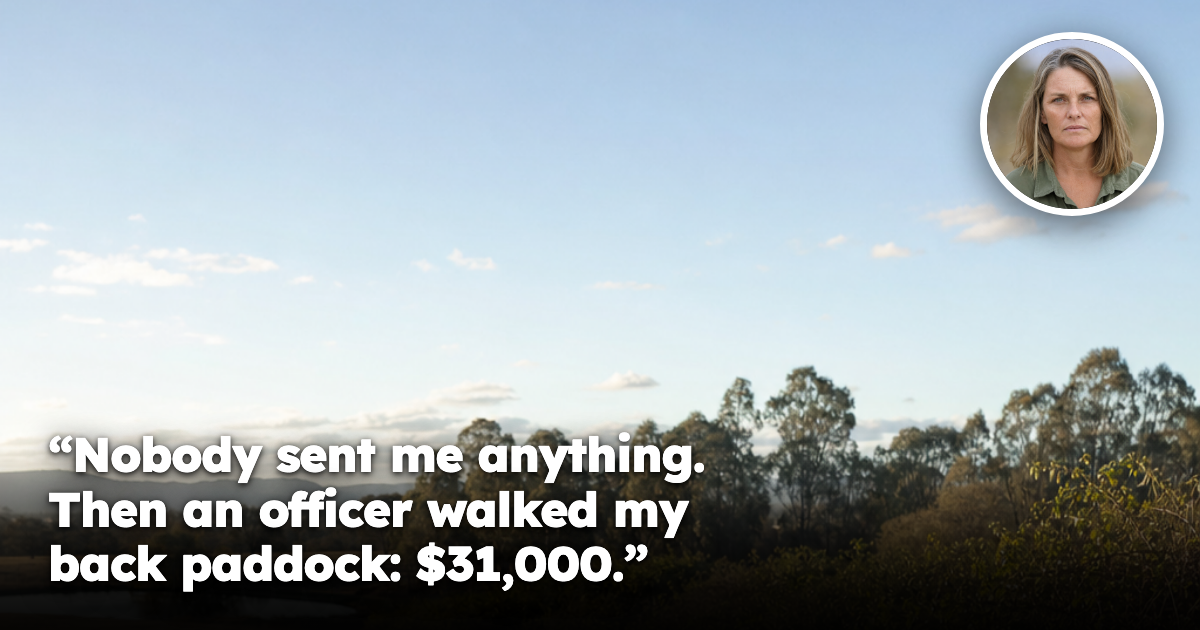
She is 52. Last year she sold the suburban block she had owned since her thirties, moved an hour out, and bought four hectares with a house on it — her first property that was not a rectangle of lawn.
She did it carefully. Building and pest. Contract reviewed. Council searches through her solicitor, all clear. She walked the property twice before signing, and what she saw was grass, a dam, old fencing, and a back corner she describes as "scrubby, like everyone's."
Eleven months later an officer came out about something else entirely — a neighbouring landholder's matter, nothing to do with her. He was there with her permission and was, by her account, perfectly polite. On his way back he stopped at that corner.
Two weeks later she had a written order requiring her to treat that corner, in a stated way, within a stated period, and to photograph the work before, during and after. She has priced the treatment and follow-up passes: $31,000 over three years.
Her question was one sentence.
"Nobody ever sent me anything, nobody registered anything against my title, and I didn't put it there. How was I already breaking a law I'd never been told about?"
The answer nobody gives you at the contract stage
The obligation she breached is not created by a notice, a registration, or anyone contacting you at all. It applies, by force of the legislation itself, to a person who deals with certain matter or carries out an activity where that person "knows or ought reasonably to know" that it poses, or is likely to pose, a risk of the relevant kind. The duty is to take all reasonable and practical measures.
Read that trigger again. It is not was told. It is not was served. It is knows, or ought reasonably to know. And the legislation lists, among its own examples of falling short, failing to manage the impact of invasive plants and animals on a person's land. "Carrying out an activity" is defined to include simply entering, being present at, or leaving a place.
So the honest answer is uncomfortable: she was not in breach because someone made a decision about her. She was in breach, if she was, from the moment the test was satisfied — likely before she owned the place.
Then a belief becomes an order
Where an officer reasonably believes a person has failed, or MAY FAIL, to discharge that obligation at a place, the officer may give that person an order — and may give it regardless of the circumstances in which the officer forms the belief.
That is not loose drafting. The legislation's own illustrations make it explicit: an officer who enters responding to one thing entirely, notices something else, and may issue an order about it. A visit you invited, for a matter that was not yours, is a lawful occasion for an order about your own back corner. And note the trigger — "has failed, or may fail" is a forecast, and present facts cannot falsify it. Non-compliance is then a separate offence with its own maximum penalty, on top of the underlying obligation.
The two things that make this a property problem
First: they can do the work and send you the bill. If the order requires steps and they are not taken, the issuing authority may enter — by its employees or agents — and take those steps itself, then recover what it properly and reasonably incurs as a debt, payable 30 days after it tells you the amount. You control neither contractor nor price.
Second: the order is recorded against the LAND. A register of these orders must be kept, and its first prescribed particular is the real property description of the land — then the day it was given, the matter, the action required and the period allowed.
Now find the provision requiring that to be noted on the title. There isn't one.
The record is public and inspectable. It is simply not in the register your conveyancer searches. Her solicitor's searches came back clear because they were run, correctly, against the wrong registry — a habit, not a quirk. See also a tree order that transferred to a buyer at settlement, a repair order attaching to the premises rather than the tenancy, and a land register recording historic land use that never appears on title.
And the compensation chapter does not reach it
The legislation does contain a compensation regime — where the State destroys or damages property in a lawful response, compensation can be payable. But that chapter turns on the definition of a "response", and the definition says a response does not include any action taken under the chapter that contains these orders.
So the State compensates for what it does to your property. It does not compensate for what it orders you to do to your own land at your own cost. The instrument most likely to land on an ordinary owner is written out of the chapter.
In fairness — because this cuts both ways
None of this is unreasonable in design, and she says so herself. Invasive plants and pests spread from land to land; a duty that only bit people individually served would protect nothing. Her order had to state the failure, the place, the action, the period and that non-compliance is an offence — and the period must be reasonable. It came with review rights, a stay can be sought, and there is a due diligence defence. Where somebody else is genuinely responsible, a court can make a cost recovery order against that third party.
Nobody behaved badly. The officer applied the law as written. The failure was a knowledge gap.
What this actually is: a street-level pricing problem
Two acreage properties in the same postcode return a word-for-word identical suburb report. Same median. Same growth rate. Same council. Same catchment. Same vacancy rate. Every number the same number. One carries a live order with a three-year treatment schedule attached. The summary cannot see it — a median has never once been served with anything.
That is the whole argument for street-level data over suburb averages. Across a single suburb the effective-yield spread between best and worst streets routinely runs 20–30% — on achieved rents, real vacancy duration and true days on market. An unresolved holding obligation drags a property to the far end of that spread, because an asset with a mandated annual spend is not the same asset as its neighbour.
The close
All of it was published, in force and readable years before she made an offer — the obligation, the knowledge test, the order power, the register keyed to the real property description, the do-it-and-bill-you provision and the compensation carve-out.
The fix is one more line on the pre-purchase list, in writing, before the offer: has any order of this kind been made about this land, is it still on the register, and has it been complied with? On anything rural or semi-rural, ask it every time. Walk the back corner with someone who knows what they are looking at.
Risk you cannot see is a threat. Risk you can read is a line item — and a priced line item is an edge over every other buyer at that inspection who never looked.
She did not lose $31,000 to a dishonest vendor, a careless solicitor or an unfair officer. She lost it to a register nobody told her to search.
If there's a specific street you're weighing up right now, check its Street Score first — it's free, takes ten seconds, and tells you whether that street is pulling the suburb average up or riding on it.
Frequently asked questions
Why could a buyer in Australia get an order and a bill for invasive plants or pests on land they thought was clear?
Because the duty applies by operation of the legislation itself when a person knows, or ought reasonably to know, of the risk. It does not depend on being formally notified, registered against the title, or served with a warning.
Can an officer issue an order after visiting a property for a completely different reason?
Yes. The article says an officer can form a reasonable belief and give an order regardless of the circumstances that led to the visit, including when they were on the land for another matter.
Is this kind of order usually shown on the property title or found in standard conveyancing searches?
No. The article says the order is kept on a separate register linked to the real property description, but there is no provision requiring it to be noted on title. That is why standard title searches can come back clear.
If the owner does not carry out the work required by the order, what can happen?
The issuing authority can enter the land, do the work itself through employees or agents, and recover the cost as a debt. The article says the owner may then be billed for what the authority properly and reasonably incurs.
What should a buyer of rural or semi-rural land ask before making an offer?
The article recommends asking whether any order of this kind has been made about the land, whether it is still on the register, and whether it has been complied with. It also says to walk the back corner with someone who knows what they are looking at.
General information only. It does not take your objectives, financial situation or needs into account, and nothing here is legal, financial, taxation or investment advice specific to your circumstances.