News · 14 August 2026 · 5 min read
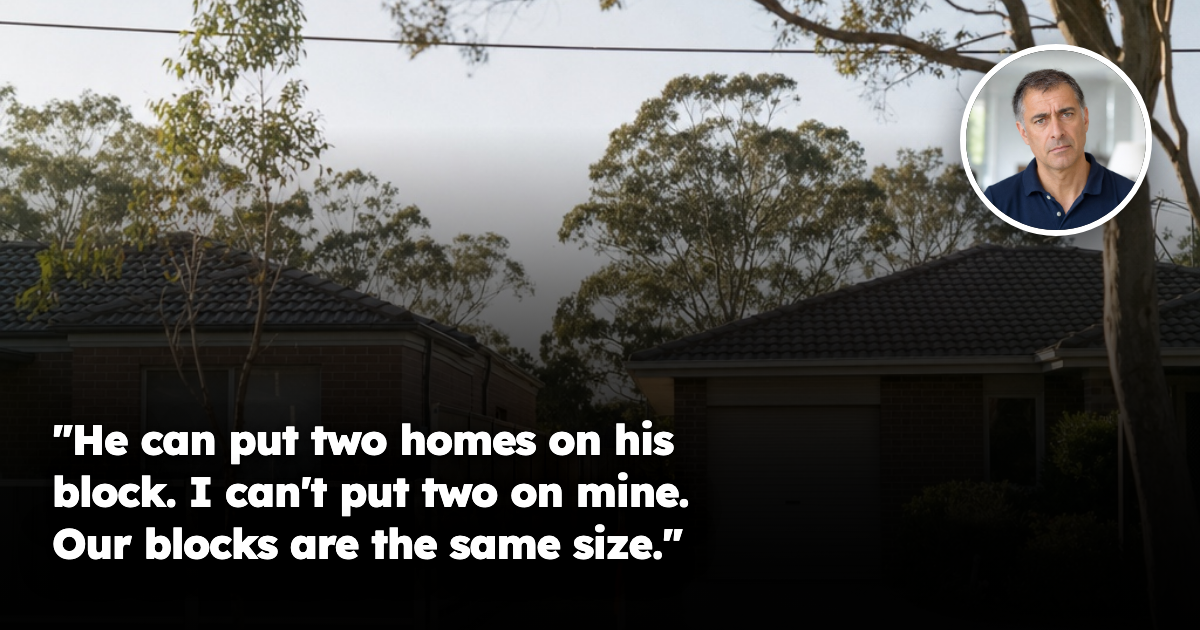
'My neighbour was told he can put two homes on his block. I was told I can't. Our blocks are the same size'
A client's 620sqm block cleared every area threshold and still couldn't carry a dual occupancy. Two doors up, a smaller block could. The difference was frontage — and it's invisible in every suburb median.
A client came to us in June with a survey plan, a planning certificate and a simple question.
He owns a house on a 620-square-metre block in Sydney's south. Two doors up, same street, a neighbour with a block of almost identical area had just been told he could build a dual occupancy — two homes where one stands — and subdivide onto separate titles. Our client had been told no.
Same street. Same zone. Same council. Same median. Blocks within twenty square metres of each other. His question was the one anybody would ask: how is that possible?
The answer is one number, and it isn't area
Almost everyone who thinks about splitting a block thinks in square metres. It's the number on the contract, the number in the listing, the number people quote at barbecues.
But the rules deciding whether a block can carry two homes don't stop at area. They also set a minimum lot width — the frontage — and for a dual occupancy in the relevant zones that number is 12 metres.
The area threshold is 450 square metres. Our client's 620 cleared that comfortably. His frontage was just over eleven. Two doors up, the neighbour's block was narrower in area and wider at the street.
That is the whole story. Not the size of the land. The shape of it.
And it doesn't stop there. Terraces need 18 metres. Where subdivision is allowed, each resulting lot must hold 225 square metres and 6 metres of width — which is why a wide block splits cleanly and a deep, narrow one often can't, whatever the title says. The same trap turns a subdivision approval into an equity write-down.
Why this is suddenly worth so much money
These aren't ordinary council guidelines. They're non-discretionary development standards — non-refusal standards. Meet them and the consent authority cannot refuse on that ground; the standard overrides a more onerous local rule. That is unusual certainty in a system that runs on judgement. It converts "you might get this through" into "they can't knock this back for being too small."
The policy arrived in two steps. From 1 July 2024, dual occupancies became permissible with consent in low-density residential zones state-wide. From 28 February 2025, the standards above switched on inside defined low- and mid-rise housing areas — residential land within 800 metres walking distance of 171 nominated town centres and stations, expected to deliver up to 112,000 homes over five years.
So a rule change most owners registered as background noise handed a valuable, legally-backed entitlement to some blocks — and nothing to the block next door. Exactly how a granny flat and a duplex on one block ended up with opposite tax outcomes.
The second line almost nobody measures properly
There is a further trap in that 800-metre figure, and it catches people certain they're inside it.
It is 800 metres walking distance — along the walking network, from the station entrance, not a circle on a map. A rail corridor, a river or a dead-end street can push a block outside a line it appears to sit well within. Two houses can be the same straight-line distance from one station and only one is in. The department says so itself: its maps are labelled indicative and cannot account for individual property constraints or local walking networks.
Then there are the exclusions, which are absolute. The policy does not apply to bushfire-prone land (categories 1, 2 and 3, and the buffer), land inside the higher aircraft noise contours, land in the probable maximum flood of the Hawkesbury-Nepean or parts of the Georges River catchment, or land with a heritage item. Four local government areas are excluded outright.
Every one is a boundary that runs through suburbs. A bushfire buffer stops at a line. A heritage listing attaches to individual properties, often a handful in one street. And none of it touches your title — a covenant can block a subdivision the council would happily approve.
What this actually tells you about property data
This is the clearest example we have of something people find hard to believe until they see it priced.
Two houses on one street, sharing a postcode, a median, a council, a catchment and a station, can be fundamentally different assets — and here the difference is legally enforceable and worth a great deal of money. One block carries the right to a second dwelling and a second title. The other carries a house. Suburb data is structurally incapable of seeing that: a median averages both and reports one number. Frontage doesn't appear in a median. Neither does a walking network or a bushfire buffer.
It is the same dispersion we measure everywhere else, in its most visible form. Between the best and worst streets inside one suburb we routinely see a 20–30% spread in effective yield using achieved rents, real vacancy duration and actual days on market rather than advertised figures. Development potential behaves the same way — except it doesn't grade, it switches. You are over 12 metres or you are not.
Four things to check before you assume anything
Get the frontage from the survey. Not the listing, not the title area, not a pace-out. A dimensioned plan. Thirty centimetres is the difference between an entitlement and a house.
Check the zone and the walking route separately. The right zone is not the same as being in the area, and 800 metres in a straight line is not 800 metres on foot.
Order the planning certificate. Bushfire mapping, flood extent and heritage all appear there. So does anything on the title — an easement can quietly remove the buildable area you were counting on. Any one switches it off regardless of dimensions.
Then work out whether it's worth doing. Being allowed to build two homes and it being a good idea are different questions. The second is answered by street-level demand.
The part investors should take from this
Our client's block doesn't work. The one two doors up does. Nothing about that was visible in the suburb data either was looking at, and nothing about it appears in the price either paid.
That gap is not a defect in the market. It is the return.
A rule that hands a legally protected entitlement to some blocks and not others creates permanent differences between properties a median treats as identical. Most buyers won't check. They'll compare square metres, look at a suburb growth chart, and never open a survey plan.
Which is precisely why checking is worth something. If everyone measured frontage before buying, wide blocks would already be priced for it. They aren't, because most people don't — and the owners who do are buying a second dwelling's worth of upside inside the price of a house. Property rewards this work more reliably than almost any other asset, because so much of it is priced off averages that describe nobody's property in particular.
He researched a suburb. He bought a shape. Almost everyone does it in that order.
If there's a specific street you're weighing up right now, check its Street Score first — it's free, takes ten seconds, and tells you whether that street is pulling the suburb average up or riding on it.
Market data & R-Scores for locations in this article
Drill Down Into the Markets Mentioned Above
Inspect live monthly R-Scores, median prices, rental yields, and street-by-street scores for the cities and council areas referenced in this article:
Frequently asked questions
Why can one Sydney block be eligible for a dual occupancy while a nearby block of the same size is not?
Because the rules depend on more than land area. For a dual occupancy in the relevant zones, the block also needs at least 12 metres of frontage, so a wider smaller block can qualify while a slightly larger but narrower one cannot.
What frontage and lot size do you need for a dual occupancy or subdivision under the rules in the article?
The article says a dual occupancy needs 450 square metres and 12 metres of frontage. If subdivision is allowed, each new lot must be at least 225 square metres and 6 metres wide.
Does being inside 800 metres of a station automatically mean a block is eligible?
No. The 800-metre test is walking distance from the station entrance along the walking network, not a straight-line circle on a map. A block can look close but still fall outside the policy area.
What can stop a block from qualifying even if it meets the size and frontage rules?
The policy does not apply to certain exclusions, including bushfire-prone land, higher aircraft noise contours, parts of the Hawkesbury-Nepean probable maximum flood area and parts of the Georges River catchment, land with a heritage item, and four excluded local government areas.
What should a buyer check before assuming a block can be developed for two homes?
The article recommends checking the frontage on a survey plan, confirming the zone and walking route, and ordering the planning certificate. It notes that bushfire, flood, heritage and title constraints such as easements can override the apparent development potential.
General information only. It does not take your objectives, financial situation or needs into account, and nothing here is legal, financial, taxation or investment advice specific to your circumstances.