News · 16 August 2026 · 6 min read
'They rezoned my land without asking me. Then I got a $300,000 tax bill for money I have never seen'
He did not apply for anything. A planning amendment passed, his land was moved into a different zone, and a valuer decided he was several hundred thousand dollars richer. The tax on that is charged at rezoning, not at sale — and the parcel across the road was not touched.
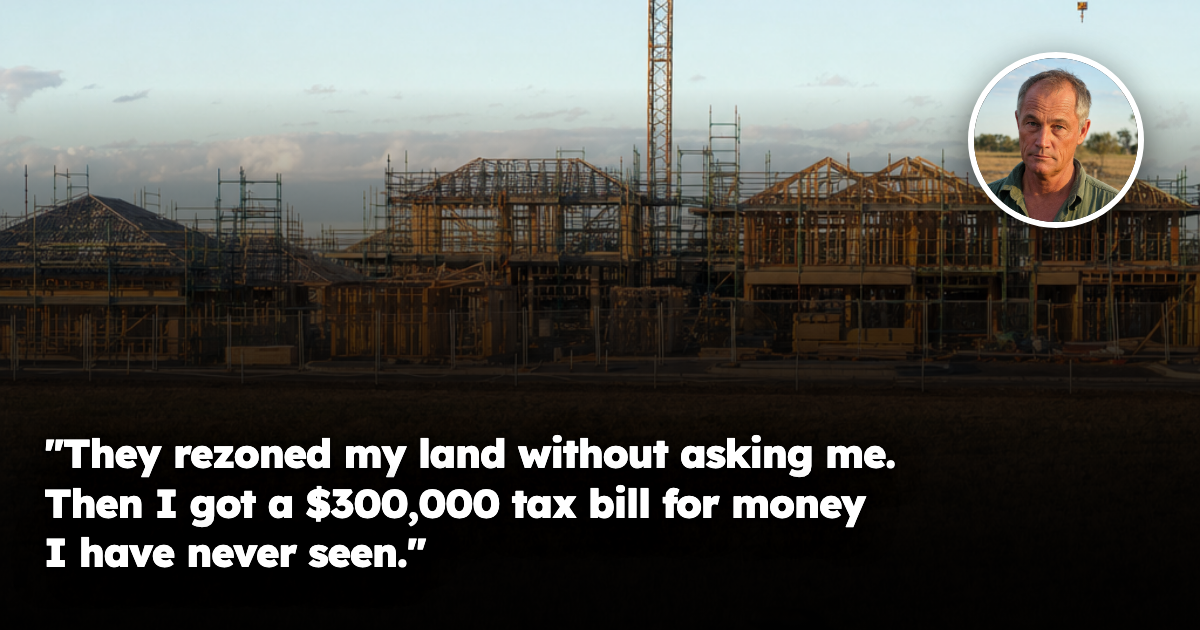
He is 58, and he has owned the same parcel on the edge of a growth corridor since 2006. He did not apply for anything — no plan lodged, no planner engaged, no favour asked.
A planning amendment went through. His land was moved from one zone into another. A valuer then formed a view that it was worth several hundred thousand dollars more than it had been the week before, and a tax assessment arrived based on that number.
He has not sold anything. He has not subdivided, built, borrowed against it or received a cent.
"How can they tax me on money I have never seen? And the bloke across the road got nothing — his land wasn't touched."
Both halves of that question have precise answers. The second is worth reading twice.
The mechanism: the tax event is the rezoning, not the sale
This is the part that catches people, and it is by design.
Where an uplift tax of this kind applies, it is triggered when the land is rezoned — not when it is sold, and not when it is developed. Whoever owns the land the day the rezoning takes effect is liable. There is no transaction, no settlement, no cash. There is a gazettal notice and, some time later, an assessment.
The numbers are not small. The taxable uplift is the difference between the land's value before the rezoning and after, as determined by the state valuer. Above a $100,000 threshold, the rates run to 62.5 per cent of the uplift above $100,000, and where the uplift reaches $500,000 or more, 50 per cent of the entire amount. On a $600,000 uplift that is a $300,000 liability.
Note the shape of that. Just under $500,000, only the amount above the threshold is taxed. At $500,000, the whole sum becomes taxable. A single dollar of assessed uplift can change what is taxed by $100,000 — which makes the valuation itself the highest-stakes number in the process.
Three mechanics matter enormously and are routinely missed:
You can defer, but it compounds. Payment can generally be deferred until the next dutiable transaction or up to 30 years, whichever comes first, with interest accruing throughout. Unpaid, the amount is recorded against the land and must be cleared before sale. Deferral is a financing decision, not an escape — and if the land is later subdivided, the deferred amount splits across the new lots and carries on. It does not reset.
Losses are ignored. Where someone owns several parcels caught by the same amendment, the uplifts are added together — but reductions in value are disregarded. You are assessed on the parcels that went up, with no credit for those that went down. Joint owners are treated as one owner, and grouping rules reach across related companies and trusts.
A schedule change is not a rezoning. Moving between schedules within the same zone generally does not trigger the tax. Moving from one zone to a different zone does. Two planning changes that sound nearly identical in a council letter can have completely different consequences, and the letter will not explain which one you have received.
There are real exemptions — residential land up to two hectares is the significant one for most owners, along with charitable and university land, and rezonings into public or rural zones. Some apply automatically; others must be claimed, and that distinction has cost people real money.
The part his neighbour proves
The parcel across the road was not touched. Same street, same distance to the same station, same amenity, same market. One owner has a six-figure liability and a materially more valuable asset. The other has neither.
That is not an anomaly. That is how rezoning works. Amendment boundaries follow lot lines, road centrelines, catchment edges and corridor limits — and then they stop. Somewhere in every rezoning there is a final lot, and then the next one along, unchanged. Two owners who bought in the same year at the same price on the same street now hold assets that have diverged permanently, for reasons neither influenced and only one will benefit from.
This is precisely the resolution problem we spend our working lives measuring. A suburb median cannot see a rezoning boundary running down the middle of a street: it averages the rezoned lots and the untouched ones and reports the middle — a number that describes neither owner. The gap between the best and worst streets inside a single suburb already runs to 20 to 30 per cent on effective yield once you use achieved rents, real vacancy duration and true days-on-market. A rezoning boundary can open a gap that large in an afternoon.
It also compounds with everything underneath it. Zoning grants theoretical capacity; whether that capacity is usable depends on frontage, easements, servicing and the constraints on the title. Two lots can receive the identical zone and deliver completely different yields — the same logic that decides whether two identically sized blocks fit the same number of homes, and the same reason a subdivision approval can leave an owner with less equity than they started with.
What to actually do
Read the valuation, not just the bill. The assessment rests on a before-and-after valuation of your specific land. Valuations at this scale compare sales across an area and apply relationships broadly — which assumes land within an area behaves consistently. It does not. Objection windows are short and strictly enforced: typically two months for the valuation and 60 days for the assessment, from the issue date. Diarise them the day the notice arrives, because an objection is an evidentiary argument about comparables, not an appeal to fairness.
If you are buying, get the clearance certificate. A buyer can request a certificate showing any liability recorded against the land, and it caps their exposure to the amount shown. It costs almost nothing, and skipping it can mean inheriting somebody else's deferred tax plus interest.
Know which side of the line you are on before it is drawn. Rezoning programs are published, consulted on and gazetted, and draft amendment maps exist long before the tax does. Same discipline as every other planning overlay that can decide your land's value without consulting you — check your lot, then check the one over the fence.
What it means for you
He is not selling. He is objecting on the valuation, deferring the balance, and — for the first time in twenty years — reading his planning scheme.
The reframe is this. A tax on rezoning uplift is, awkwardly, a government confirming in writing that your land became substantially more valuable. That is a good problem, badly timed and clumsily delivered. It hurts those who were unaware, unadvised and unable to fund it. It barely touches those who saw the amendment coming and planned around it.
And the wider point holds whichever side of the line you are on: Australian property is not becoming a worse asset class. It is becoming a less forgiving one, in which the difference between an excellent outcome and an expensive one is decided by lines, lots and overlays that never appear in the number quoted on the evening news.
His neighbour across the road did not dodge anything. He simply owned a different piece of land, one hundred metres away.
If there's a specific street you're weighing up right now, check its Street Score first — it's free, takes ten seconds, and tells you whether that street is pulling the suburb average up or riding on it.
Frequently asked questions
Why can someone be taxed after their land is rezoned even if they never sold it?
Because the tax event is the rezoning itself, not a sale or development. Whoever owns the land when the rezoning takes effect is liable, even if no cash has changed hands.
How is the rezoning tax calculated in Australia under this article?
The tax is based on the uplift in land value before and after rezoning, as set by the state valuer. Above $100,000, the rates increase, and at $500,000 or more of uplift, 50 per cent of the entire amount can apply.
Can rezoning tax be deferred if the owner cannot pay straight away?
Yes, it can generally be deferred until the next dutiable transaction or for up to 30 years, whichever comes first. But interest accrues, and the deferred amount stays recorded against the land until it is cleared.
Does every planning change trigger this tax?
No. A change between schedules within the same zone generally does not trigger it, but moving from one zone to a different zone does. The distinction matters because planning letters can sound similar even when the tax outcome is very different.
What should an owner do if they receive a rezoning valuation or assessment notice?
They should read the valuation carefully, not just the bill, because objections are about the evidence supporting the value. The article says objection windows are short, so the notice date should be diarised immediately.
General information only. It does not take your objectives, financial situation or needs into account, and nothing here is legal, financial, taxation or investment advice specific to your circumstances.