News · 12 August 2026 · 5 min read
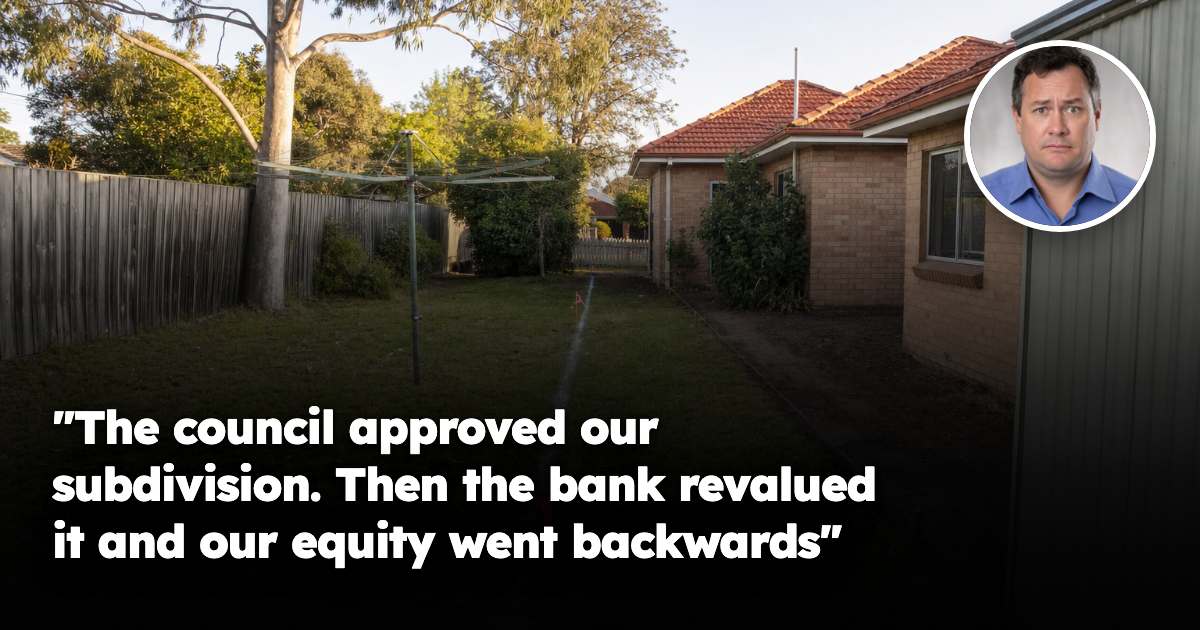
'The council approved our subdivision. Then the bank revalued it and our equity went backwards'
A client got his subdivision approved and came out with less usable equity than he had as one house on one title. Here's the mechanic most buyers never model - and why 'subdivision potential, STCA' is a marketing line, not information.
The block was big, the zoning was right, the council said yes — and the approval made him poorer.
A client came to us this year with a question we now hear constantly. He and his wife had bought an older brick home on a generous block in an established middle-ring suburb — Hills Hoist out the back, enough lawn to lose a cricket ball in. The listing had the words that made the purchase make sense to him: subdivision potential, STCA.
He was not reckless about it. He checked the zoning, checked the lot size against the minimum in his area, paid for a survey, lodged the application, answered the council's questions and eventually got the approval letter. Two titles where there had been one.
Then he asked his bank to revalue the property so he could draw on the new equity and fund the build.
The valuation came back and he had less usable equity than he'd had as one house on one title.
His question was simple, and slightly stunned: how is that possible?
The answer nobody puts in the listing
It's possible because of something most buyers never model: a subdivision approval is not a valuation event. It's a credit event.
Here's the mechanic. A house on a large block is about the easiest security a lender can hold — a finished, income-capable asset with a deep buyer pool. Split that title and the lender is holding a house on a smaller parcel plus a block of vacant dirt. Lenders discount vacant land hard: it earns nothing, costs money to hold, and if the loan goes bad it's much harder to sell.
Same dirt. Less money. Two titles is not the same thing as two assets.
Worse, the shrunken lending headroom lands exactly when the owner needs to fund construction. The approval meant to unlock the project is what stopped it.
There's a second trap. A standard home loan wasn't written for a title split. The lender holds the property as security, and many loan contracts require its written consent before an application is lodged, not after. Owners routinely discover this in the wrong order.
For the first year or two, subdividing doesn't unlock equity — it locks it up.
Then there's the part that actually kills deals
Permission is only the first gate, and it's the cheap one. The expensive gate is physical.
A new lot isn't a lot until it can be used, and that means services: water, sewer, power, stormwater, access. The application fee can be modest; a surveyor a couple of thousand dollars. What ruins feasibilities is what the approval requires you to build.
We had a client discover — well after committing — that connecting the rear block meant a driveway down the side of the house, quoted at $100,000. Not the house. Not the subdivision. Just the concrete needed to make the second lot usable. The project died on that line item.
Slope, sewer mains through the yard, stormwater falling the wrong way, retaining, tree protection, the width of the side access, the shape of the parcel you'd create — every one is a number sitting underneath the zoning that made the block look attractive.
Then add the costs that don't feel like costs: 12 to 18 months of interest while the new block earns nothing, plus GST on the sale. A subdivision isn't a property purchase. It's a small development, and should be underwritten like one.
The people who do this professionally are blunt about the hit rate. A subdivision specialist we rate says that of every ten projects he looks at seriously, he says no to at least eight — not because councils are unreasonable, but because the numbers don't stack up.
Why 'subdivision potential' keeps working as a marketing line
Because it isn't a lie. It just isn't information.
Subject to council approval means what it says: someone may approve this, subject to conditions nobody has specified, at a cost nobody has priced. Sometimes it's a flat no — a restriction on the title, or a definition in the planning instrument, deciding it before anyone assesses your plans. The rest lives in engineering drawings and council requirement schedules, and nobody must find them before the auction — leaving the buyer investigating in the wrong order: buy first, price the constraints later.
This is exactly where suburb data fails you
Development potential is measured by most buyers with two numbers: land size and zoning. Both are in every listing and every suburb report. Both feel authoritative. Neither tells you whether a subdivision will make money.
Two houses on the same street can share a postcode, a median, a council, a zone, a school catchment and an identical census profile — and be completely different development propositions. One has a wide side setback, a flat run to the street and services at the frontage. The other has a main through the back third, a cross-fall away from the road, and a side gap that will never take a compliant driveway. The suburb data says they're twins. The market does not.
That's why we work at street and property level, not suburb level. The gap between the best and worst streets in one suburb routinely runs to 20–30% on effective yield, and development potential is among the biggest drivers of that spread — because it's the factor most likely to be assumed rather than checked. With residential land in the major capitals now transacting around $2,019 per square metre in new estates, up from roughly $1,000 in 2015, every square metre you can or can't use is a materially bigger number than a decade ago.
Four things worth doing before you pay for potential
1. Price the approval, not the permission. Ask what the consent would require you to build — access, services, stormwater, retaining. That schedule, not the zoning, is your feasibility.
2. Talk to your lender before you lodge anything. Confirm whether consent is needed, and what a subdivided holding does to what they'll lend you, while it's still hypothetical.
3. Work backwards from a realistic end value, in today's market. If you've never developed before, expect a conservative valuation — the bank values the risk it's carrying, not your optimism.
4. Use the cooling-off period, where you have one. Get the council's planning controls, then a town planner, a surveyor and a builder. A few thousand dollars of investigation is the cheapest part of any development you'll ever do.
The pro-investment read
None of this is an argument against subdividing. Done properly it remains one of the most reliable ways to manufacture value in Australian property, and in a softer market, where you can buy the land well, the numbers stack up more often than at the peak.
It's an argument about sequence. The value was never in the approval. It was in the block being genuinely capable of carrying a second dwelling economically — knowable before he made an offer, for a fraction of what the lesson cost.
He researched a suburb and a zoning code. He never priced the driveway.
If there's a specific street you're weighing up right now, check its Street Score first — it's free, takes ten seconds, and tells you whether that street is pulling the suburb average up or riding on it.
Frequently asked questions
Why can a subdivision approval leave an owner with less usable equity in Australia?
Because a subdivision approval is a credit event, not a valuation event. Once the block is split, the lender may see one dwelling on a smaller lot plus vacant land, and vacant land is typically discounted more heavily.
Does council approval mean a subdivision will automatically be easy to finance?
No. The article says many home loan contracts require the lender’s written consent before lodging a subdivision application, and the bank may revalue the property conservatively after approval.
What hidden costs can make a subdivision unworkable even if council says yes?
The approval can require expensive physical works such as a driveway, services, stormwater, retaining or access works. The article gives an example where a driveway quote of $100,000 killed the deal.
Why is 'subdivision potential, STCA' not enough information when buying a property?
It only means something may be approved subject to conditions and costs that are not yet priced. The real feasibility depends on engineering, council requirements, lender settings and the site’s physical constraints.
What should a buyer check before paying extra for a block with subdivision potential?
The article says to price the approval, talk to the lender before lodging anything, work backwards from a realistic end value, and use the cooling-off period to get a planner, surveyor and builder involved early.
General information only. It does not take your objectives, financial situation or needs into account, and nothing here is legal, financial, taxation or investment advice specific to your circumstances.