
News · 22 August 2026 · 6 min read
'I paid $329,000 cash for my home. Someone else owns the ground it sits on — and they want it back'
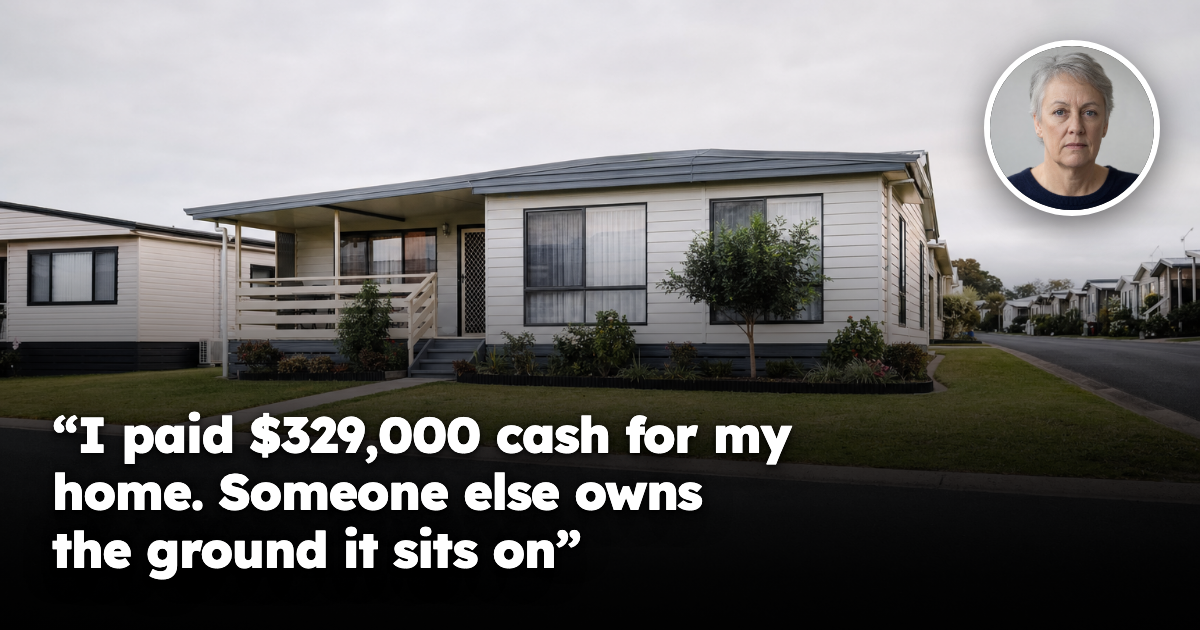
She paid $329,000 cash for her home and owns it outright. The company that owns the ground underneath has applied to end every site agreement in the community — not for any breach, but because it wants the land for something else.
She did everything the responsible way, in the right order, and that order is what has put her here.
She is 66. Four years ago she sold the family home of twenty-eight years, cleared a small mortgage, and bought outright into a land-lease community — one of those neat over-fifties villages with a bowling green and a shared hall. She paid $329,000 cash. No loan, no lender, no repayments ever again. The rest went into superannuation, and the arithmetic worked.
She owns that home outright. Nobody disputes it. Her name, her asset, her door.
What she does not own — and did not fully absorb, because it was explained once in a folder she read while organising removalists — is the ground the home sits on. She rents that, for a weekly fee paid to the company that owns the land under all one hundred and forty homes.
Last month every household got a letter. That company has applied to end the site agreements. Not because anybody did anything wrong. Because it wants the land for something else.
Her question was the one anybody would ask:
"I own my home. I paid cash. I've never missed a fee or broken a rule. How can somebody else's plans for the dirt underneath me end my housing?"
The answer is uncomfortable, and it is not a loophole
There is a specific statutory ground for this, and most people in these communities have never read it.
The landholder may apply to the tribunal to terminate a site agreement on the ground that they wish to use the land for another purpose. That is the whole ground. Not breach, not arrears, not nuisance — simply an intention to do something different with land they own.
There is one evidentiary requirement, and it is the detail that startles people most. The application must be accompanied by a document from the local government certifying that the proposed alternative use is lawful. Not better. Not necessary. Only permitted.
Lawful is an extremely low bar to clear to end someone's housing. But it is the bar the legislation sets.
What the law does give her, and it is more than she assumed
Here the picture stops being one-way.
The tribunal sets the end date, and it can be up to a year away. The termination day must be just and equitable, and the legislation lists what to weigh: the home owner's personal and financial circumstances, including health, age and mobility; the availability and location of alternative accommodation at a similar cost; and the effect on the landholder of waiting. Her age and fixed income are not sentiment here. They are listed considerations.
The order must choose one of two endings, and one needs her signature. A termination order must include either an order that she give up the site, or an order that she transfer ownership of the home to the landholder. The second can only be made with her consent. That is a real veto — but be honest about what it guards. Refusing consent does not stop the termination. It only decides how it ends.
Seven matters must be weighed before that choice is made, reading like a checklist written by someone who watched this go badly: the cost and practicality of relocating the home; whether she intends to; whether it should instead be resold within the community; whether alternative locations exist within a reasonable distance; its condition and saleability; what she paid, and how far its value would fall if she is simply required to vacate; and what is fair overall.
Compensation is available — but discretionary, not automatic. The tribunal may order it, weighing dismantling costs, transport, repositioning, what she paid, and whether the home was originally sold to her on that site by the landholder or a predecessor. Transport is capped at 300km. Any amount ordered is recoverable as a debt, and the tribunal can appoint an independent valuer whose costs the landholder pays.
She can also apply for a comparable site within the community, and if she applies to extend her compliance period before the end date, the termination order is suspended while that is heard.
The line in the legislation that tells you what you're actually buying
Buried in the compensation provisions is a phrase everyone considering this style of ownership should read. When calculating what she is owed, the tribunal may consider:
the difference between the market value of the home if sold on site, and the market value of the home if sold separately from the site.
Sit with that. The legislature has written into the formula an explicit acknowledgement that the same dwelling carries two different values depending on whether the ground stays underneath it. Same walls, same roof, same condition — two numbers, and they are not close.
That is the truth of every property transaction anyone has ever done, stated more nakedly because here the two components can actually be pulled apart. You are never buying a building. You are buying a building and a position, and the position does most of the work. In freehold that is disguised, because the two arrive stapled together and never separate. In her case the staple was never there, and she is finding out what each half was worth alone.
Where street-level data comes into this
We spend our days on a version of this problem, in a less dramatic form.
Two houses in one suburb share a median, a growth rate, a catchment and a council. They do not share a street — or achieved rent, real vacancy duration, or true days-on-market. Across one suburb the effective-yield spread between best street and worst is routinely 20–30%, and none of it shows up in the number people decide on. The same disguise operates when a group of co-owners can vote your title away, when one co-owner on a shared title wants out and the other refuses, or when a council sells land out from under an owner over arrears: the building is fine, and control is the variable nobody priced.
A suburb median has never once told anybody who owns the ground.
The habit that protects you is the same at every price point: stop buying the headline number, start buying the parcel — what surrounds it, who controls what adjoins it, what could lawfully happen next door or underneath. A data question, answerable in advance.
The part that is genuinely reassuring
Nothing that happened to her was hidden. The termination ground, the evidence required, the one-year ceiling, the seven considerations, the consent requirement, the compensation factors, the valuer rule, the suspension mechanism — all of it was published, free and readable on the day she signed.
That is not a criticism of her. She read what she was given in a difficult week and understood what most people do. But it means this is not a risk that hides.
Risk you can read in advance is not risk. It is a line item. And pricing a line item nobody else bothered to read is precisely how disciplined investors keep buying good assets from people who never checked.
She is not finished. She has a year, considerations favouring her age and income, a genuine veto over one of the two endings, and a compensation claim she did not know she had.
She also has something she lacked four years ago: she knows what she is buying next time, and she asks who owns the ground first.
If there's a specific street you're weighing up right now, check its Street Score first — it's free, takes ten seconds, and tells you whether that street is pulling the suburb average up or riding on it.
Frequently asked questions
Can a land-lease community in Australia end my site agreement even if I have done nothing wrong?
Yes. The article says the landholder can apply to the tribunal to terminate a site agreement simply because it wants to use the land for another purpose. It is not limited to breaches, arrears or nuisance.
What has to happen before a landholder can end site agreements for another land use?
The application must include a document from the local government certifying that the proposed alternative use is lawful. The article says that lawful use is the key evidentiary requirement.
How does the tribunal decide when a termination will take effect?
The tribunal sets the end date, and it can be up to a year away. It must consider the homeowner’s age, health, mobility, financial circumstances and the availability of alternative accommodation at a similar cost.
Can a homeowner refuse to transfer their home to the landholder if a site agreement is terminated?
Yes, the tribunal can only order a transfer of ownership of the home to the landholder with the homeowner’s consent. But refusing consent does not stop the termination itself; it only affects how the ending happens.
Is compensation guaranteed if a land-lease site agreement is ended?
No. Compensation is available, but it is discretionary rather than automatic. The tribunal may consider factors such as dismantling and transport costs, what the homeowner paid, and the difference between the home’s value on site and its value if sold separately from the site.
General information only. It does not take your objectives, financial situation or needs into account, and nothing here is legal, financial, taxation or investment advice specific to your circumstances.