News · 16 August 2026 · 5 min read
'The shop had traded for forty years. We closed it for one winter — and the council told us we couldn't reopen'
Existing use rights survive rezonings indefinitely, but the law presumes they are abandoned after 12 months of non-use — and the burden of proof falls on the owner. Why this invisible, per-lot permission is one of the most valuable and least-checked factors in property.
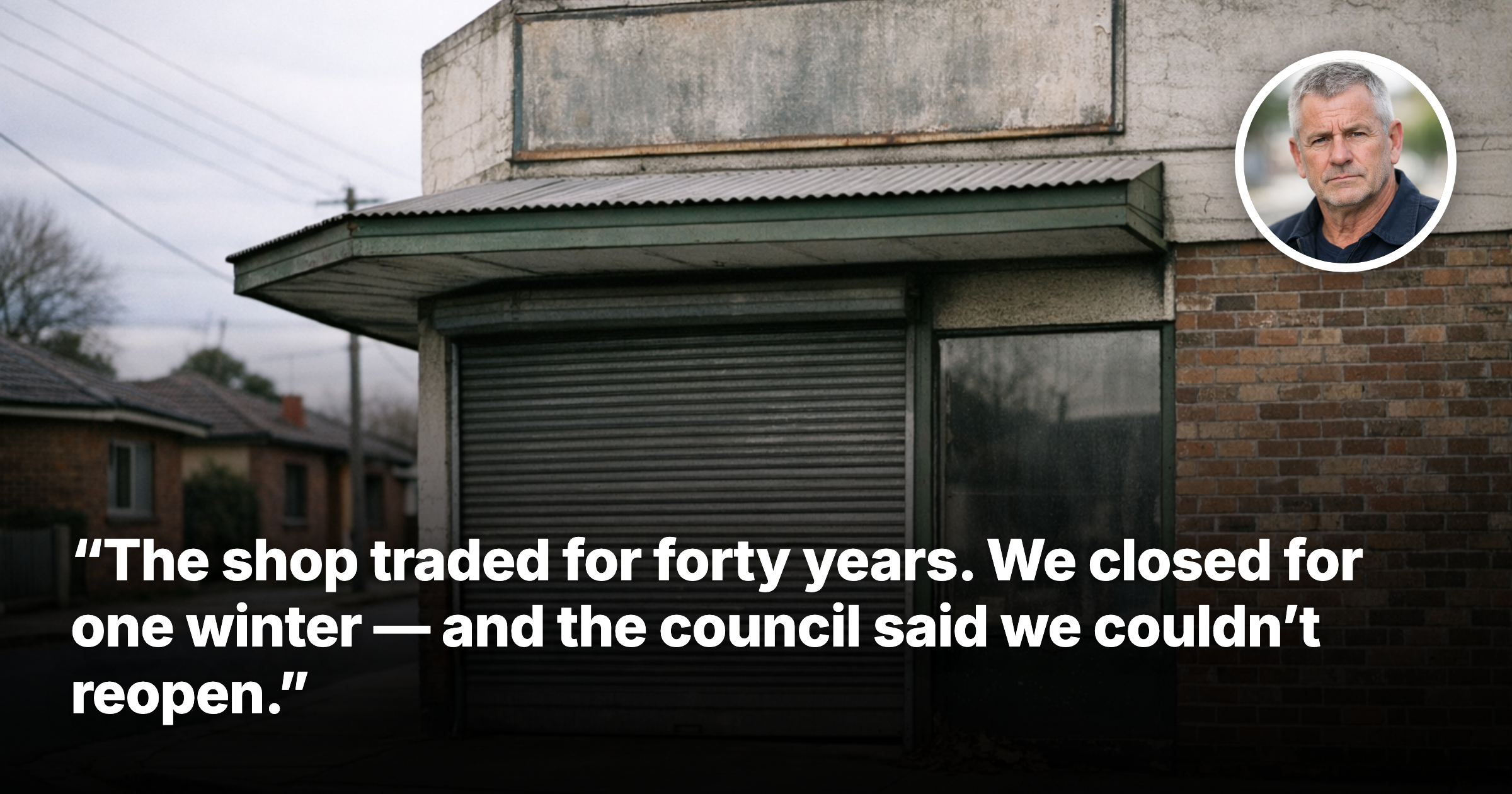
A question we get asked more often than you'd think came from a man in his early sixties who had just inherited a corner property from his father: a small building on a residential street, operating as a shop since the 1970s.
The zoning changed decades ago. The shop kept trading anyway — legally, uninterrupted, right through the rezoning. Nobody ever objected.
Then his father got sick. The doors closed while the family sorted out the estate. Fourteen months later he went to reopen, and was told the use was gone.
His question was blunt: how can a right that survived forty years of rezoning disappear because we shut for a winter?
What he actually owned
When a planning instrument changes and makes an existing activity prohibited, the law does not switch the lights off on businesses already there. The use that was lawful immediately before the new rules took force is allowed to continue.
The protection is categorical. Nothing in the planning legislation, and nothing in any instrument made under it, prevents the continuance of that use.
That is an unusually strong right. It has no expiry date, needs no renewing, and joins no register. It survives changes of government and successive rounds of rezoning.
So his instinct was right. His father's shop was not trading on borrowed time or council indulgence. It held a genuine legal right to keep being a shop in a street where new shops could no longer be built.
The sentence that cost him the asset
The protection permits the continuance of the use. It authorises nothing else — and the legislation spells out the exclusions with real precision.
It does not authorise altering, extending or rebuilding. It does not authorise any increase in the area of the use beyond the area actually, physically and lawfully used at the moment the rules changed. It does not authorise enlarging, expanding or intensifying the activity.
And it does not authorise the continuance of the use where that use is abandoned.
Then comes the sentence that decides these cases. A use is presumed to be abandoned if it stops actually being carried on for a continuous period of 12 months — unless the contrary is established.
Read that structure carefully, because it is the whole story.
The right is not cancelled by anyone. No inspector attends, no notice is issued, no decision is made that could be appealed. The clock simply runs. At twelve months the presumption flips, and from that moment the owner must prove the use was not abandoned. The burden sits on the person who lost the most.
His shop closed for fourteen months. Nobody took the right off him. It expired quietly, on a date nobody wrote down.
Why this matters far beyond corner shops
Most people hear "existing use" and picture a milk bar or a panel beater. That is a serious under-reading of who is exposed.
The same protection — and the same twelve-month fuse — attaches to a block of flats in a street since downzoned to single dwellings, a home-based workshop, extra dwellings on a rural block, a car park, a light-industrial tenancy in an area now residential.
In every one of those cases, the thing that makes the property worth more than its neighbours is a permission that cannot be recreated today.
That is precisely why it is dangerous. A property carrying a right nobody can obtain any more attracts a premium, and that premium is invisible on the title. It shows up only as a slightly better rent, or a slightly higher price, than the identical-looking house two doors down.
And it can be lost by a long vacancy between tenants. By a renovation that overruns. By an illness. By an executor doing exactly what this man did.
A second, harder-edged rule sits alongside it. A use unlawfully commenced is not made lawful by the passage of time; only a new instrument permitting it, or a grant of consent, can do that. There is no adverse possession in planning law. Twenty years of nobody complaining buys precisely nothing — worth remembering whenever a listing hints that an unapproved structure has simply been there for years.
What we tell clients to do about it
This is where street-level data does the work a suburb report cannot.
Every metric most buyers rely on — median price, days on market, vacancy rates, rental history — measures the use happening now. Not one measures whether that use is permitted, or whether the permission is a frozen historical right sitting one quiet year away from extinguishing itself.
Two properties on the same street, in the same zone, with identical suburb metrics, can carry completely different futures. Nothing in a suburb-level report separates them, because the difference is per-lot and per-title.
That is the same reason we see a 20–30% spread in effective yields between the best and worst streets within a single suburb. Part of that spread is quality. But part of it is permission — what each property is actually allowed to do, set at the lot level and invisible from above. It is the same mechanism that lets one owner subdivide while a neighbour two doors down cannot, or lets one site clear a development hurdle another on the same road never will.
The practical checks are unglamorous and cheap. Establish what the lawful use is, and when it started. Keep evidence of continuous operation — leases, rates notices, utility accounts, trading records — because that is what rebuts the presumption later. Never let a non-conforming use go dark without advice. And if you are extending or intensifying anything protected this way, the protection does not cover you; that is a separate approval.
The part investors should take as good news
It would be easy to read this as another reason property is a minefield. We'd argue the opposite.
This is one of the very few risks in property entirely within the owner's control. It is not a market or a rate decision you cannot influence. The right survives rezonings, governments and decades of change. The only thing that reliably kills it is doing nothing for twelve months.
That makes it checkable — and anything checkable is priceable. Most buyers never ask, so the market prices the ambiguity instead of the fact. A buyer who does ask is buying a genuinely scarce permission at a price set by people who didn't know it was there. As with an unnoticed heritage constraint that reprices a property overnight, the information asymmetry is the opportunity.
As for the man with his father's shop: the fourteen months are the fight, and evidence of what was really happening in that building is the whole case. What is not in dispute is the lesson. The right had lasted forty years and cost nothing to keep. All it ever required was that somebody knew it was there.
If there's a specific street you're weighing up right now, check its Street Score first — it's free, takes ten seconds, and tells you whether that street is pulling the suburb average up or riding on it.
Frequently asked questions
What are existing use rights in Australian planning law, and do they survive a rezoning?
Yes. If a use was lawful immediately before a planning change made it prohibited, that use can generally continue even after the rezoning. The right is unusually strong, has no expiry date, and does not need to be renewed.
How can an existing use right be lost if the use stops for a while?
A use is presumed abandoned if it is not actually carried on for a continuous period of 12 months. Once that happens, the burden shifts to the owner to prove the use was not abandoned.
What kinds of properties can be affected by these hidden permissions?
It is not just shops. The same issue can affect flats, home-based workshops, extra dwellings on rural land, car parks and light-industrial premises in areas that are now zoned residential.
What evidence helps show that a non-conforming use has continued?
The article says owners should keep evidence such as leases, rates notices, utility accounts and trading records. That kind of evidence can help show the use was continuous if it is later challenged.
Can a long-standing unlawful use become legal just because nobody complained?
No. The article says there is no adverse possession in planning law. If a use started unlawfully, time alone does not make it lawful; only a new approval or consent can do that.
General information only. It does not take your objectives, financial situation or needs into account, and nothing here is legal, financial, taxation or investment advice specific to your circumstances.