News · 16 August 2026 · 5 min read
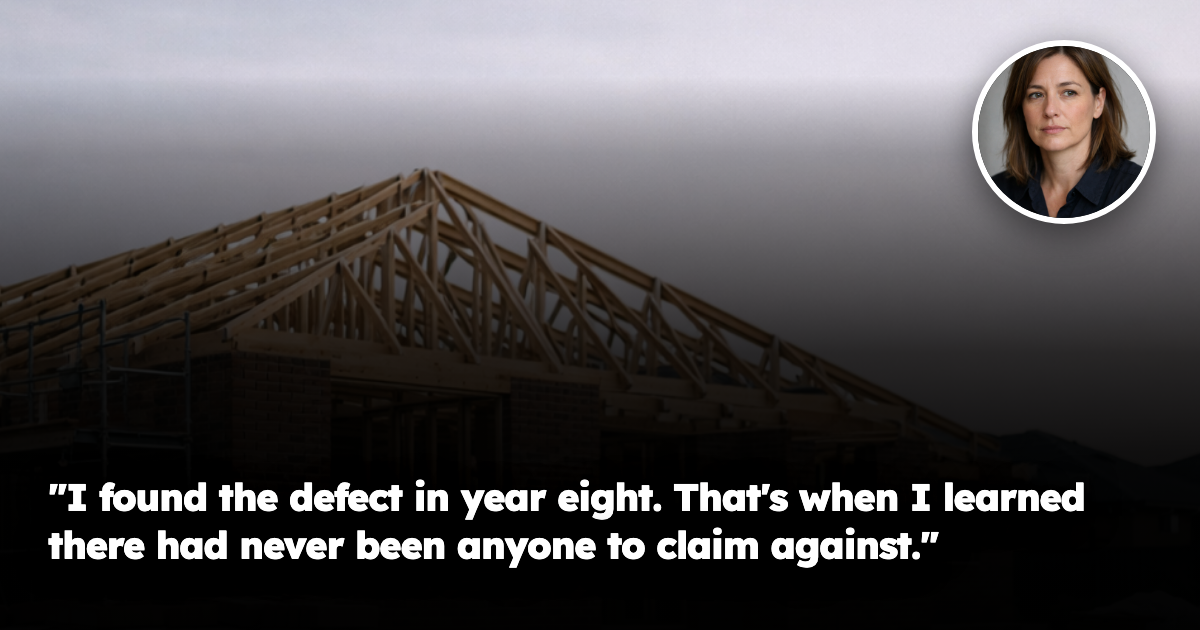
I found the defect in year eight. That is when I learned there had never been anyone to claim against
A buyer found a defect eight years after her house was built and discovered there was no insurer, no builder and no warranty to claim against. The reason was a decision made before the slab was poured - and it stays attached to the land.
Category: News · Author: Jacob Field · Date: 2026-08-16
She is 44, works in logistics, and describes herself as the kind of buyer who does the homework. She had a building inspection. She read the contract.
Eight years after that house was built, a structural problem surfaced in a load-bearing element. Not catastrophic. Not cosmetic either — the sort of thing that needs an engineer before it needs a builder, and a five-figure sum after that.
Her question was simple:
'Who do I claim against?'
The answer was nobody. Not because she had missed a deadline — because there had never been anyone there.
What she actually bought
It had been built by its original owner under a permit that lets an individual take on the role of builder on their own land.
These permits are not a loophole but a deliberate, regulated category. In this owner's state, only an individual can apply — never a company — and they must own the land, intend to live in the finished dwelling, and complete required training. Tellingly, an application can be refused if a permit already issued over other land they owned in the preceding five years, whether or not that earlier permit was issued to the applicant themselves. The legislature was already thinking in terms of parcels. The permit authorises described work on a specified piece of land. It is not a builder's licence.
The layer that goes missing
When you buy a home built by a licensed contractor, warranties are implied into the building contract automatically and cannot be contracted out of — due care and skill, suitable materials, compliance with the law, and a result reasonably fit for occupation as a dwelling. Crucially, they run with the land: a successor in title is entitled to the same rights as their predecessor. Buy an ordinary house and you inherit somebody else's builder's promises. The periods are finite — in this owner's state, six years for a breach causing a major defect, two years otherwise, from completion.
But the trigger for every one of those warranties is a contract with someone required to hold a contractor licence. Where the owner built it themselves, there is no such contract, and no licence holder. So there is nothing to inherit.
The sentence that surprises people
There is a second layer, blunter than most buyers expect. An insurance scheme normally sits behind residential building work — the safety net for when a builder has died, disappeared or become insolvent. For work carried out by an owner under one of these permits, the legislation does not say insurance was not obtained. It says a contract of insurance cannot be entered into at all. The Act's own note is plain: cover cannot be offered or obtained.
That is the trade — the owner accepts the risk in exchange for the right to build their own home. The bargain holds right up until the land is sold, and the person carrying the risk is somebody who was never party to the deal.
The warning — and its expiry date
The law does account for this. Selling land that has had one of these permits over it, you must include a conspicuous note in the contract of sale stating that a permit was issued, specifying the date, and that the work is not required to be insured. Getting this wrong makes the contract voidable at the purchaser's option before completion. The duty applies whether you are the permit holder or a successor in title.
Then comes the number that matters. The warning requirement does not apply to a sale more than seven years and six months after the permit was issued.
Her purchase was outside the window. The seller hid nothing and broke no rule. The obligation had expired.
That is the point: the duty to warn has an end date. The construction history does not. The house has no builder's warranties and no insurance behind it for as long as it stands. Only the requirement to mention it lapses.
Why the suburb median cannot see this
This is the sort of fact our research work exists to surface, because it is invisible at every level of data most buyers use.
A permit attaches to a parcel of land. Two houses on the same street — same era, same estate, same council, same catchment, same median — can carry entirely different construction status. One arrived with enforceable promises. The other never had them, and never could have. Nothing in a suburb-level report distinguishes them, and nothing in the price does either, which is the problem. They also cluster, in particular release stages and eras of a suburb's development, so one street can carry several while the street behind it carries none.
Street-level analysis routinely finds a 20–30% spread in effective yield between the best and worst streets in a single suburb, because achieved rents, vacancy duration and days-on-market diverge sharply within one postcode. Construction status is one of the facts underneath that dispersion. It does not change the rent — it changes what the asset is, and what it costs to hold when something fails. Same principle as soil classification varying block by block and depreciation entitlements differing between near-identical houses.
What to actually do
Ask directly whether an owner-builder permit was ever issued over the land, and do not treat the absence of a warning in the contract as an answer — once the window closes, its absence means nothing. Permit records are held by the state regulator and are obtainable. Where one exists, brief your building inspector on it and widen the scope to structural and concealed elements, because that inspection is now doing a job otherwise shared with a warranty and an insurer — alongside the era-driven checks we have covered, like what pre-1990 materials can do to a settlement.
The part most people get backwards
None of this is an argument against owner-built homes. Plenty are excellent — often better finished than volume product, because someone was building the place they meant to live in. The problem is never the house. It is buying one priced as though it came with protections it cannot have.
That gap is where opportunity sits. Construction status is objective, obtainable before you commit, and almost universally skipped. When a measurable factor sits below the resolution of the data most buyers use, the market prices it inconsistently — some properties carry a discount for a problem they do not have, others are bought at full price with a risk nobody counted. Property remains one of the few asset classes where diligence is genuinely rewarded, because the information is there and most people bidding against you have not got it.
She fixed her defect, and was frank that it stung. Her closing remark was the sharpest thing said in the conversation:
'The mistake was never buying a house someone built themselves. It was assuming that because nobody warned me, there was nothing to be warned about.'
If there's a specific street you're weighing up right now, check its Street Score first — it's free, takes ten seconds, and tells you whether that street is pulling the suburb average up or riding on it.
Frequently asked questions
What happens if a house in Australia was built by the owner under an owner-builder permit and a defect shows up later?
If the home was built by the owner under an owner-builder permit, there is no builder’s contract to inherit and no insurer behind the work. That means a later buyer may have no builder, no warranty and no insurance claim to rely on.
Why can’t a buyer claim the normal residential building warranties in this situation?
The ordinary implied warranties apply when there is a contract with someone required to hold a contractor licence. Where the owner built the home themselves, there is no such contract and no licence holder, so there is nothing for a later purchaser to inherit.
Does an owner-builder home in this article have any insurance cover attached to it?
No. The article says the legislation does not allow a contract of insurance to be entered into for work carried out by an owner under one of these permits, and cover cannot be offered or obtained.
What should a buyer check before purchasing land with an owner-built house on it?
Ask directly whether an owner-builder permit was ever issued over the land and check the permit records with the state regulator. If one exists, the building inspection should pay extra attention to structural and concealed elements.
Is there a warning a seller has to include when a property was built under an owner-builder permit?
Yes, the contract of sale must include a conspicuous note that a permit was issued, state the date, and say the work is not required to be insured. But that warning requirement ends more than seven years and six months after the permit was issued.
General information only. It does not take your objectives, financial situation or needs into account, and nothing here is legal, financial, taxation or investment advice specific to your circumstances.