News · 12 August 2026 · 8 min read
I bought the house at auction in July. In October, a stranger wrote one paragraph about it — and it cost me almost $500,000
A single anonymous paragraph applied heritage protection to a house days before settlement, at a cost of almost $500,000. The detail that matters for every investor: on that same street, the council''s own consultant selected one address for protection and not another — identical era, identical architecture, opposite legal status. No suburb-level dataset can see it.
We get asked a version of this question more often than you would think, and it is almost always asked too late.
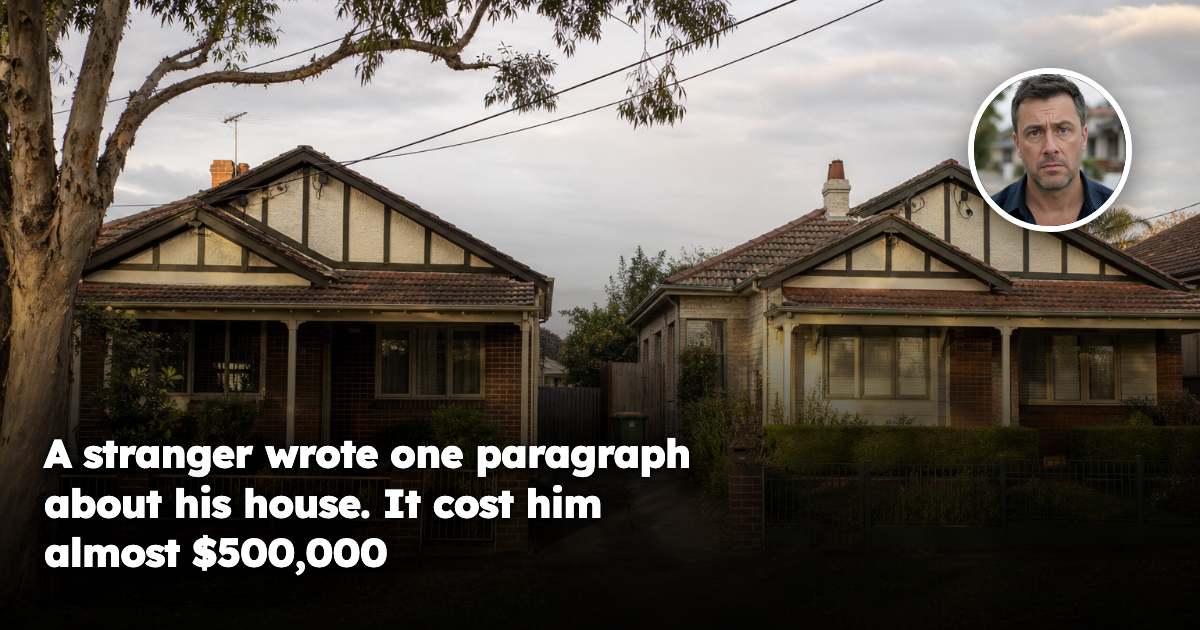
A buyer paid $3.2 million for a house at auction in July. Nothing unusual about the purchase. It was an older home on an established street, the kind of street where every second house was built within a decade of the one next door. He had plans. He had a settlement date. He had, as far as he knew, bought a piece of land with a house on it that he was entitled to do something with.
In October — days before settlement — somebody he had never met lodged a single-paragraph nomination asking the council to give the house heritage protection.
He was not told. The council considered it. After a discussion running a little over an hour, protection was applied. His lawyers later put the cost of that hour at almost $500,000. He was not formally contacted about any of it until May the following year.
His question to us was short: how is that possible, and how could I have known?
The uncomfortable answer to the first half
It is possible because that is how the system is designed to work, and — this is the part owners find hardest to accept — there is a legitimate public-interest reason for it.
If heritage protection could only be triggered by the owner, nothing would ever be protected. The whole point of the mechanism is that it does not require the consent of the person who benefits from removing the building. So in most Australian states, a nomination can be made by essentially anyone, it does not need to be long, it does not need to be expert, and in many cases it does not need to be signed.
We are not going to argue that heritage protection shouldn't exist. That is a genuine public debate and it is not the one that decides whether an investment works. A councillor involved in a case like this put the risk in a line that has stuck with us: someone on the other side of the world could sit at a computer, scroll a real estate listing site, and nominate any property they liked the look of. A state government spokesperson, from the opposite direction, warned that heritage controls must not become weapons used to lock down housing.
Both of those things are true at once. And neither of them helps the owner who has already bought.
What the protection actually does to the asset
People assume a heritage overlay means "you can't knock it down". That is the headline version, and it understates it considerably.
Generally, once a property sits within a heritage overlay, a planning permit is required for things that would not have needed one the day before: demolition, yes, but frequently also external alterations, extensions, outbuildings, fences, painting of previously unpainted surfaces, and sometimes subdivision. The specifics vary by state and by council, and you must read the actual planning scheme for the actual address — but the shape is consistent everywhere. The list of things you may do without asking gets shorter, and the list of things that require a decision from someone else gets longer.
Consider a second case we look at often, because it shows how far inside the property line this reaches. A homeowner installed rooftop solar. The property sat in a heritage overlay. A tribunal ordered the panels removed, because they obscured a sizeable proportion of a roof plane on the principal facade. The owner pointed out that taking down the street-facing panels would cut the system's total generation by around 40%. The tribunal member's response was, in substance, that sustainability considerations simply were not among the decision guidelines in the applicable heritage policies.
The detail that makes it land: that same council had formally declared a climate emergency a few years earlier, and had publicly called for a tripling of rooftop solar across its own area.
That is not hypocrisy so much as a demonstration of how these controls work. An overlay is not a policy conversation. It is a filter that only asks the questions it was written to ask. You cannot argue your way past it with a better argument, because your argument is not one of the inputs.
The financial consequence is straightforward. Anything that narrows what a future owner may do to a property narrows the pool of buyers who want it, and a narrower buyer pool is a lower price and a longer campaign. It also removes the redevelopment option — often the single largest component of value in an older house on a good block, because in many established suburbs the buyer is not paying for the building at all.
Now the part almost nobody checks
Here is the fact from that first case that should stop any investor in their tracks.
The council's own heritage consultant had assessed that same street back in 2015. In that assessment, the consultant selected number 7 for inclusion — and not number 23.
Same street. Same period. Same architecture. Same postcode, same median, same council, same school catchment, same census profile, same everything that any suburb-level dataset can see. One address carried a latent constraint worth hundreds of thousands of dollars. The one down the road did not.
We spend a lot of time explaining to people why suburb research is not property research, and this is the cleanest example we have ever come across, because it isn't a statistical artefact or an averaging problem. It is a human being with a clipboard walking down a street in 2015 and making a judgement call, address by address, that would sit dormant for years and then decide the outcome of somebody's purchase a decade later.
No median can see that. No growth chart can see that. No "top ten suburbs" list can see that. It is not in the data most buyers look at, because it is not the kind of thing that suburb data is made of.
It is the same pattern we have documented over and over in physical form — a single street tree ten metres from the front fence moving the number by tens of thousands, or two near-identical houses a hundred metres apart on the same road pricing 20% differently. Heritage is simply the version where the variable is a decision rather than an object.
This is exactly why our research runs at street and property level rather than suburb level. The gap between the best and worst streets inside a single suburb routinely runs to 20–30% on effective yield once you use achieved rents, real vacancy duration and true days on market rather than advertised figures — and that gap exists for reasons just like this one. Overlays, zoning splits, subdivision potential, lot geometry, the era a particular run of houses was built. All of it sits below the level at which most people make the decision.
What you can actually do about it
Four things, in this order.
Check the planning scheme for the specific address before you bid — not the suburb, the address. Every state publishes a free property report or planning-scheme map showing the overlays that apply to an individual parcel. It takes minutes. Most buyers never open it, and the ones who do often check the suburb page instead.
Check whether the property sits inside a heritage precinct as well as an individual listing. Precinct-wide controls catch enormous numbers of otherwise unremarkable houses, and owners frequently have no idea they are in one.
Check what your council is currently working on. Heritage studies, amendments and draft precinct expansions are public, and they are the leading indicator. A house that is not protected today but sits inside a study area that is out for exhibition is a different asset from one that doesn't.
Then ask the question the price depends on: if the redevelopment option disappeared tomorrow, would I still want this property at this number? This is the same test that decides whether a renovation you are about to fund will ever come back to you — you are pricing what the street will pay for the finished thing, not what the work cost you. If the answer is yes, you have bought a house you like on merit. If the answer is no, you have not bought a house — you have bought a permission you do not yet hold.
Where this leaves you
None of this is an argument against buying older property in established suburbs. Those streets are usually the best-located, largest-block, most tightly-held stock in any city, and they have generally been the best places to own an asset for decades. The buyer above is likely to do perfectly well over time. He simply paid roughly half a million dollars for a piece of information that was publicly available and free.
The pattern is national and it is accelerating. One council has quietly extended protection over hundreds of ordinary suburban homes. Another removed more than a hundred sites from a list residents did not know existed. Another gutted a heritage plan after residents filled the chamber. Brick and brutalist housing stock built well within living memory is now being added to lists, to the surprise of the people living in it. Owners are finding out by a knock on the door.
That is not a reason to stay out of property. It is a reason to stop researching suburbs and start researching addresses. Every one of those stories is a case where two nearly identical houses ended up as legally different assets — and in every one of them, the difference was knowable in advance by someone who bothered to look.
He researched the market, the suburb and the price. He never researched the paperwork attached to the specific title he was bidding on. Almost everyone does it in that order.
If there's a specific street you're weighing up right now, check its Street Score first — it's free, takes ten seconds, and tells you whether that street is pulling the suburb average up or riding on it.
Frequently asked questions
How can a house in Australia be hit with heritage protection after it has already been bought at auction?
In most Australian states, almost anyone can lodge a heritage nomination, and it does not need to be long or expert. The council can consider it and apply protection even if the owner is unaware, because the system is designed to allow non-owner nominations in the public interest.
What changes once a property is in a heritage overlay?
A heritage overlay can mean you need a planning permit for more than just demolition. It can also affect external alterations, extensions, outbuildings, fences, painting, and sometimes subdivision, depending on the state and council.
Why can heritage protection reduce a property's value so much?
It narrows what a future owner can do, which shrinks the buyer pool and can lengthen the time it takes to sell. It can also remove redevelopment potential, which is often a major part of value in older houses on good blocks.
Why is checking only suburb data not enough before buying an older house?
Because heritage status, zoning splits and subdivision potential can vary from one address to the next, even on the same street. The article's example showed two near-identical homes on the same street with different heritage outcomes, which suburb-level data could not reveal.
What should a buyer check before bidding on an established house in Australia?
Check the planning scheme for the exact address, not just the suburb, and see whether the property sits in a heritage precinct or individual listing. Also check whether the council has current heritage studies or draft expansions that could affect the property.
General information only. It does not take your objectives, financial situation or needs into account, and nothing here is legal, financial, taxation or investment advice specific to your circumstances.