News · 12 August 2026 · 8 min read
I spent $15,000 trying to build a house for my son in my own backyard. Two doors down, they were allowed to do it
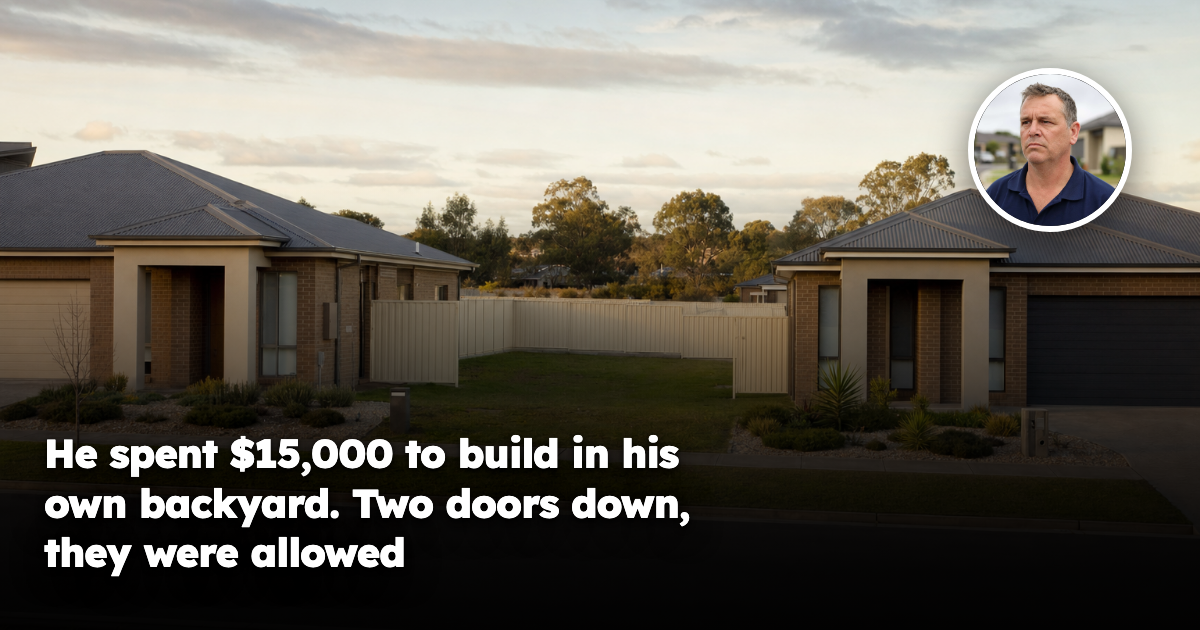
A restrictive covenant stopped one family subdividing their own backyard, at a cost of $15,000 and a refusal that took under ten minutes. Two other properties in the same estate had already been subdivided — the covenant simply never touched their titles. Same estate, same street, same zoning, opposite development rights. It is written on the title, not in any suburb dataset.
We get asked this one constantly, and it is almost always asked after the money has been spent.
An owner in a growth-corridor estate had a straightforward plan. His block was big enough. His 22-year-old son was an apprentice, priced further out of the market every year he waited, and the backyard was sitting there doing nothing. Subdivide, build a second dwelling, keep the family in the suburb they already lived in.
He expected red tape. Everybody expects red tape.
What he did not expect was that the obstacle would not be the council, or the zoning, or the planning scheme, or the building code. It was a private agreement written into his title by a developer years before he ever saw the place — one that says only one house may ever stand on that block, and even dictates which materials it may be built from.
He spent $15,000 trying to have it lifted. The council debated it and rejected it unanimously in under ten minutes.
Then he found out that two other properties in the same estate had already been subdivided into multiple units.
His question to us was the obvious one: how are they allowed and I'm not?
The answer, and it is not what most people assume
Because the covenant was never written onto those two titles.
That is the entire explanation. Not a different zone. Not a different council. Not a different suburb, median, catchment, overlay or planning rule. Same estate, same streets, same everything a dataset can measure. The developer, decades ago, drew a line around some lots and not others, and that line is still running.
This is the part that catches experienced investors, not just first-timers: a restrictive covenant is not part of the planning system at all. Governments do not create them and, for the most part, do not enforce them. They are private agreements between landowners, registered on the title, usually put there by a developer selling an estate — the mechanism by which "exclusivity" gets manufactured and sold as a feature.
Which means the ordinary checks people run do not touch it. You can pull the zoning, confirm the minimum lot size, confirm the overlay position, get comfortable that the council supports subdivision in that area — and still own a block on which you may not lawfully do it, because of a document signed by people you have never met about land they no longer own.
Most of these instruments sit on a statutory framework first drafted in 1918 and largely unchanged for more than a century.
The trap inside the trap
Here is where it turns genuinely expensive.
Several states have spent recent years making it easier to build a small second dwelling — removing the need for a planning permit for backyard units in an effort to get more homes built. Enormous amounts of media coverage. A lot of people bought on the strength of it.
Those reforms generally did not touch restrictive covenants.
So you can be in a position where you do not need a permit and you still cannot legally build. The government has removed its own requirement and left the private one standing. The permit exemption is real; the covenant is also real; and the covenant wins. We have seen people buy specifically for the granny-flat play, on advice that was entirely accurate about the planning rules and entirely silent about the title — a variation of the approval problem that quietly voids insurance and rental income on second dwellings.
And if a covenant is contested, the remedy in most cases is not a tribunal or a planning appeal. It is the Supreme Court. Which is why, in practice, most owners simply stop. The cost of the process exceeds the value of the argument, and everybody involved knows it.
In this case the numbers were stark. The owner's own assessment was that fighting on would be expensive — but not as expensive as the alternative, which was buying a separate block of land for $440,000. That is the honest price of the covenant on that title: the cost of the land it denies you.
We should be fair about the other side
It would be easy to write covenants off as an artefact, and we are not going to do that, because the people enforcing them are usually not villains.
The objectors in a case like this are neighbours protecting the largest asset they own. The estate was sold to them on a promise of consistency — matching fencing, similar houses, similar spacing, no units — and they paid for that promise. The councillors who refused this application said so directly: allowing a second dwelling would harm the character of the area and the property values of adjoining owners. One had driven the streets and noted the uniform fencing and the unity of the housing as evidence that people had bought into something deliberate.
That is a coherent position. It is also a real value: buyers do pay for predictability, and covenants deliver it.
But notice what it means for the person doing the buying. The covenant is simultaneously the thing that protects your neighbour's value and the thing that caps yours. The same clause is an asset or a liability depending entirely on which side of it your title sits. Nothing about the suburb tells you which one you are.
And it barely takes a crowd to enforce. That application drew three objections — a number that would not normally be enough to refuse anything. The covenant gave those three objections weight that three objections do not usually carry.
The other direction: they are not as solid as they look either
The mirror image is worth understanding, because it explains why nobody should be relying on a covenant as a guarantee.
A retired couple subdivided part of their own land, sold off the vacant lot, and wrote a covenant onto it capping the new lot at one dwelling of limited height — specifically to protect the view from their own house above. The buyers, unaware of the detail and relying on their builder's assurances, built something that breached it.
The couple raised concerns. They spoke to the builders. They spoke to the owners. What they did not do was take formal action until the house was nearly finished.
The Supreme Court modified the covenant and let the house stand. The reasoning, in substance: seven months of inaction after the breach became unmistakable amounted to acquiescence — agreement by implication.
So the same instrument that costs one family $15,000 and a subdivision can be lost by another family through seven months of politeness. The rule is not the variable. Who is standing next to it, and how quickly they move, is the variable.
What this means for how you actually research a property
This is the most literal possible version of the argument we make constantly, and it is why our research runs at street and property level rather than suburb level.
Two blocks in one estate. Identical postcode, identical median, identical growth chart, identical vacancy rate, identical school catchment, identical census profile, identical council. One can be subdivided and one cannot, and the difference is worth the price of a $440,000 block of land.
There is no suburb-level dataset in existence that can see that difference, because the difference is not a property of the suburb. It is a property of the title. It is the same shape we keep documenting in physical form — a single street tree ten metres from the front fence moving the number by tens of thousands, or two near-identical houses a hundred metres apart pricing 20% differently on the same road — except this one isn't even visible from the street. You cannot photograph it. You cannot drive past and notice it.
The gap between the best and worst streets inside a single suburb routinely runs to 20–30% on effective yield once you work from achieved rents, real vacancy duration and true days on market rather than advertised figures. Development potential is one of the biggest single drivers of that gap, and covenants are one of the biggest single drivers of development potential. They are invisible to the averages and decisive at the individual address.
Four things to do before you buy
Read the title, not just the contract summary. A copy of title with the registered instruments attached is cheap and fast, and the covenant will be one of those instruments. Do not accept "there's a covenant but it's standard" — the whole point is that they are not standard. They vary lot by lot within a single estate.
Read the actual wording, not the description. Single-dwelling restrictions, minimum floor areas, build-completion deadlines, material and roofing specifications, fencing rules, and outright subdivision prohibitions are all common, and they are all enforceable. What the covenant restricts is a question with a specific answer written down in a specific document.
Assume planning reform does not rescue you. Where governments have made second dwellings or subdivision easier, the change usually applies to the permit, not to private covenants. A state may currently be moving to let councils override covenants where a proposal meets housing objectives — reforms of that kind are live in more than one jurisdiction — but until something has passed and applies to the address you are buying, it is a hope, not a plan. Price the property on the rules as they stand today.
Then price the property twice. Once with the development upside, once without it. If the deal only works with the upside, the covenant is not a detail — it is the whole investment. This is the same discipline as testing whether a renovation will ever come back to you before you fund it: you are pricing what the market will pay for the finished thing, not what you hoped to do.
Where this leaves you
None of this is an argument against buying in covenanted estates. They are often well-built, well-planned, consistent and genuinely pleasant to live in, and that consistency is worth real money — that is precisely why the covenants exist and why neighbours defend them. Plenty of them have performed well and will keep performing well.
It is an argument for knowing which of the two lots you are buying.
Every serious edge in property comes from the same place: knowing something specific about a specific address that the people bidding against you have not bothered to look up. Covenants are close to the purest example available, because the information is registered, public, cheap and takes minutes to obtain, and almost nobody reads it. The owner above did everything right on the market, the suburb and the price. He simply never read the document that decided what he was allowed to do with what he bought.
Right asset, right street, right data still beats the headlines. It just has to include the paperwork attached to that particular title — because two doors down, the answer is different.
If there's a specific street you're weighing up right now, check its Street Score first — it's free, takes ten seconds, and tells you whether that street is pulling the suburb average up or riding on it.
Frequently asked questions
Why could one backyard in the same estate be subdivided while another one couldn’t?
Because the restriction was on the title itself. The covenant was written into one property’s title but not the other two, so the same estate and zoning produced different development rights.
What is a restrictive covenant, and why does it matter for backyard subdivisions in Australia?
A restrictive covenant is a private agreement registered on a title, usually by a developer, that can limit how land is used. It can stop subdivision or second dwellings even when council zoning or planning rules would otherwise allow them.
If council rules now allow small second dwellings, can a covenant still block one?
Yes. Planning reforms may remove the need for a permit, but they usually do not remove private covenants. In that situation, the covenant still wins.
What should I check before buying a property if I want future subdivision or a granny flat?
Read the title, not just the contract summary, and check the actual wording of any registered covenants. You should also assume planning reform does not override a private restriction unless it clearly applies to that address.
What is the main risk if I buy a block assuming I can develop it later?
The property may have no development potential at all because of a title restriction you did not notice. If the deal only works with subdivision or a second dwelling, the covenant may be the difference between a viable purchase and a very expensive mistake.
General information only. It does not take your objectives, financial situation or needs into account, and nothing here is legal, financial, taxation or investment advice specific to your circumstances.