News · 9 August 2026 · 10 min read
'The agent said the granny flat brings in $380 a week. Then I asked one question and the whole deal changed'
A backyard granny flat can add real income — or void the insurance on your entire property and shrink the pool of buyers who can ever purchase it. Here is the hard line between an approved secondary dwelling and an unapproved one, why the low enforcement rate is a trap, and why the answer is decided block by block rather than suburb by suburb.
He had done the arithmetic in the car on the way home, the way most people do.
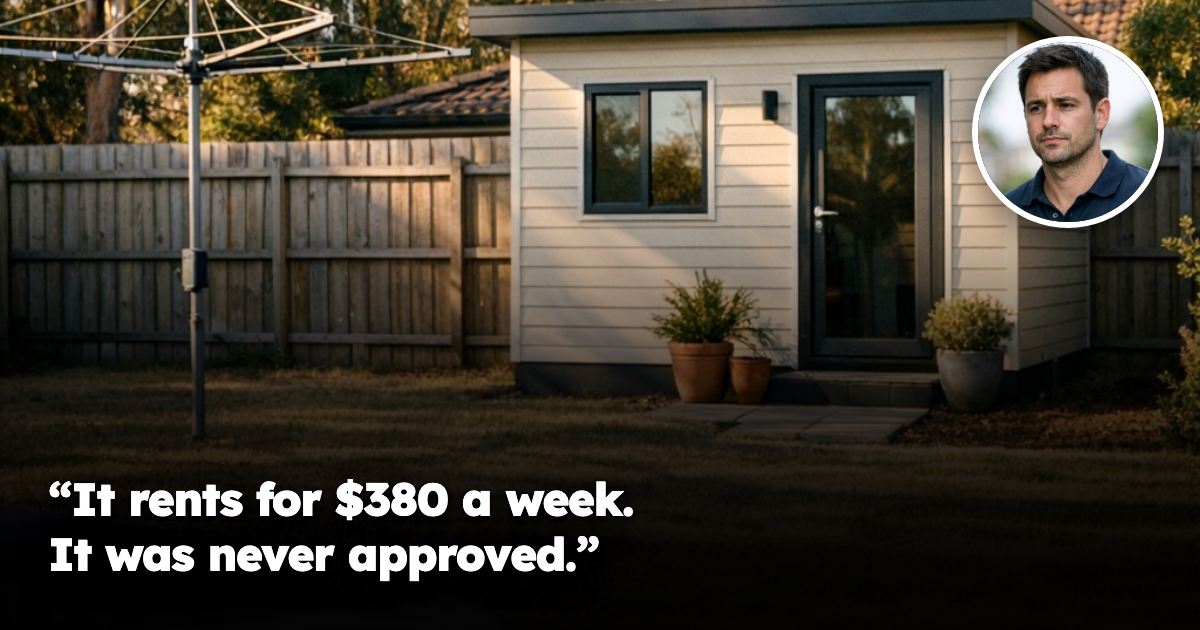
The house was at the top of his budget but not over it. Three bedrooms, decent land, a suburb he had been watching for the better part of a year. And at the back of the block, past the clothesline, a neat self-contained studio with its own bathroom, its own kitchenette and its own little paved entry off the side gate. The agent had mentioned, almost in passing, that it was currently bringing in three hundred and eighty dollars a week.
That number changed everything. It turned a stretch into a plan. It covered a meaningful slice of the repayment, and it meant that a property he could only just afford became one he could comfortably hold.
He is 38, works in logistics, and this would be his second property. He is not naive. He asked about the roof, the stumps, how old the hot water system was and whether the fence on the eastern boundary was shared. He booked a building inspection.
The question he very nearly did not ask was the one that mattered: is the studio approved?
The answer, after some back and forth, was no. It had been built by the previous owner, it had been there for years, nobody had ever complained, and it had been quietly rented the entire time.
He rang us and asked what we would have asked. It is one of the most common questions we get, and it is getting more common every month.
Why this question is suddenly everywhere
There is a genuine shift happening in Australian backyards.
Self-contained secondary dwellings — granny flats, studios, backyard pods, whatever the listing calls them — have moved from a niche solution for housing an elderly parent to a mainstream financial strategy. You can now buy one flat-packed, off the shelf, delivered on a truck. Several states are actively rewriting their planning rules to make them faster and easier to approve, and there are open calls for the rest of the country to follow.
The demand behind it is real and it is not a fad. Families are consolidating under one roof to manage costs. Adult children are staying home longer. Older parents are moving in rather than into care. People need a room to work from that is not the end of the dining table. And every one of those uses can, in the right circumstances, be converted into rent.
So the interest is rational. The risk sits somewhere almost nobody is looking.
The line that actually matters
There are not two kinds of granny flat — good ones and bad ones. There are approved ones and unapproved ones, and almost everything that matters financially sits on one side of that line.
The volume of unapproved structures out there is larger than most buyers assume. In just one large metropolitan council area, more than two thousand reports of suspected or detected unlawful structures were logged over a recent twenty-two month period — roughly a thousand in one financial year and just under a thousand in the next. The council's own position is that most of those are minor and ancillary: sheds, patios, carports, things nobody lives in. Most are resolved early, without enforcement. In that same period the council issued 9 show cause notices and 2 enforcement notices, and had not issued a single fine.
That is worth sitting with, because it cuts both ways.
It tells you the demolition scenario people fear most is genuinely uncommon. It also tells you that a low enforcement rate is not the same thing as a low risk — and the reason has nothing to do with councils.
The three things that go wrong, in order of how expensive they are
The cheapest problem is the fine. Penalties for unapproved building work generally start modestly — in the hundreds of dollars for minor works — and rise into the low thousands for an individual and higher again for a company where the breach is serious or the owner refuses to comply. Renting out a dwelling that is not approved or not lawfully habitable is treated more seriously than simply having built it: in one state that exposure runs to around eleven thousand dollars, and in another it can reach six figures if the matter ends up in court.
Those numbers hurt. They are not, however, the ones that ruin people.
The expensive problem is insurance. This is the part that consistently surprises buyers, and it is the reason experienced advisers are far more relaxed about an unapproved pergola than an unapproved granny flat.
If a structure was never approved, an insurer may treat it as not lawfully habitable. If it is damaged — or worse, if there is a fire — you may find there is no cover for it. And the exposure does not necessarily stop at the studio's own walls. Where an owner has been renting out an unapproved dwelling, there is a real risk to the cover over the entire property, because the insurer was pricing one thing and the owner was doing another.
Read that again in the context of our buyer's arithmetic. He was planning to use the studio's rent to make the house affordable. The act of collecting that rent is precisely what could jeopardise the insurance on the main dwelling — the asset he has just borrowed several hundred thousand dollars to buy.
And a point that catches out a surprising number of well-meaning families: this is not about whether money changes hands. A secondary dwelling generally needs to be approved whether you are renting it to a stranger at market rate or letting your mother live in it for nothing. Good intentions are not an approval.
The third problem is the one nobody prices at all: what it does to the sale.
The buyer pool is the real number
Here is where the story stops being about compliance and starts being about property.
Australia's valuation profession is fairly blunt on this. Putting a precise dollar value on a secondary dwelling is highly context dependent, and whether construction cost translates dollar-for-dollar into value uplift is not something anyone can generalise — it varies by location, by demand and by property type. What is consistent is the mechanism. Approved secondary accommodation broadens the buyer pool, and in competitive conditions a broader buyer pool supports a stronger sale outcome than an otherwise similar property without that flexibility.
Approval, in other words, is not really a piece of paperwork. It is a certainty product. It is the thing that lets the next buyer believe the income is durable, lets their lender count it, and lets their insurer cover it.
Strip the approval out and the property does not become worthless. It becomes narrower. Some buyers will still take it on and price the risk in — plenty do, particularly when affordability is tight and people are willing to accept a problem in exchange for a number they can afford. But not all buyers will, and critically, not all lenders will. A purchaser who needs finance is at the mercy of a valuer and a credit policy, and an unapproved self-contained dwelling is exactly the sort of thing that gets noted, discounted, or excluded from the assessment entirely.
The cost of fixing it, meanwhile, is genuinely unpredictable. Sometimes a certifier can assess an existing structure and bring it into compliance for a manageable sum. Sometimes the work required runs to tens of thousands. Occasionally — where the structure was never capable of being approved on that block, or where there was no building entitlement on the land to begin with — the honest number is enormous, and there is no version of the story where it gets cheaper by waiting.
This is why the low enforcement rate is a trap. You will probably never hear from the council. You will absolutely hear from the insurer, the lender and the buyer.
So what did we tell him?
We told him what we tell everyone in this position, which is that he had asked the right question and was now asking the wrong one.
He wanted to know whether the risk of getting caught was high. That is unknowable and, frankly, beside the point. The better question is: what would this property be worth to me if the studio simply did not exist?
If the deal still works with the granny flat treated as a shed — if the house alone stacks up on the street it sits on — then the studio is genuine upside, and the sensible path is to get a certifier to tell you what approval would actually cost before you exchange, and negotiate accordingly. Plenty of unapproved structures can be regularised. That is a price, and prices can be dealt with.
If the deal only works because of the studio's income, then he is not buying a house with a bonus. He is buying an income stream that his insurer may not recognise, his lender may not count, and his eventual buyer may not pay for. That is a much riskier proposition than the listing implied, and it should be priced like one.
Why the answer is decided block by block, not suburb by suburb
There is a reason we cannot answer this question over the phone from the address alone, and it is the same reason we have been making in one form or another all year.
Whether a secondary dwelling can be approved on a given property is not a suburb-level fact. It is a block-level fact. It turns on land size, on frontage, on setbacks, on where the sewer runs, on the fall of the land, on easements, on access for a second driveway, and on whatever overlays happen to sit across that particular parcel. Two properties in the same street, sharing a postcode, a median, a school catchment and a council, can have completely opposite answers — one has a straightforward path to an approved second dwelling, the other has no path at all.
And the value of getting it approved is equally local. A compliant secondary dwelling adds most where there is genuine, demonstrated demand for a small, separate, self-contained home — and that demand is not evenly spread across a suburb. It is a function of who is actually renting in those few streets, how quickly small dwellings let, and how long they sit vacant between tenants. It is the same finding we keep arriving at from different directions: between the best and worst streets inside a single suburb we routinely see a 20–30% spread in effective yield once you use achieved rents, real vacancy duration and true days on market rather than advertised asking prices.
We have watched a third party price this exact dispersion in what an insurance renewal reveals about a specific address, and watched it show up in the gap between a national rent forecast and an actual rent notice. It shows up again here, in a question about a shed with a shower in it. Different instrument, same finding.
It is also worth noting that whether a second dwelling is a good idea and whether it is a good tax idea are two entirely separate questions, decided by different rules — something we covered in detail when a granny flat and a duplex on the same block produced opposite outcomes. Answer the property question first. It is the one that survives every change of government.
The part that should make you optimistic
It would be easy to read all of this as a warning against backyard dwellings. It is the opposite.
The demand underneath this trend is structural, not cyclical. Multi-generational living, affordability pressure, working from home and the sheer shortage of small, well-located rental stock are not going to reverse. Approved secondary accommodation genuinely does broaden the buyer pool, genuinely does create a second income line on land you already own, and in the right location it is one of the few remaining ways to materially improve a yield without buying anything else. Several jurisdictions are actively making it easier, and there is national pressure to go further.
The opportunity is real. It is just that the value sits entirely in the word approved, and whether you can get there is a question about your specific block — which is knowable, cheaply, before you sign anything, and which almost nobody checks until it is too late.
Our buyer went back with a certifier's estimate and a lower offer. He may get the house and he may not. Either way he is now buying a property rather than a paragraph in an advertisement.
The mistake was never putting a second dwelling in the backyard. The mistake is paying for one twice — once at settlement, and again when you find out what you actually bought.
If there's a specific street you're weighing up right now, check its Street Score first — it's free, takes ten seconds, and tells you whether that street is pulling the suburb average up or riding on it.
Frequently asked questions
Why does it matter whether a granny flat is approved in Australia?
Approval matters because it affects insurance, lending and resale. An unapproved secondary dwelling may not be treated as lawfully habitable, and renting it can even put cover over the entire property at risk.
Can an unapproved granny flat still be rented out if nobody has complained?
The article says low enforcement does not mean low risk. Even if councils rarely act, insurers, lenders and future buyers may still treat an unapproved dwelling as a problem.
Does a granny flat have to be approved even if it is for family use, not rent?
Yes. The article says good intentions are not approval, and a secondary dwelling generally needs to be approved whether it is rented at market rate or used by a family member for free.
What is the biggest financial risk with buying a house that has an unapproved studio?
The biggest risk is often insurance, not fines. If the studio is unapproved and rented out, the insurer may refuse cover for the structure and potentially for the whole property.
How do you know whether a backyard granny flat adds value to a property?
The article says it depends on the specific block, not just the suburb. Approval broadens the buyer pool and can support a stronger sale outcome, but the real value depends on land, demand and whether the dwelling can be lawfully approved.
General information only. It does not take your objectives, financial situation or needs into account, and nothing here is legal, financial, taxation or investment advice specific to your circumstances.